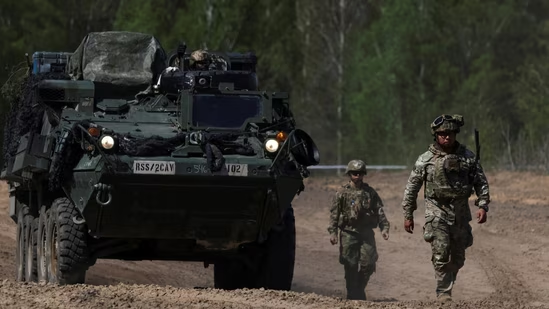
President Trump said Thursday that he plans to send 5,000 troops to Poland, a move that is intended to reassure an ally but which won’t forestall the White House’s effort to shrink the American military presence in Europe.
“Based on the successful Election of the now President of Poland, Karol Nawrocki,” Trump wrote in a social-media post, “I am pleased to announce that the United States will be sending an additional 5,000 Troops to Poland.”
Trump’s decision followed a surprise move by Defense Secretary Pete Hegseth this month to cancel the nine-month rotation of an armored brigade to Poland from Fort Hood, Texas.
The decision by Hegseth drew sharp criticism from Republican and Democratic lawmakers and concerned Polish officials, who told The Wall Street Journal they were not consulted about the move.
Hegseth’s move also surprised some officials because it was Germany—not Poland—that criticized the U.S. strategy in the war with Iran, drawing Trump’s ire. In early May, Trump responded to criticism from German Chancellor Friedrich Merz by ordering the withdrawal of 5,000 troops from the country, a process that the Pentagon said would take six to 12 months.
A current and a former U.S. official said Trump asked Hegseth in a recent phone call why the troop deployment to Poland was canceled. Trump told Hegseth that the U.S. shouldn’t treat Poland poorly, given it is an American ally with close ties to the White House.
White House spokeswoman Anna Kelly said, “President Trump appreciates all the secretary has done—and will continue to do—in executing the America First agenda within our military and prioritizing our warfighters like never before.”
The Pentagon didn’t respond to requests for comment. The Wall Street Journal first reported in April that Trump was considering punishing countries that didn’t support the war with Iran by removing U.S. troops.
In his social-media post Thursday, Trump didn’t say which American units would be sent to Poland, whether they would come from elsewhere in Europe or whether he was prepared to reinstate the canceled deployment.
Trump said earlier this month that he might send some troops to Poland from Germany. One option that has been under discussion in the Pentagon would shift the 2nd Cavalry Regiment to Poland from Vilseck, Germany.
Such a step would give Trump a way to punish Germany while maintaining close ties with Warsaw. Nawrocki, an ally of the president, took office in August.
It would also keep overall U.S. troop levels in Europe on a downward trajectory, which is in line with the Pentagon’s longer-term policy to reduce the U.S. military commitment to the North Atlantic Treaty Organization and give European allies the lead responsibility for conventional defense.
U.S. relations with Europe have been severely strained as Trump has mused about acquiring Greenland, an autonomous territory of Denmark, and amid disagreements over the war with Iran.
The brigade that had been headed to Poland for nine months—the 2nd Armored Brigade Combat Team of the 1st Cavalry Division—has more than 4,000 troops. Hegseth’s decision to halt its deployment provided a quick way to reduce U.S. force levels in Europe.
The decision was so sudden, however, that Army Secretary Dan Driscoll and acting Army chief of staff Gen. Christopher LaNeve acknowledged during congressional testimony that they were only told the deployment had been canceled a couple of days before that decision was announced.
Poland’s deputy defense minister, Pawel Zalewski, who met with U.S. officials at the Pentagon Thursday, said the U.S. planned to present options to Warsaw in coming weeks on ways “not to decrease American engagement in Poland.”
Zalewski said his government was prepared to build infrastructure to house new troops and their dependents so the American units could be permanently stationed in Poland.
“We have offered to the Pentagon to host American soldiers on a permanent basis and we understand what it means,” Zalewski said in an interview. “It means that we have to build a small city for this unit, and we are ready for that. We will cover the cost.”
While Trump’s move is expected to ease concerns in Warsaw, other adjustments to the U.S. policy toward NATO are in the works. The U.S. is reducing the number of forces it is prepared to send to Europe in a conflict under the NATO Force Model, which specifies the forces and assets countries would provide in crisis, U.S. officials said.
That step, which the administration plans to brief allies on in coming days, is being taken so the U.S. can allocate more forces to the Pacific and Western Hemisphere, as stipulated in the Trump administration’s National Defense Strategy.
In Congress, frustration has been mounting over the Trump administration’s bypassing of lawmakers on the Iran war and now the troop withdrawal from Europe. Lawmakers and aides have been trying to piece together the Pentagon’s troop withdrawal plan.
The first briefings on the withdrawal by Pentagon officials to congressional staff, including those for the Senate and House and Armed Services Committees, happened only this week and were conducted by career officials, not senior-level political appointees, people familiar with the matter said.
Republican lawmakers have said they could take legislative action to preclude deeper force cuts in Europe, such as by inserting provisions in Pentagon spending bills, including the National Defense Authorization Act.
“There will be more action in the 2027 NDAA to create even more guardrails than already exist,” Rep. Mike Rogers, the Alabama Republican who chairs the House Armed Services Committee, said this week.
Asked whether lawmakers could signal their concern by limiting travel budgets for senior Pentagon officials, Rogers said: “It won’t just be travel budgets.”
The latest National Defense Authorization Act stipulated that U.S. force levels in Europe cannot be reduced below 76,000 troops unless a comprehensive series of assessments are provided to lawmakers on the effects on U.S. security. Withdrawing any equipment with an initial purchase value of more than $500,000 would also require similar assessments.
Write to Michael R. Gordon at michael.gordon@wsj.com, Alexander Ward at alex.ward@wsj.com and Yoko Kubota at yoko.kubota@wsj.com