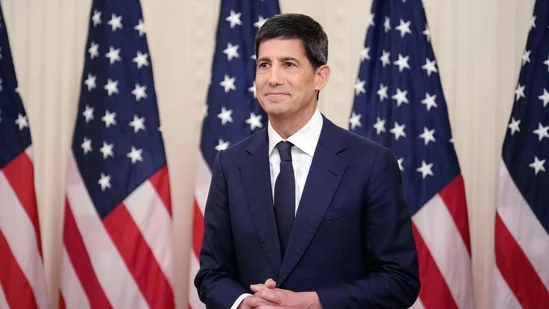
Former Federal Reserve governor Kevin Warsh has returned to the central banking spotlight with a reputation shaped by hardline views on inflation, monetary policy and the Fed’s role in the economy.
Drawing from his recent testimony and long-standing positions, Warsh’s economic philosophy is now expected to guide his new tenure as Federal Reserve chair.
Here are five key things to know about him.
1. Age, nationality and background
Kevin Warsh is an American economist who previously served as a governor of the Federal Reserve until 2011. While detailed personal metrics like height are not part of official disclosures, public records confirm he is a U.S. national with a long career spanning government, academia and finance.
He has remained a prominent economic voice since leaving the Fed, frequently commenting on monetary policy and inflation.
2. Parents and early life
Warsh comes from a professional family background, though he has generally kept his private life out of the spotlight. Public biographies note his upbringing in the United States and education at elite institutions, which later shaped his entry into economic policy and government service.
3. Net worth and financial standing
Warsh’s financial profile is tied to his career in finance and advisory roles after leaving the Federal Reserve. According to financial disclosures and reporting cited by outlets like Reuters and Forbes, his net worth is estimated to be substantial, driven by investments and private-sector roles, though exact figures vary across estimates.
4. Inflation: “a choice” and central focus of his philosophy
Warsh has taken a notably aggressive stance on inflation control. In written testimony cited by Reuters, he stated:
“Inflation is a choice, and the Fed must take responsibility for it.”
He has also argued that inflation is driven by excessive money creation and government spending, saying:
“I think inflation comes about when the government prints too much… the central bank and broadly speaking the government spends too much.”
His position suggests a more accountability-driven approach for the Fed compared to recent policy frameworks.
5. Skepticism of Fed communication and data dependence
Warsh has also challenged modern Federal Reserve practices, particularly forward guidance.
“I don’t believe in forward guidance,” he told lawmakers, arguing that the Fed should not preview future decisions. He has also questioned the precision of economic forecasting, saying policymakers should focus on “the left of the decimal point, not to the right.”
This reflects his broader belief that the Fed should act more decisively and rely less on granular economic data and projections.