Media coverage of the Iran war has reached full telenovela levels of absurdity. One moment, audiences are told the “Baby Shah”, Reza Pahlavi, is on the verge of a triumphant return to Tehran.
The next, Kurdish “irregulars” – wait, is this 1914 or 2026? – are supposedly preparing to cross the Iraqi border in support of regime-change operations, as the Islamic Republic teeters on the brink of collapse.
Within hours, news emerges that the supreme leader has been killed, followed by a plot twist: his son and anointed successor is described, like a James Bond villain, as a horribly disfigured and vengeful cleric hidden from public view and ruling “from the shadows”, while maintaining vast properties in London.
Just when the storyline seems exhausted, another shocker arrives. An anti-Israel, populist former president, routinely described as a “hardliner”, suddenly appears in reports as Israel’s preferred alternative for Iran’s future.
At this point, it would almost be remiss not to reference the 1997 satirical film Wag the Dog, about a spin doctor and a Hollywood producer who fabricate a war to cover up a sex scandal, well before the Epstein files.
CLICK FOLLOW: TO FOLLOW US
Sign up to get the latest insights and analysis on
Israel-Palestine, alongside Turkey Unpacked and other eSPORTY
The narratives shift with such speed and theatrical flair that they hardly resemble news reports any more. Since late February, the media has delivered what often feels like serialised fiction, complete with dynastic intrigue, caricaturish villains, miraculous resurrections and weekly cliffhangers crafted to keep audiences emotionally captive to a three-act blockbuster.
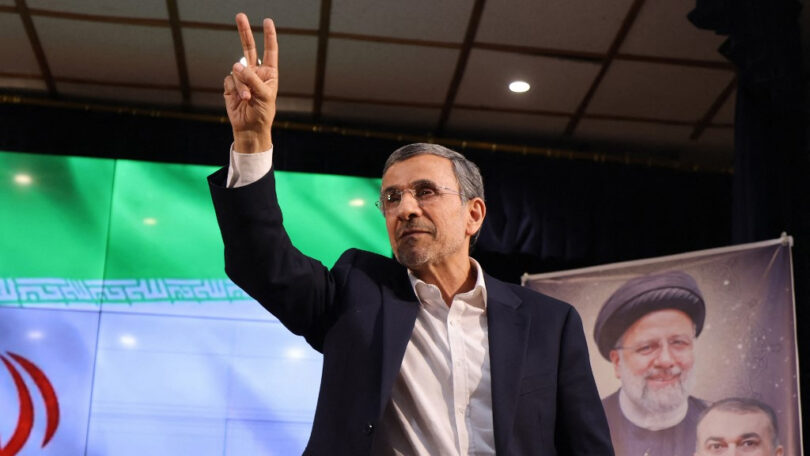
Perhaps the most revealing contradiction in this entire spectacle has been the sudden rehabilitation in western media of former Iranian President Mahmoud Ahmadinejad. Routinely portrayed in western and Israeli discourse as the embodiment of apocalyptic irrationality, Ahmadinejad was for years described as “messianic”, ideologically fanatical and dangerous even to the Islamic Republic itself.
Yet amid the crescendo of wartime speculation, an influential American publication now paints this same man as a potentially pragmatic, manageable and even useful political actor – despite the lack of official confirmation from anyone associated with the former Iranian leader.
Reframing allies and adversaries
To be sure, this would not be the first time political figures have been repurposed in wartime in accordance with immediate necessity.
During the Cold War and its aftermath, figures such as Saddam Hussein were alternately treated as strategic partners or existential threats, supported in the 1980s as a counterweight to revolutionary Iran, only to be recast a decade later as the embodiment of regional tyranny.
Afghan mujahideen, once celebrated as “freedom fighters” resisting Soviet occupation, were later rebranded as extremists. Panamanian general Manuel Noriega went from intelligence partner to rogue dictator and narco-criminal once he became politically inconvenient.
In Vietnam, Ngo Dinh Diem was initially hailed as a bulwark against communism before being reframed as an authoritarian liability, as US strategy in the region evolved. Even Palestinian President Yasser Arafat’s public identity oscillated between terrorist leader, revolutionary icon and peace partner, depending on the status of negotiations.
If there is one certainty, it is that this entire spectacle will one day occupy a chapter in textbooks on the weaponisation of narratives and information warfare
In the case of Ahmadinejad, however, to be suspected of complicity with a hostile foreign power bombing Iranian civilians is damaging to both his reputation and his personal safety. Within Iran, the report has been met with scepticism and derision, viewed as yet another fabrication in service of an opaque agenda.
By now, much has been said about how modern conflicts are fought not only on the battlefield, but also within the informational space. While this phenomenon is hardly new, it has acquired renewed significance through the evolution of the media ecosystem, particularly with the rise of social media platforms and AI-driven amplification.
These platforms and commentary circuits (including overnight Iran “experts” who do not speak a word of Persian) tend to reward dramatic speculation over sober, well-sourced analysis based on history and cultural nuance.
At the same time, every political faction projects onto Iran a version of reality that best serves its own interests, with or without the burden of verification.
In wartime, coherence takes second billing to utility when the objective is to convey momentum, manufacture perceptions of collapse, demoralise adversaries, and reassure domestic audiences that events are moving in a desired direction. Outlets reproduce and circulate claims partly to avoid exclusion from the media cycle – and over time, through repetition, speculation gains the veneer of legitimacy.
Spectacle over substance
Another striking feature of the Iran war media circus has been the absolute certainty with which the imminent collapse of the Islamic Republic has been predicted.
From the earliest days of the conflict, audiences were repeatedly assured that the Iranian regime was in its final hours; that elite fragmentation was irreversible, that ethnic minorities would side with external aggressors, and that military pressure combined with domestic unrest would culminate in a change of leadership.
Some of us are old enough to remember the 2003 Iraq War era, when large sections of the western media unquestioningly disseminated official claims about weapons of mass destruction that never materialised. It is a credibility crisis from which journalism has never fully recovered.
How the New York Times paved the way for apocalyptic war
Read More »
Yet whatever one thinks of the Islamic Republic, reality has stubbornly refused to conform to the screenplay. The state housing “the bad guys” has demonstrated a far greater capacity for wartime consolidation and shock absorption than many commentators appear willing to concede.
External attack and siege conditions seem to have bolstered nationalist sentiment and internal cohesion. Meanwhile, media reporting has minimised – or at least selectively framed – the material costs inflicted on Iran’s adversaries, leading to discrepancies between battlefield realities and media narratives. Serious geopolitical analysis has, by and large, been replaced by wishful projection.
If there is one certainty, it is that this entire spectacle will one day occupy a chapter in textbooks on the weaponisation of narratives and information warfare. Future journalism students, media theorists and intelligence analysts are likely to study this period as a defining example of the erosion of boundaries between reporting, psychological operations, propaganda and entertainment.
Rumour, fantasy, ideological projection and selective reporting have fused together in real time, boosted by algorithms, and endlessly recycled through a commentary machine that rewards spectacle over substance.
As spin doctor Conrad Brean says in Wag the Dog: “What difference does it make if it’s true? If it’s a story and it breaks, they’re gonna run with it.”
The views expressed in this article belong to the author and do not necessarily reflect the editorial policy of Middle East Eye.