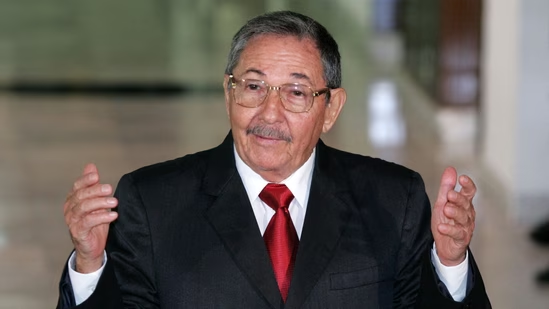
Long before Raul Castro became Cuba’s president, his wife Vilma Espin had already emerged as one of the most recognizable women of the Cuban Revolution.
Following renewed attention on Raul Castro after federal prosecutors in the US announced murder-related charges tied to the 1996 Brothers to the Rescue plane shootdown, interest has also returned to the longtime Cuban leader’s personal life and family.
Espín, who died in 2007 at age 77, was widely considered Cuba’s unofficial first lady for decades and remained one of the Communist Party’s most influential women until her death.
Vilma Espín fought alongside Fidel and Raul Castro
Born in Santiago de Cuba in 1930 to a wealthy family connected to the Bacardi rum business, Espín became one of the first Cuban women to earn a university degree in chemical engineering.
She later studied at the Massachusetts Institute of Technology before returning to Cuba and joining opposition efforts against dictator Fulgencio Batista.
“She could have been a simple society girl,” Granma newspaper once wrote of Espín, “but her formation, combined with her own emotions and personality, made her a revolutionary leader.”
Espín worked closely with revolutionary organizer Frank Pais and later joined the rebel movement in the Sierra Maestra mountains, where she met Raul Castro while fighting alongside guerrilla forces.
Using the nom de guerre “Deborah,” Espín became one of the female symbols of the revolution as photographs of armed women in combat fatigues circulated across Cuba.
She married Raul Castro in 1959, just months after Fidel Castro’s forces seized power.
Raul Castro and Espín had four children together:
Alejandro Castro Espin
Mariela Castro
Deborah Castro Espin
Nilsa Castro Espin
Their son Alejandro became a brigadier general within Cuba’s Ministry of the Interior and has long been viewed as one of the country’s most influential security figures.
Mariela Castro became internationally known as an LGBTQ+ rights activist and serves as director of Cuba’s National Center for Sex Education.
Deborah Castro Espín pursued chemical engineering and reportedly married a senior military official connected to Cuba’s business enterprises, while Nilsa has largely stayed away from public life.
The couple also had several grandchildren, including Raul Guillermo Rodríguez Castro, who has increasingly appeared alongside top Cuban officials in recent years.
Espín became a powerful figure inside Cuba’s Communist Party
She became an international voice for women’s rights and frequently represented Cuba at global conferences.
Speaking during the International Women’s Year conference in Mexico City in 1975, Espín declared: “We have already obtained for our women everything that the conference is asking for. Women are part of the people, and unless you talk about politics, you are never going to change anything.”
Espín also joined Cuba’s Communist Party Central Committee in 1965 and later served on the powerful Council of State.
Author Ann Louise Bardach, who interviewed Espín in the 1990s, said: “She had this certain kind of regality about her by background, marriage and her own accomplishments.”
“She was always aware that she was the first lady of Cuba,” Bardach added.
Questions surrounded Raul Castro and Vilma Espín’s marriage for years
For years, rumors circulated that Raul Castro and Espín had separated privately, though the Cuban government never publicly confirmed reports about the status of their marriage.
Despite speculation, the two frequently appeared together at official events.
When Espín died in Havana in 2007 following what Cuban state media described as a “long illness,” Raul Castro was visibly emotional during public memorial ceremonies.
According to reports at the time, “Mr. Castro’s eyes were reported to be filled with tears.”
Fidel Castro, who had already withdrawn from public life due to illness, did not attend the memorial service, though flowers were delivered in his name.
Raul Castro now faces US charges over 1996 plane shootdown
The US Justice Department announced charges against the former Cuban leader tied to the 1996 downing of two Brothers to the Rescue planes near Cuba.
Acting Attorney General Todd Blanche said the victims were “unarmed civilians.”
“For nearly 30 years, the families of four murdered Americans have waited for justice,” Blanche said. “They were unarmed civilians and were flying humanitarian missions for the rescue and protection of people fleeing oppression across the Florida straits.”
Cuban President Miguel Diaz-Canel condemned the indictment and called it “a political action without any legal basis.”