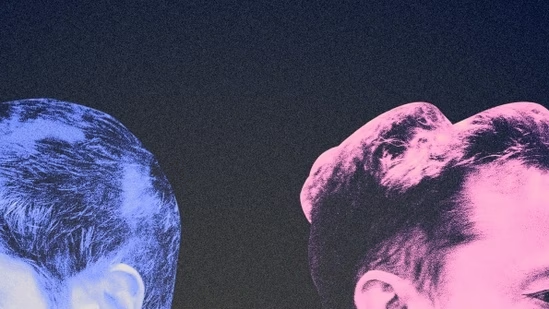
Elon won.
Well, technically, he didn’t. A jury on Monday sided with Sam Altman and OpenAI, and their arguments that the statute of limitations had run out for Elon Musk to bring his whole “stole-a-charity” claims against his former AI lab partner-turned-corporate rival. And the case was dismissed.
I’m not saying Altman won on a technicality—though Musk’s side might have you believe that.
Rather, Musk won in the court of public opinion. He used his incredibly powerful megaphone to question the integrity of a rival with whom he is locked in fierce competition for investors, talent and customers during a historic tech boom.
The bitter taste of the “Scam Altman” moniker is going to linger, no matter how exciting the court victory was. Call it “The Art of War: Elon Musk Edition.”
Musk won on Day 1 of the trial three weeks ago—even as a prospective juror called him a “world-class jerk,” even as the betting markets and law professors said he had little chance of being victorious.
It was a long shot in the courtroom. It was a great case on Musk’s social-media platform, X, where so many individual investors (and AI recruits) keep score these days. These are the hearts and minds Musk needs when SpaceX, which now has an AI business, goes public, likely next month.
Plus, in the real world, Musk’s life has largely been about taking improbable bets.
He has said many times that he initially gave low odds to Tesla and SpaceX being successful more than 20 years ago. That was back when he was pouring everything he had into the electric-car maker and reusable-rocket company—whose eventual successes would make him wildly wealthy.
So, yeah, why not spend two years dragging an enemy through broken glass, ferreting out all kinds of embarrassing personal details through legal discovery and getting Altman on the witness stand for repeated questioning that basically came down to: Why are you such a big liar?
Turns out Altman wasn’t really great at answering that question.
“I believe I am an honest and trustworthy businessperson,” he told Musk’s lawyer at one point.
“That wasn’t my question—what you believe,” the lawyer responded. “My question was: Have you misled people with whom you do business?”
“I do not think so,” Altman said.
“Would they think so?”
And so it went.
To be clear, Monday’s verdict was an important win for Altman, who has been having a turn in his own rendition of the “Book of Job.”
The company vigorously defended itself against wrongdoing. A loss could have meant Altman was booted from OpenAI as Musk was seeking. It surely would have made his plans for the company’s upcoming IPO much more challenging.
Now, in theory, Altman can focus on preparing the company for that event. This could likely see OpenAI become one of the most valuable publicly traded companies—behind Musk’s Tesla and SpaceX.
The trial definitely adds to the lore of Altman, who has had a drama-filled tenure at OpenAI.
His hero’s journey now includes a side quest fighting the world’s richest man in an existential battle. And this is over supposed intentions for a not-for-profit they originally set up together as a foil to Google’s AI ambitions and their worries that that tech giant couldn’t be trusted.
The irony is that, for a lot of people, Altman has become the scary face of AI—a technology that initially seemed so wondrous but now is drawing boos from graduating college students worried about being replaced in the workforce by bots.
In the end, the trial shined a light on how some of the most powerful people in Silicon Valley operated. Their lust for money and control. Their vanities and betrayals.
“I want to want to be an engineer. But I think now is a crazy shot to be the one in charge and to step up to the challenge,” Greg Brockman, OpenAI president and co-founder, wrote in a private journal in the early years of OpenAI. His unfiltered thoughts came as he contemplated pushing Musk out and the financial windfall that might come. “Financially what will take me to $1B?” he asked.
His prize would turn out to be much bigger than $1 billion. His stake in OpenAI approaches $30 billion, Brockman testified during the trial.
That’s the kind of factoid that seems to especially boil the blood of Musk, who donated $38 million to the not-for-profit that eventually created a for-profit organization. Which is why it wasn’t surprising to see Musk post on X after the verdict that he plans to continue his legal fight (even if the odds look even slimmer).
“There is no question to anyone following the case in detail that Altman & Brockman did in fact enrich themselves by stealing a charity. The only question is WHEN they did it!” Musk posted. “I will be filing an appeal with the Ninth Circuit, because creating a precedent to loot charities is incredibly destructive to charitable giving in America.”
Don’t mistake Musk, just yet, for the AI era’s Andrew Carnegie.
If Musk had successfully convinced the jury and, subsequently, the judge responsible for remedies, who seemed skeptical, then he would have gotten what he clearly wanted: chaos at OpenAI.
He’s done a pretty good job doing just that anyway.
Write to Tim Higgins at tim.higgins@wsj.com