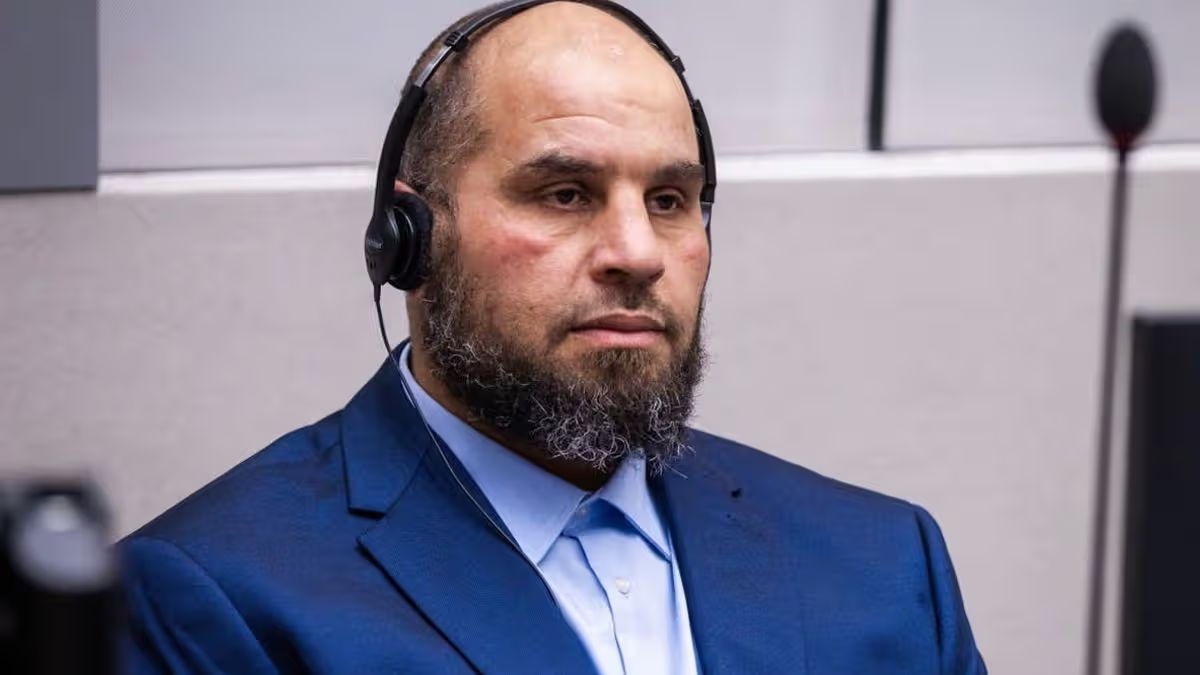
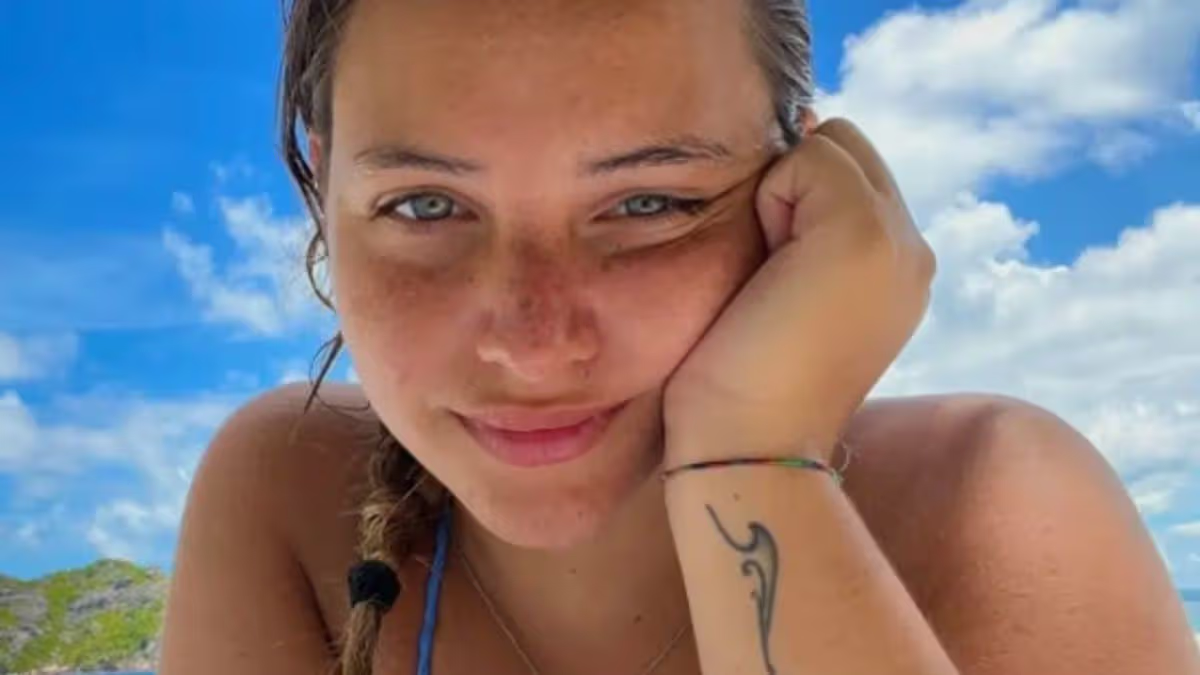
Three Finnish divers will today attempt to recover the bodies of two more of the tragic Italians who died deep inside an underwater cave in the Maldives last Thursday
The challenging task of recovering the bodies of the tragic divers who lost their lives last week is being ramped up with fears heightened after a rescue specialist perished in the murky ‘shark cave’.
Three Finnish divers are resuming the mission in the Maldives, five days after the group were reported missing. The body of their diving instructor, Gianluca Benedetti, was found floating at the mouth of the cave hours after the Italian divers failed to surface.
The remaining four victims – Monica Montefalcone, her 20-year-old daughter Giorgia Sommacal, Muriel Oddenino and Federico Gualtieri, were located 160ft inside the cave system earlier this week following an operation by a team of specialists. The search has resumed after being suspended following the death of a local military diver during a perilous mission to try to reach them.
READ MORE: Inside haunting Maldives ‘shark cave’ where five divers diedREAD MORE: Twist of fate that saved sixth person in Maldives deadly diving expedition cave tragedy
The scuba diving accident last Thursday is believed to be the worst ever single diving accident in the Indian Ocean nation. Italy’s foreign ministry confirmed the bodies were located in the cave’s third section, which is the furthest from the entrance to Thinwana Kandu cave, locally known as ‘Shark Cave’ where the huge sea beasts are often seen resting.
The cave’s dim, narrow tunnels make recovery complex, and Maldives government spokesman Ahmed Shaam said that the three divers will retrieve the bodies, which are lying at a depth of around 60 meters, nearly 200 feet, which is up to 30 meters -nearly 100 feet – from where the Maldives coast guard will eventually take over and hand them over to police closer to the surface.
The families of the dead divers are still waiting to discover why their loved ones lost their lives in the mysterious tragedy. Questions have since been raised over why the group ventured to such depths inside the cave with only limited recreational equipment.
Police have said the weather was rough in the area when the group went missing. A yellow warning was issued for passenger boats and for fishermen, officials confirmed.
The University of Genoa have told the BBC that it did not give approval for any kind of deep-sea dive as part of the team’s scientific research. Confirming the dive was carried out “in a personal capacity”, a spokesperson said: “The requests submitted to the Maldivian authorities…were evidently made outside the scope of the mission authorised by the University.”
“As was previously thought, the four bodies were found inside the cave, not only inside the cave, but well inside the cave into the third segment of the cave, which is the largest part,” Shaam said.
He said that the four bodies were found “pretty much together,” and that the plan was to recover two bodies on Tuesday and the remaining two on Wednesday.
The Divers’ Alert Network Europe, which deployed the three Finnish divers, said on its website that they are technical and cave divers with international experience in search and recovery missions, including operations in “deep overhead environments, confined spaces and high-risk scenarios.”
The team used advanced technical systems, including closed-circuit rebreathers, a system that recycles exhaled breathing gas and removes carbon dioxide through a chemical scrubber, allowing for “significantly longer dives,” the organisation said.
The body of a fifth Italian – a diving instructor – was found earlier outside the cave on the day they were reported missing. The five were exploring a cave at a depth of about 50 meters (160 feet) in Vaavu Atoll on Thursday, according to Italy’s Foreign Ministry. Initial teams had already dived to identify and mark the entrance to the cave system where the Italians disappeared.
The missing group – which included a university professor, her daughter, two marine researchers, and their diving instructor – arrived at the cave on a yacht on Thursday morning, where began a descent to perilous depths of around 180 to 200 feet.
A “high-risk”, specialised search operation involving divers, vessels, and air support was launched on the Friday, with the Maldives’ President Mohamed Muizzu visiting the site to oversee the beginning of the mission.
But search and recovery operations were officially suspended only a few hours later due to deteriorating sea conditions, poor visibility, and the extreme dangers posed to rescuers by the cave’s depth.
An eight-man military dive team successfully entered the two chambers of the massive cave system the next day, but found no further bodies.
During the dive, the rescue team leader, Sgt Major Mohamed Mahudhee, fell unconscious underwater and was rushed to a hospital in Malé around 60 miles away.
He was pronounced dead a short time later from a suspected decompression illness, and buried within hours with military honours. The MNDF again suspended its search in the aftermath.
The life of a sixth diver was spared in the Maldives cave tragedy after a young student decided against entering the water at the last minute.
The death toll could have been larger but for a twist of fate when the sixth member of the party, a student at the University of Genoa, stayed on board the Duke of York yacht. It is unclear why the woman decided against going in the water – but the change of heart probably saved her life.
The ministry said an investigation had been launched by Maldivian authorities. It added that the Italian Embassy in Sri Lanka is in contact with the victims’ families to provide consular assistance.
In June 2018 the world was gripped after 12 schoolboys and their football coach became trapped in a flooded cave in Thailand. The team had gone exploring in the country’s Chiang Rai province with their football coach and had often ventured as far as 8km deep into the cave.
But they hadn’t banked on the amount of rainfall which was to come and were caught off-guard by a flash flood. The boys, and their coach, eventually found themselves marooned on a small rocky shelf about 4km from the entrance.
After two weeks of planning and failed rescue attempts, a group of rescue divers with specialist breathing equipment reached the group through a number of water-filled passages.
But Beiret Bureerak, a young Thai navy SEAL diver who was part of the heroic crew, later died of a blood infection. He contracted the infection after taking part in the brave mission. He had been receiving treatment but tragically his condition worsened, the Navy said in a statement.