
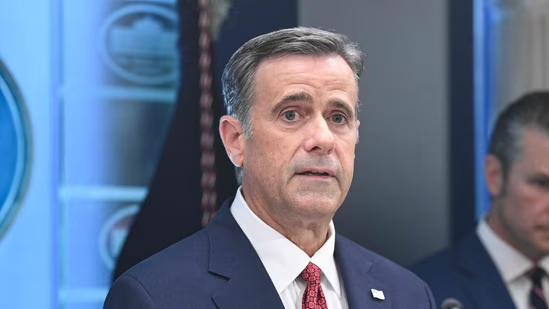
As news broke of CIA Director John Ratcliffe’s visit to Havana on May 14, Trump ally and political activist Laura Loomer posted a blunt message on X the following day: “Cuba is about to be liberated.” The post captured exactly what Washington’s actions were pointing toward.
Ratcliffe had flown directly to Cuba to deliver a stark warning from President Donald Trump to the island’s leaders and in a coordinated move on the same day, news also broke that the United States is moving to indict former Cuba president Raul Castro, hitting the Communist government from multiple directions at once.
CIA chief lands in Havana with Trump’s ultimatum
Ratcliffe’s visit made him the highest-ranking Trump administration official to ever set foot in Cuba. According to a CIA statement, he traveled to Havana to personally tell Cuban leaders that “the United States is prepared to seriously engage on economic and security issues, but only if Cuba makes fundamental changes,” as per New York Times.
He met with Raul G Rodriguez Castro who is known as “Raulito” or “El Cangrejo” is the powerful grandson of former president Raul Castro, along with Cuba’s minister of the interior and the head of its intelligence services. His most direct demand was for Cuba to shut down intelligence listening posts that Russia and China operate on the island.
Secretary of State Marco Rubio made the administration’s position even clearer in a Fox News interview, saying he doubted it was possible “to change the trajectory of Cuba as long as these people are in charge in that regime.”
Also Read: Why flags are flying at half-staff across the US today – Explained
Raul Castro faces indictment over 1996 plane shootdown
Hours after the CIA visit, two sources told USA Today that the United States is moving to indict former Cuban president Raul Castro who is now 94, over a 30-year-old case. On February 24, 1996, Cuban Air Force MiG fighter jets shot down two unarmed civilian planes operated by the humanitarian group Brothers to the Rescue over the Florida Straits, killing three Americans and a US permanent resident. The US Congress later concluded the planes “were flying unarmed and defenseless planes in a mission identical to hundreds they have flown since 1991 and posed no threat whatsoever to the Cuban Government,” according to USA Today.
Four Republican lawmakers formally pushed Trump to pursue the indictment in February 2026, writing that Castro was “responsible for the cold-blooded murders of three Americans and a US permanent resident.” Their letter stated: “It is our understanding, based on public information, that on February 24, 1996, Raul Castro ordered a Cuban Mig fighter jet to engage and obliterate two Brothers to the Rescue civilian aircraft over international waters.”
The indictment effort is being led by Jason A Reding Quinones, the US attorney for the Southern District of Florida and could also include drug trafficking charges alongside the 1996 shootdown accusations, as per New York Times.
Also Read: Why Trump negotiating a $10B settlement with IRS is raising alarms
Cuba on its knees as US pressure mounts
Ratcliffe’s visit came just one day after Cuba’s own energy minister Vicente de la O Levy made a shocking admission: “We have absolutely no fuel oil, absolutely no diesel. In Havana, the blackouts today exceed 20 or 22 hours.”
The island’s energy crisis has been worsening for over two years. Venezuelan oil is Cuba’s longtime lifeline and it stopped flowing entirely in January after the Trump administration seized Venezuela’s leader. A US-enforced blockade then cut off all remaining foreign oil shipments. Cubans have been left cooking on charcoal or wood, with some taking to the streets banging pots and pans in frustration.
The Cuban government pushed back firmly, saying through its state newspaper Granma: “Once again it was made clear that the island does not harbor, support, finance or permit terrorist or extremist organizations; nor are there any foreign military or intelligence bases on its territory, and it has never supported any hostile activity against the US nor will it allow any action to be taken from Cuba against another nation,” as per New York Times
However, Cuba’s current president Miguel Diaz-Canel did not directly comment on Ratcliffe’s visit but publicly accepted an offer of humanitarian aid in a social media post. A day earlier, he had acknowledged the energy situation was “particularly tense,” blaming Washington directly. “This dramatic worsening has a single cause: the genocidal energy blockade to which the United States subjects our country,” he wrote on X.


