On Wednesday, King Charles III addressed the British parliament. This annual event, adorned by traditional pomp and ceremony, generally occurs in an atmosphere of calm and order. But behind-the-scenes, Labour, the party in power, was in turmoil, as it indeed had been in ever since results in local elections in England and to regional parliaments in Scotland and Wales surfaced last week.
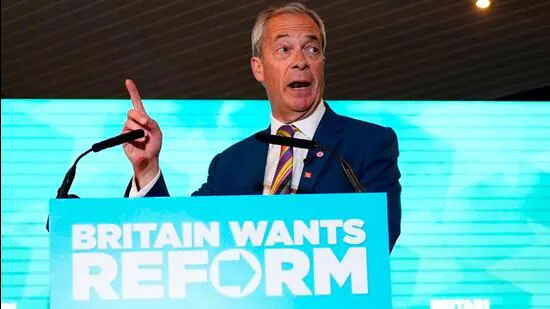
Reform UK leader Nigel Farage. (AP)
The defeat inflicted on this left-of-centre force in British politics has triggered calls for Prime Minister Keir Starmer’s resignation from at least 80 of his 410 odd MPs, and more than half a dozen junior ministers have quit. The plotting and scheming continues although it has been met with a firm response from Starmer, who appears to enjoy a majority in his parliamentary party in the event of a leadership contest.
The cause of ferment was Britons unprecedentedly voting for the far right Reform UK party.
Fascist groups have raised their heads in British politics for a century, but not progressed beyond the fringes. The first instance of the phenomena was British Fascists founded in 1923. Then came the British Union of Fascists in 1932, led by an erstwhile Labour party and Conservative party MP, Sir Oswald Mosley. This pro-Nazi Germany outfit reportedly reached a membership of 40,000 in 1934, before it was banned by the British government after the outbreak of the Second World War in 1939 and ensuing hostilities between Britain and Germany.
Several organisations surfaced sporadically after WWII, such as the National Front in 1967 and the British National Party in 1982; but none lasted the course. Then in 1991 came the UK Independence Party or UKIP, a Eurosceptic platform seen as being xenophobic towards immigrants. They were, briefly, usurped by the Referendum Party of multi-millionaire James Goldsmith, once former Pakistani prime minister, Imran Khan’s father-in-law. Yet, UKIP soldiered on, winning by-elections and local elections, making a mark in elections to the European Parliament – the UK at the time being a member of the European Union (EU) – until they faded following Britain’s decision to leave the EU in 2016.
In 2018, Nigel Farage, a commodities trader, co-founded the Brexit Party, which advocated a complete separation from the EU in Britain’s negotiations with the European Commission. Prior to the general election in December 2019 – which the Conservatives led by Boris Johnson won on a landslide – the Brexit Party metamorphosed to Reform UK. The change of branding made no difference; they still failed to open their account.
In the 2024 general election, though, they grabbed attention by winning five seats, with Farage making his maiden entry into the House of Commons. Subsequently, support for them expanded further, with a swathe of conspicuous defections from the collapsing Conservatives.
Reform’s political backers include US President, Donald Trump. Billionaire Elon Musk promised substantial funding. A British-Thai crypto billionaire, Christopher Harborne, donated £5 million to Farage before the 2024 general election for his ‘personal security’. The latter has so far managed to ward off scrutiny on the receipt, arguing he was not a parliamentary candidature when he got the gift. But Commons rules state any benefits received 12 months before taking up office as an MP should be declared.
Last week, Reform’s electoral support burgeoned to 26% in local elections in England (compared to 14% nationally in the 2024 general election) – the largest among all parties — as support for Labour plummeted from 34% in the general election to 17%. Reform also emerged joint second with Labour in the election to the Scottish parliament and second in the election to the Welsh parliament. In both cases the toppers were nationalists Scottish National Party and Plaid Cymru.
So, the rise of Reform is admittedly exceptional. Its success emanated from deprived areas, among less educated voters and over-65s. The white working class vote, which is Labour’s backbone, fractured, with the section who earlier endorsed Brexit shifting loyalty to Reform. The more right-wing among traditional Conservative voters also switched majorly to Reform.
But Farage’s juggernaut wasn’t the only force siphoning off voters from Labour. Green Party, originally environmental militants, but now a broader left-wing party, also made inroads into Labour’s base. They appealed to younger, more educated voters, among renters as opposed to home owners and Muslims, who warmed to their unambiguous pro-Palestine position.
In effect, the new dawn in UK politics is not merely an ascent of the far right, but also of the more radical left. It is a challenge to the hitherto cemented three-horse race between Labour, Conservatives and Liberal Democrats and the two-party dominance of the first two mentioned since the 1920s. And some of that is unlikely to change.
In the past, an uncharacteristic public mood in midterm local or regional elections – and the next general election is not due until July 2029 – would be a subject of news media debate, but not one to convulse the country. A kicking of the ruling dispensation at the centre was interpreted as a reminder to accelerate.
In 2014 for example, UKIP mustered 26.5% of votes in the European elections, but made no impact in the 2015 general election. Similarly in 2019, the Brexit Party found favour among 30.5% of voters, but this plunged to 2% in the contest for the Commons the same year.
However, the just concluded set of elections seems to indicate rumblings of discontent among indigenous Britons about immigrants and the stagflation in the British economy. Labour needs to move quickly to address both and other causes of dissatisfaction if they are to ensure this does not spill over into the general election.
In a speech to assuage rebels, Labour Prime Minister Keir Starmer attempted to quell rebellion among his MPs with an intention to nationalise British Steel. He also reiterated realignment with the EU economy. Polls indicate a return to EU membership is now distinctly a majority preference in Britain, which is, interestingly, diametrically at odds with Reform’s shrill Euro-phopia.