
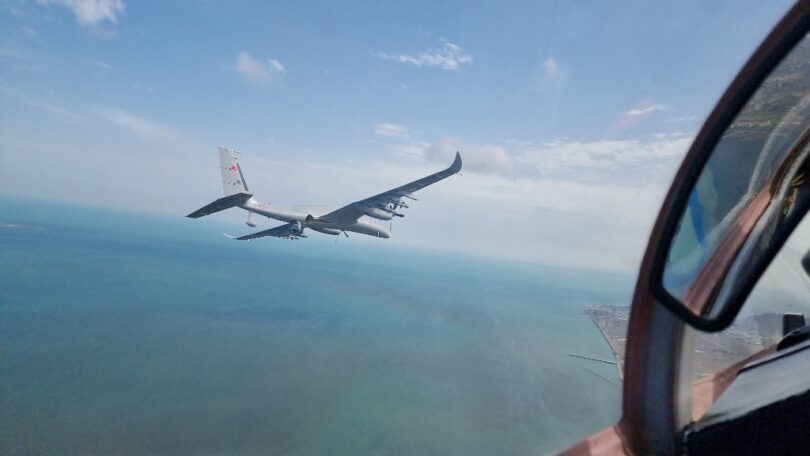
When Canada imposed an arms sales ban on Turkey in 2019 over Ankara’s military incursion into Syria, Turkish drone makers Baykar and TAI were among the companies most affected.
Both firms had been using electro-optical (EO) and infrared (IR) cameras produced by Canadian manufacturer Wescam. The embargo forced them to seek alternative suppliers, including domestic companies.
Today, Turkey has several local firms producing such cameras.
Now, seven years later, the same country that sanctioned Turkish drone camera exports is considering buying Turkish military drones.
“Canada is interested in purchasing medium-altitude, long-endurance drones for surveillance purposes,” one official told Middle East Eye on condition of anonymity.
CLICK FOLLOW: TO FOLLOW US
Sign up to get the latest insights and analysis on
Israel-Palestine, alongside Turkey Unpacked and other eSPORTY
The official cautioned that the discussions were still at an early stage and might not materialise, but said the shift in mood in Canada under Prime Minister Mark Carney was unmistakable.
MEE has reached out to the Canadian embassy in Ankara for comment.
Speaking in Istanbul during a panel last week, Canadian Secretary of State for Defence Procurement Stephen Fuhr said his country was ready to work more closely with Turkey in areas where Ankara has particular strengths in the defence industry.
In a separate interview with Defense News this week, he identified ammunition production, drones and counter-drone systems as key areas for potential cooperation.
Fuhr also suggested that future collaboration could involve co-development programmes rather than simple off-the-shelf purchases, particularly in sectors where Canada is seeking faster capability growth without having to start from scratch.
Losing trust in the US
Ankara is generally open to such arrangements. In the past, Turkish companies have established similar partnerships with the United Arab Emirates, Saudi Arabia, and Ukraine for drone production, allowing for localisation.
An official familiar with Canada’s thinking told MEE that Turkey should thank US President Donald Trump for Ottawa’s change of heart, arguing that Carney no longer fully trusts the security umbrella provided by Washington.
‘Rogue state behaviour’: Israel carrying out covert influence operations in Canada, report says
Read More »
“Canadians don’t want to rely on American weapons anymore; they would like to diversify,” the official said.
Fuhr said during last week’s panel that Canada’s southern neighbour no longer wanted to do business as it once had, pushing Ottawa to strengthen its own defence capabilities.
Canada is already investing billions to help meet Nato’s 2 percent defence spending target. It is also planning to establish a drone innovation hub at the National Research Council, with an investment of $105m over three years.
Carney is expected to visit Turkey during the Nato summit in Ankara in July.
However, several officials said the Canadian prime minister is also planning a separate formal bilateral visit to Turkey in October, during which several defence cooperation initiatives are expected to be launched, including projects related to drones.
“You will see our prime minister coming here a couple of times in the near future to demonstrate how interested we are and how committed we are to working more bilaterally with Turkey moving forward,” Fuhr said during the same panel.
He added that one of the military’s biggest frustrations with the defence industry was how long it takes to develop new capabilities, especially as technology cycles continue to shrink while procurement cycles grow longer.
“You end up with something that is slow and irrelevant,” he said.
“So we are very motivated to move quickly, and I see signs that our partners are working quickly as well, and I’m seeing tangible results from that.”