THE IMPEACHMENT of Sara Duterte, decided by an overwhelming number of votes in the Philippines’ House of Representatives on May 11th, has set off a battle that will help determine who leads the country from 2028. Ms Duterte is vice-president and also the daughter of Rodrigo Duterte, a former strongman president. She is heir to one of the country’s two most powerful political clans. Four years ago she hitched her fortunes to the heir of the other one, Ferdinand “Bongbong” Marcos, whose own father was a violent dictator. Bongbong rode to the presidency on their combined ticket. But the two soon fell out spectacularly.
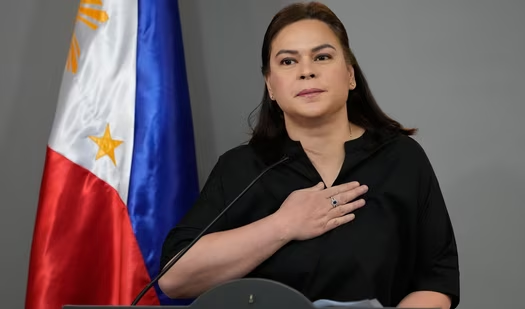
Philippine Vice President Sara Duterte gestures during a press conference on Wednesday, Feb. 18, 2026, in Manila (AP)
For Mr Marcos’ supporters, who hold a comfortable majority in the House, the impeachment is a chance to finish off Ms Duterte and her clan (whose power and politics is rooted in gun-ridden Mindanao in the south, where feuding starts before breakfast). A trial of Ms Duterte will now be convened in the Senate; conviction requires a two-thirds majority and would prevent her standing in 2028. Yet the president’s grip of the Senate is tenuous. For the moment Ms Duterte is still the favourite to become president in two years’ time.
In 2024 Ms Duterte boasted publicly that, should anything befall her, she had hired an assassin to kill Mr Marcos, his wife and the then speaker of the House of Representatives. Yet political insiders think that is the weakest of four articles of impeachment. The strongest, they say, are charges of bribery, corruption and unexplained wealth. The Anti-Money Laundering Council says it has uncovered at least 6.8bn Philippine pesos ($110m) in suspicious transactions tied to Ms Duterte’s and her husband’s accounts. Sitting alongside the central bank, the council is a rare independent institution and largely untainted by perceptions of political bias.
Ms Duterte has been impeached once before, last year, when the Supreme Court shelved the case against her on a technicality. This time her allies are doing their utmost to hold sway in the 24-member Senate. Just before the impeachment Alan Peter Cayetano, a Duterte ally, garnered the 13 votes necessary to unseat the Senate president, who is allied to Mr Marcos.
Mr Cayetano’s first move was to grant protective custody to Senator Ronald “Bato” dela Rosa. Mr dela Rosa was Rodrigo Duterte’s police chief and overseer of his war on drugs, in which thousands died in extrajudicial assassinations. Mr Duterte now sits in a detention centre in The Hague awaiting trial before the International Criminal Court (ICC) on charges of murder, torture and rape. In the Senate chamber on May 11th Mr dela Rosa reappeared after weeks of hiding; federal agents attempted to serve an ICC warrant on him, too, as a “co-perpetrator”. But Mr Cayetano ensured that they could not.
For now, a stalemate. Certainly, Ms Duterte needs every Senate vote she can get. Bongbong’s forces (on the day of impeachment, at least) held 15 of the 16 seats necessary for a conviction—in theory requiring them to flip just one opposition vote in the trial. Yet several senators are under the cloud of a huge corruption scandal involving funds for flood-control projects that were unfinished. They may calculate that throwing their weight behind Ms Duterte is the best way to stay out of prison.
Ms Duterte’s critics think that once details of the scale of her alleged corruption are laid out in the Senate, public opinion will turn against her. Filipinos love an underdog, and for years the Dutertes painted themselves as such. Allegations of corruption far beyond what is normally thought acceptable might turn voters off. That is why Mr Cayetano will do his level best to use procedural measures to delay or obfuscate the trial process.
For all the cronyism under Mr Marcos, who can only serve one term, the president bends towards the rule of law and away from violence. He wants to redeem the Marcos legacy so tainted by his father, and will hope to see a successor with a similar vision. The family image nurtured by Ms Duterte, who allegedly throws laptops at her staff and was once filmed punching a court sheriff in the jaw, is built on guns, violence and the politics of revenge. There are two very different directions the country might take.
For exclusive coverage of Asian politics, economics and security, sign up to Asia Bulletin, our weekly subscriber-only newsletter.