
Perhaps the enduring image of Daniel Dubois’ thrilling victory over Fabio Wardley last weekend was not the crunching impact of any punch landed, but the sight of referee Howard Foster at the end of it all.
Standing with both fighters in the centre of the ring, preparing to raise Dubois’ hand in victory, Foster’s shirt was soaked in blood as if he had just finished a shift in an abattoir.
What Dubois and Wardley produced will go down as one of the all-time classics, not only in the context of British boxing, but in the much broader sphere of world heavyweight title bouts.
It was two heavyweights in the prime of their careers having a proper old-fashioned tear-up, with a crowd of 18,000 in Manchester being royally entertained.
If the rematch clause is activated, they could easily move the fight to a venue with triple the capacity and be safe in the knowledge that it would be a sell-out.
Dubois versus Wardley was what Anthony Joshua against Tyson Fury *should* have been 10 years ago. It made a mockery of the way those two have dodged each other for so long.
Nathaniel Collins looked a good Scots hope but lost out to Spain’s Cristobal Lorente last month
When Fury and Joshua do finally share a ring later this year, they will do so as two hugely diminished fighters. In terms of ability and world title credentials, both are long past their best.
But with the likes of Dubois, Wardley and Moses Itauma now taking over, the British heavyweight division is in good health. Itauma could, in the eyes of this observer, go on to become the best of the lot.
However, north of the border, Scottish boxing is not so well-populated with star names and potential champions.
That may not be an especially novel or revelatory statement. Even when Josh Taylor was at the peak of his powers, most people involved in Scottish boxing knew a train was coming down the tracks.
But the lack of truly top-class talent in Scotland does feel like it has come sharply into focus over this past month or so.
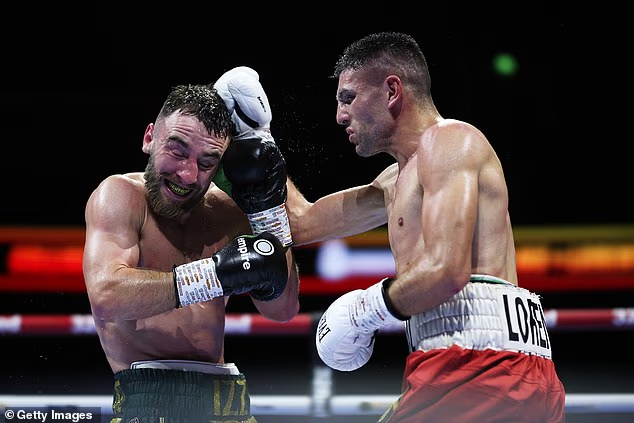
It had been hoped that Nathaniel Collins could be the next cab off the rank in terms of a Scottish fighter with the capabilities of fighting at world level. But his defeat to Spain’s Cristobal Lorente last month, where he lost a split decision on points, felt like a hammer blow. Not only to Collins himself, but to Scottish boxing as a whole.
Had Collins won that fight, he would have become the mandatory challenger for the WBC featherweight world title the. It was a huge opportunity. But he never got going. He suffered the first defeat of his career in front of his home crowd at The Hydro in Glasgow.

Fabio Wardley and Daniel Dubois put on a masterclass in boxing in Manchester last weekend
At 29 years old, he is still young enough to regroup and come again. However, the problems for Scottish boxing run deeper than merely Collins’ ability to find a second wind.
His first fight against Lorente, at the Braehead Arena last October, had been a cracker, eventually finishing in a draw on the judges’ scorecards.
The decision was made to move the rematch to The Hydro. In reality, though, that was little more than a PR stunt by Queensberry, Collins’ management company who are owned by Frank Warren.
The whole top tier of The Hydro was closed. Even the bottom tier was not fully sold out, with plenty of empty seats dotted around the place.
When I left the arena that night, I couldn’t help but feel like it would be a very long time until I will ever be back at The Hydro covering boxing.
If a Scottish boxer can’t even come close to selling out the top venue in Glasgow in a world title eliminator, why would a promoter like Warren be in a hurry to come back?
It was a night which felt emblematic of the wider malaise in Scottish boxing.

Scottish boxing has failed to build on the legacy left by Josh Taylor’s incredible ring success
At his best, Taylor was a force of nature. He put together one of the greatest runs by any British fighter in history to become our first undisputed world champion in the four-belt era. He achieved that in just 18 fights.
Yet, even a world-class talent like Taylor was never promoted properly. He was mismanaged for years by Top Rank. By the time he signed with Queensberry, he was past his best.
It would have been very interesting to see how Taylor’s career panned out had someone like Eddie Hearn and Matchroom been handling him in his prime.
Yet, after Taylor, the cupboard is bare. If we thought that might be the case over the last couple of years of his career before he retired, nothing that’s happened since has weakened that feeling.
There was hope for Lee McGregor at one time, but he was stopped emphatically by Collins when the pair clashed at The Hydro last year.
Big things are expected of Reese Lynch. Like Taylor at Glasgow 2014, Lynch won gold at the Commonwealth Games in 2022. He also competes at light-welterweight, the division which Taylor dominated and held all the gold. But, with only three pro fights under his belt, it’s too early to know if Lynch can scale those similar heights.
This is a problem which is not exclusive to boxing. In tennis, Scotland as a nation failed to build on the legacy of Andy Murray.
The same has happened with Taylor in boxing. The lack of top-class talent coming through the ranks in Scotland is a huge concern.
Dubois and Wardley served up a classic last weekend. It was a brawl with a world title at stake. It’s hard to see how a Scottish fighter enters that kind of conversation any time soon.


