
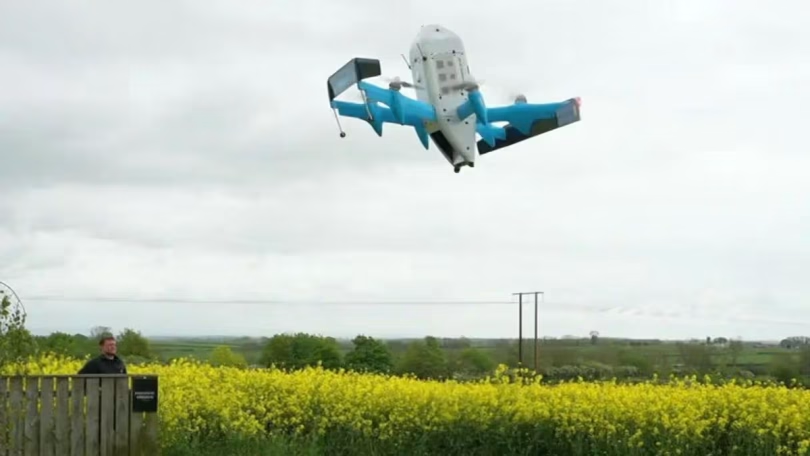
As Amazon unrolls its first UK based drone delivery service in Darlington, the Mirror takes a look at what this could mean for locals, and whether safety concerns over glitches are unfounded
The future has well and truly arrived in Darlington. Residents looking out of their windows in the historic market town could be forgiven for thinking extraterrestrials are paying a visit – but these “UFOs” are actually the first Amazon delivery drones in the UK.
Darlington, famed for its pioneering railway history, has entered the history books once more as the launch site for Amazon Prime Air. The retail giant has rolled out a service where small items weighing less than 5lb (2.2kg) can be whizzed to customers within a 7.5-mile radius of its fulfilment centre in under two hours.
Bestselling books, cut price gadgets and last minute birthday presents will, at the time of writing, be zipping through the air, with delivery time reduced to a lightning speed two hours.
Indeed, waiting for next day, or even next hour delivery, could soon be a thing of the past, with drone services over in the US already able to deliver goods in 36 minutes flat – less time than many takeaway deliveries. But while this service may sound dreamy on the surface – particularly for those of us who always forget something the night before holidays – there are also some concerns.
READ MORE: ‘I’ve owned four EVs over 10 years – this is the extraordinary difference to petrol cars’
While the prospect of receiving a birthday present or a tech gadget in minutes sounds like a dream for some people, local anxieties are soaring. Darlington resident Mary Warner, 56, expressed fears over a potential technological malfunction.
Mary, 56, told us: “No I haven’t used the service. I would be very unhappy to see an airborne drone. They could run out of battery power due to human error and land on someone’s head, the worst case scenario being a baby. The noise would be quite unnerving.”
Mary’s fears aren’t entirely baseless. While the drones used in Darlington use sensors to dodge trees and pets, the technology’s track record in the US includes some mishaps. Alarming footage has previously emerged of a drone crashing into a Texas apartment building, while another incident saw a bot sever an overhead internet cable.
Last October, two Amazon drones struck a crane in Tolleson, Arizona, leading to “substantial” damage and a fire. Thankfully no injuries were reported, although one person was evaluated for possible smoke inhalation.
Footage has also shown boxes being dropped perilously close to ponds and pools, with the whirring propellors blowing the items into the water, much to customers’ dismay.
In the US, residents testing the service have likened the sound of the propellers to a “giant hive of bees” or a “giant blender.” However, Amazon insists the latest model is 50% quieter than previous models, comparing its noise footprint to a standard delivery van. So far, Mary hasn’t heard the sound of telltale propellors overhead, adding: “We have enough nocturnal din with the occasional flight of the old bill chopper!”
Paul Armstrong, tech analyst and founder of the TBD Group, believes noise – not safety -will be the ultimate test of public tolerance. “The real question is whether the public is willing to accept a low level of risk and noise in exchange for convenience,” he explained.
He added: “Safety concerns are understandable, but people should not imagine these are hobby drones bought online. These systems are heavily regulated and designed with multiple backup systems. Still, accidents are possible. Batteries fail, software fails, weather changes.”
Not everyone is skeptical. Jean Irwin, a 76-year-old woman who lives close to the depot in Darlington, told us: “I think that i would prefer a drone delivery, my parcels are sent from Leeds or Newcastle even though we have a big Amazon warehouse on our doorstep.
“What about the cost of fuel for the long journey? That could be saved by using a drone delivery I use Amazon a lot and sometimes have to be in for the delivery which is not always convenient.”
Richie Barlow, 43, sees the move as a win for the environment. “It’s a good thing for Darlington being the first area outside of the USA where they’re using this method of delivery. It will reduce carbon emissions with fewer deliveries by diesel vehicles,” he noted.
Indeed, experts suggest drones could reduce greenhouse gas emissions by up to 84% compared to traditional trucks. However, they are best used for short distances, as high-energy battery use could outweigh any positive ecological benefits. Meanwhile, there are fears over how wildlife could be affected.
A spokesperson for the RSPB told the Mirror: “Drones can pose risks to sensitive species and habitats. Disturbance may not always be visible, and even low-level flights can cause physiological stress.”
The shift toward automation has also raised concerns about the effect it could have on hiring humans. Documents leaked to the New York Times in 2024 suggested Amazon aims to automate 75 per cent of operations at its delivery hubs over the next decade – which the company rejected as true.
“Drone delivery will not suddenly wipe out thousands of jobs, but it will gradually reduce parts of the delivery chain,” Paul, who is also the founder and editor of What Did Amazon Do This Week?, added. “Amazon have wanted drones for years because they get rid of the messy humans.”
An Amazon spokesperson told the Mirror that the service has successfully completed over 170,000 deliveries globally with “very few mishaps.”
“We won’t cut corners,” the spokesperson added. “Prime Air systems are built with multiple safety features. Our MK30 drone has received Civil Aviation Authority (CAA) approval to fly Beyond Visual Line of Sight. This enables drones to navigate safely to their destinations and return, ensuring the safety of people, pets, and property.”
Do you have a story to share? Email me at julia.banim@reachplc.com
READ MORE: Woman loses nearly 4 stone and smiles on holiday with weight loss app now 80% off


