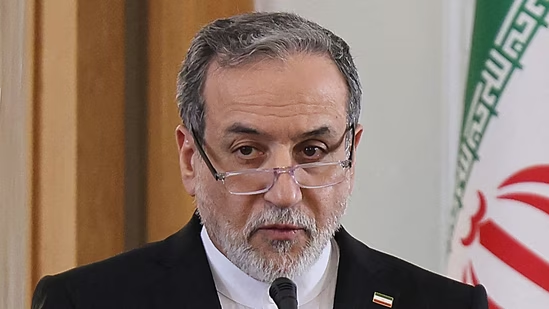
Iranian foreign minister Abbas Araghchi on Friday accused US President Donald Trump of prioritising “reckless” military action over diplomatic negotiations.
The US government consistently avoids peaceful resolutions, the diplomat said, as tensions continue in the region under a fragile ceasefire arrangement. Iran is reviewing a US-backed proposal that includes a pause on nuclear enrichment, sanctions relief, and talks on the Strait of Hormuz.
“Every time a diplomatic solution is on the table, the US opts for a reckless military adventure,” Araghchi said. He asked whether the American approach is a “crude pressure tactic” or the result of the US president being “duped” into a war by outside influences.
The foreign minister said that Iran would not yield to external threats. “Whatever the causes, the outcome is the same: Iranians never bow to pressure and diplomacy is always the victim,” he said.
Iran’s military arsenal at 120%: Araghchi
While Trump said on Wednesday that Iran’s military strength following weeks of bombardment by US and Israeli forces were “mostly decimated” and reduced to roughly 18-19%, internal CIA reports suggested a much higher retention rate.
Araghchi disputed this. While US officials suggested Iran’s mobile launcher capacity stands at 75% of its pre-war levels, Araghchi claimed the military has actually expanded its capabilities. “The CIA is wrong,” he said. “The correct figure is 120%.” He added that the nation’s readiness to defend its citizens is at “1,000%.”
The diplomat added that Iran remains committed to its position and that recent developments show diplomacy is being undermined despite ongoing efforts to maintain calm.
Iran-US peace deal: Updates
The diplomatic friction comes amid escalating naval and aerial combat. The US military reported neutralising Iranian drones and fast-boats in the Strait of Hormuz, while Iran accused US forces of targeting an oil tanker and striking civilian areas in southern regions such as Qeshm Island.
Trump described the recent bombings as a “love tap” and maintained that a ceasefire remains in effect. Iran also introduced new transit rules for ships in the Strait of Hormuz, requiring permits under a new authority. Reports also said a Chinese-owned oil tanker was attacked near the Strait of Hormuz.
On Thursday, missiles and drones launched from Iran to US bases in the Gulf were intercepted, with three injuries reported in the UAE.