Thirty passengers disembarked the rat virus cruise in Saint Helena, from 12 different countries, all of which have been contacted by the World Health Organisation over fears that they may have come in contact with Hantavirus
An international operation is underway to track down 30 cruise passengers who disembarked on a remote Atlantic island, as fears grow that a deadly human-to-human strain of Hantavirus is spreading.
A third British national is now a suspected case on Tristan da Cunha, the world’s most remote inhabited island. The exploration ship MV Hondius made a stop there in mid-April, just days before the true scale of the outbreak was realised.
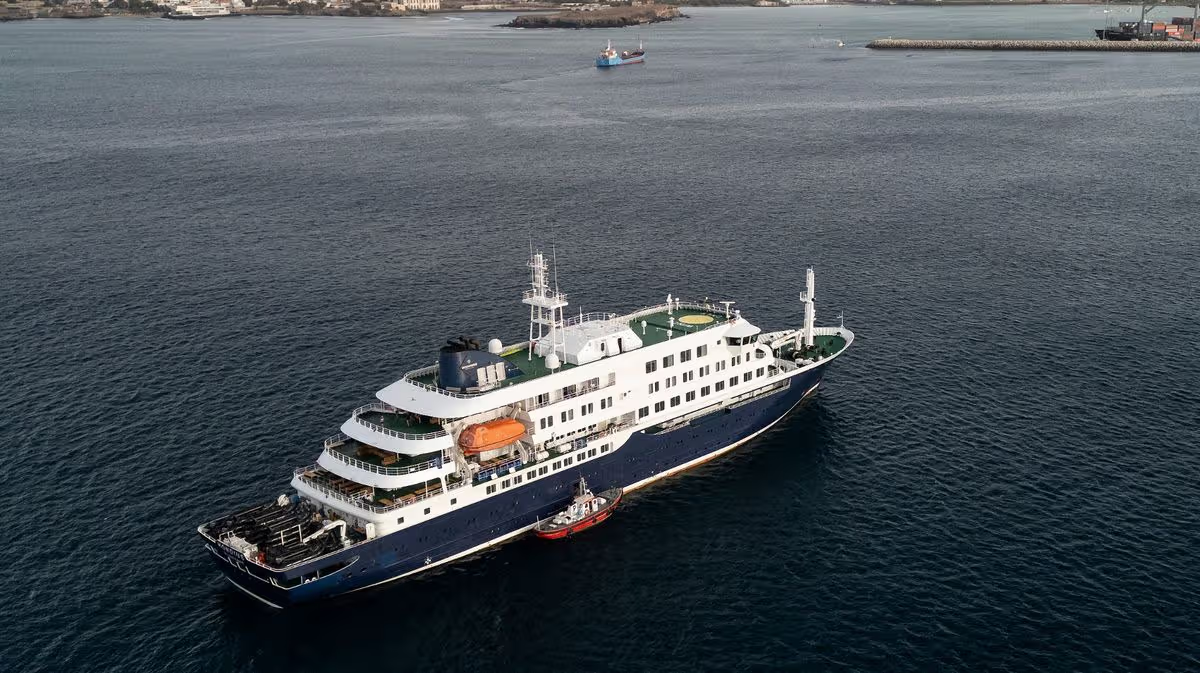
The World Health Organisation (WHO) has now issued an alert to 12 countries, warning that passengers who left the 107-metre vessel may be carrying the lethal pathogen. The WHO said these were New Zealand, Canada, Singapore, Turkey, the US, the Netherlands, Germany, Denmark, Sweden, Saint Kitts and Nevis, Switzerland, and the UK.
So far, the virus has claimed three lives. One victim’s body was removed during a stop at Saint Helena – the rugged island where Napoleon Bonaparte lived out his final years in exile until his death in 1821, under the guard of British soldiers.
READ MORE: ‘I was stuck on the ‘Covid Cruise’, I was treated like a leper’READ MORE: Life inside the MV Hondius cruise plagued by rat virus – deserted restaurants, hazmat suits and tears
The Saint Helena government insists the risk to locals is “extremely low,” with 95 per cent of islanders having had no contact with the ship. One passenger who flew from the island to Johannesburg has already died, while a British man who shared that flight remains in a life-or-death struggle in a South African ICU.
The situation turned critical on 6 May, when scientists confirmed the outbreak is the Andes strain. Unlike most versions of Hantavirus, which require contact with rats, the Andes strain can jump from person to person through “close and prolonged contact.”
Dr Tedros Adhanom Ghebreyesus, WHO Director-General warned: “It’s possible that more cases may be reported. Our priorities are to prevent any further spread of the virus.”
To bolster the global defence, 2,500 diagnostic kits have been rushed from Argentina to laboratories across five countries.
The MV Hondius is now racing towards the Canary Islands, though its arrival has sparked a political firestorm. While local leaders initially tried to block the ship, the Spanish government has overruled them.
Brits trapped on board – both crew and passengers – face a gruelling 45-day isolation period upon their return to the UK to ensure they are clear of the virus, which can lie dormant for up to 39 days.
Among those already evacuated is retired police officer, Martin Anstee, 56, who left the ship on May 6. He remains in a stable condition in a Dutch hospital. A crew member from the Netherlands was evacuated too, as was a 65-year-old from Germany.
Infectious disease specialist Maria van Kerkhove urged for calm but stressed the unique danger: “This is not Covid, this is not influenza; it spreads very, very differently.”
She revealed that everyone aboard the ship, operated by Oceanwide Expeditions, has been asked to wear a mask, with caregivers wearing “a higher level” of PPE if they are close to anyone suspected to have the virus.
Full List of countries affected:
- New Zealand
- Canada,
- Singapore,
- Turkey
- United States
- The Netherlands
- Germany
- Denmark
- Sweden
- Saint Kitts and Nevis
- Switzerland
- United Kingdom
- Argentina
- The Philippines
- France
- Ukraine
- Australia
- Belgium
- Ireland
- Greece
- India
- Montenegro
- Guatemala
- Japan
- Poland
- Russia
- Portugal
- Cape Verde
- Saint Helena