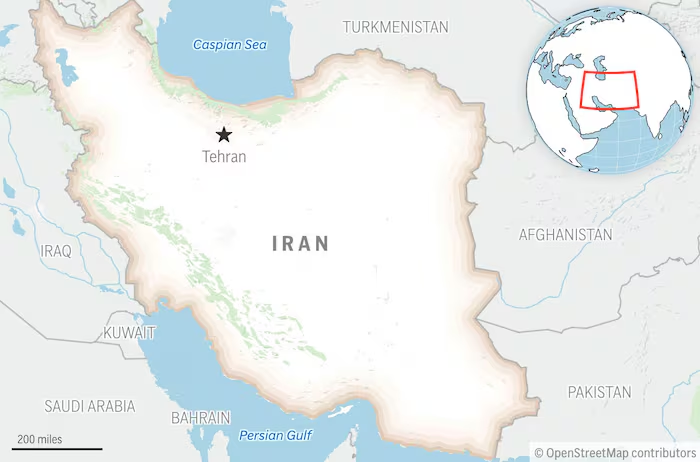
On March 5, as the U.S. and Israeli militaries hammered Iranian targets and Tehran launched attacks at Tel Aviv and Gulf countries that host American bases, an email blast emanated from a server located in China.
“We are deeply shocked and outraged by the aggression against Iran, and our hearts are with you,” read the message from Xiamen Victory Technology. The company offered to sell German-designed engines used to power one-way attack drones.
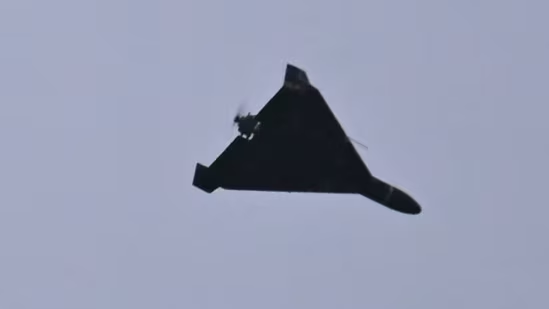
The U.S. has prohibited the sale of those engines, known as the Limbach L550, to Iran and Russia. It has been an important component in Iran’s Shahed-136 exploding drone, a version of which Russia has also been using extensively in Ukraine. Victory Technology featured an image of a Shahed-style drone on its website’s product page, alongside the slogan “Innovating Aviation Engine Solutions.”
The open wartime marketing by a small, obscure Chinese company points to a growing source of frustration for Washington: its struggle to staunch the flow of so-called dual-use goods—items with both civilian and military uses—to adversaries.
Chinese companies are shipping hundreds of containers filled with such goods to Russia and Iran, according to Chinese customs data. Items on the packing lists range from engines to computer chips, fiber-optic cables and gyroscopes. For a time, Chinese exporters intentionally mislabeled some shipments to skirt U.S. and European sanctions, but in many instances they no longer bother, according to former senior Treasury Department officials and weapons analysts.
The expanding trade marks one of the biggest challenges for American nonproliferation officials in the era of drone warfare. During the Cold War and for decades afterward, they focused intensely on nuclear weapons and ballistic missiles—high-tech instruments of mass destruction with rare components that were relatively straightforward to trace. Low-tech and disposable, drones are made almost entirely of common parts that easily enter and exit the swirl of global trade undetected.
China compounds the challenge. The U.S.’s biggest rival has long served as a clearinghouse for American and European-made components that could be diverted to drone factories in Iran and Russia, according to the former Treasury officials. Increasingly, they say, those components are being made inside China itself, often by small factories that don’t fear Western sanctions.
The email pitch from Victory Technology landed, apparently by accident, in the inbox of Iran Watch, part of the Wisconsin Project on Nuclear Arms Control that tracks Iranian weapons-proliferation networks. The group shared it with The Wall Street Journal.
“They’re out there actively trying to sell Limbach L550 engines to Iran—and doing it pretty brazenly,” said John Caves, a Wisconsin Project researcher.
The sender of the email, who identified himself as Kristoff Chen, said the company began selling engines earlier this year and hasn’t exported any to Iran or Russia. He didn’t comment on why he sent the email to Iran Watch.
Supplying the Shahed
The Shahed, Iran’s main attack drone, is one of the U.S.’s biggest worries. It can fly as far as 1,000 miles with an explosive warhead and costs $20,000 to $50,000 to produce, analysts estimate, making it essentially a cheaper alternative to cruise missiles.
The drones have proven effective at overwhelming or evading air defenses and striking targets. The U.S. recently developed its own copycat.
Early versions of the Shahed used in Ukraine were filled with microelectronics, servomotors to enable precise motion control, and other crucial parts manufactured in the U.S. and Europe, according to teardowns of drones recovered in Ukraine and the Middle East.
Investigations by the Treasury Department found virtually all of the American and European parts were being diverted through authorized distributors to retailers in mainland China or Hong Kong, which would then ship the parts to Iran or Russia.
Typically they were paid for via shell companies that are easy to set up in Hong Kong and help obscure the ultimate destination of the components.
In 2024, the department sanctioned a web of Hong Kong-based front companies associated with Hamed Dehghan, a Tehran-based trader whose company has been a key supplier to Iran’s drone and missile programs.
A year later, an entirely new network of Hong Kong companies were serving as fronts for his operation, leading to a new wave of sanctions.
“The Chinese turned a blind eye to that flow even as its role has been repeatedly exposed in public reporting and sanctions designations,” said Miad Maleki, a former Treasury official who oversaw sanctions programs at the Office of Foreign Assets Control. “They either don’t care or have chosen not to interfere.”
In a statement, China’s Foreign Ministry said it has consistently enforced restrictions on exports of dual-use items “in accordance with its own laws and regulations and its international obligations.”
Given the difficulties in interdicting components, U.S. officials say they are also trying to starve Tehran of funds by going after buyers and shippers of Iranian oil. “We are focused on the revenue because when we cut the head off the snake, that’s where we can do lasting damage,” a U.S. official said.
Recently, Russian and Iranian drone programs appear to be sourcing more of their parts directly from China, according to the former Treasury officials and industry analysts.
Conflict Armament Research, a U.K.-based group that investigates weapons trafficking, said it has noticed a “discernible increase” in the use of components produced by Chinese manufacturers in Shahed-style drones.
Meanwhile, Ukrainian military teardowns of Russian first-person-view quadcopter drones have uncovered large numbers of China-sourced parts.
Chinese customs data suggests local companies are increasingly willing to trade openly in drone-related components despite U.S. and European sanctions.
Chinese exports for fiber-optic cables spiked in the fall of 2024, shortly after Russia successfully used drones controlled via cable to resist Ukrainian signal jamming and retake the region of Kursk. They rose even more sharply after a Ukrainian attack on the city of Saransk in April 2025 knocked out Russia’s main domestic supplier of fiber-optic cables.
Exports of lithium-ion batteries to Russia also surged as the Russian military ramped up production of battery-powered quadcopters and have remained elevated since, official records show.
“There’s really no explanation that’s plausible other than this is being used for the military,” said Joseph Webster, a senior fellow at the Atlantic Council’s Global Energy Center who has been tracking the data. “It’s extremely blatant.”
Similar spikes in battery and fiber-optic cable exports to Iran appeared in July and August last year, immediately after Iran’s 12-day war with Israel. Iranian-backed militias used drones controlled via fiber-optic cable to take out a U.S. Black Hawk helicopter and air-defense radar system in Baghdad in March.
Cost analysis
Much of the recent trade in dual-use goods to Iran and Russia is driven by small, nimble Chinese companies that see an opportunity to capitalize on war-driven demand. Such firms rarely deal in dollars and therefore have little to fear from U.S. sanctions.
In the case of Victory Technology, the company’s website appeared online in late January, when the U.S. started building up military assets in the Middle East to confront Iran.
The address listed on the website is registered to Xiamen Weituo Keli, a hardware manufacturer established in 2016 that lists business interests spanning tea and tobacco production, kitchenware and industrial design.
Weituo Keli is controlled by Chen Shuixuan, a professor of engineering at Xiamen University of Technology who has been singled out by the local government for his innovative spirit. He owns or co-owns more than 100 patents related to vending-machine design and the use of lasers for cleaning industrial surfaces.
In his response to The Wall Street Journal, Victory Technology’s Kristoff Chen said the company was focused on selling its engines domestically for civilian drone uses. “They are not used in attack drones,” he wrote. “We kindly ask you do not make any false reports.”
The Victory Technology website is available in English, German, Russian and several other languages, but not Chinese. It features the L550 engine prominently in photos and a promotional video.
Another local company, Xiamen Limbach, was sanctioned by the U.S. in late 2024 for supplying the L550 to Russia for use in Shahed-type drones. Xiamen Limbach was also sanctioned by the European Union around the same time for sharing engine designs with entities involved in producing Shaheds. Its Chinese parent company also controls the German firm that originally developed the engine.
Xiamen Limbach didn’t respond to requests for comment.
The U.S. can’t fully stop the trade so its aim is to raise costs for Iran and Russia as much as possible, according to current and former officials.
Forcing them to rely on lower-quality Chinese parts is part of that effort, said Kerri Bitsoff, a former assistant director at OFAC who worked on nonproliferation. She pointed to reports of some Russian-made Shaheds falling out of the sky as evidence that the disruption campaign is having an effect on the battlefield.
The question is how American adversaries weigh trade-offs when wars increasingly favor quantity over quality.
“You have to do the cost analysis,” Bitsoff said. “Would I rather have 100 drones that can fly for two hours, than 50 that can go for 20?”
Write to Josh Chin at Josh.Chin@wsj.com and Austin Ramzy at austin.ramzy@wsj.com