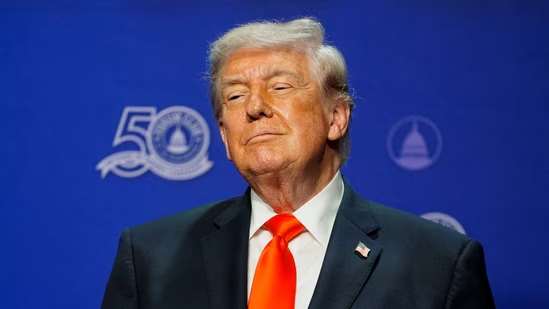
President Donald Trump’s health has been under scrutiny ever since a hoax spread that he was transported to Walter Reed Medical Center after a medical emergency. Though it was fake news, Trump’s recent comments and behavior have further escalated speculations about his health.
The 79-year-old posts at 3am. He calls himself “extraordinarily brilliant.” He threatens to “wipe out entire civilizations” before most people have had their morning coffee. He even shared an AI image of himself as Jesus and when asked why, he said it was because doctors make people better and so does he.
At this point, many people still see it as just “Trump being Trump”, but mental health experts say that repeated patterns like these are worth looking at more closely.
What are those 3am posts really telling us?
Trump’s social media doesn’t follow normal human hours. He’s deep in Truth Social late at night and back at it by 7am. The obvious question is that is the POTUS actually sleeping well? Martin Peters, a UK Registered Mental Health Professional and COO of Samarpan, thinks it deserves a serious answer.
Peters points to a specific condition that clinicians watch for in older patients, that is behavioral variant Frontotemporal Dementia or bvFTD. It is a form of dementia that doesn’t just affect memory. It changes who a person is, their personality, their judgement and their ability to restrain themselves socially. He also flagged potential sundowning, a pattern seen in dementia patients where agitation, confusion and restlessness get significantly worse as the day turns to night.
“His late-night posting does not equal sundowning,” Peters says, “but from a clinical perspective, repeated nocturnal agitation or impulsive communication would be a relevant observation.”
Trump is approaching 80. In that context, these are not trivial things to notice.
Also Read: Is Trump fit to lead? 25th amendment buzz grows as Trump’s ex-lawyer warns of mental decline; ‘governed by a madman’
Is he genuinely confident or is something else going on?
Trump has posted, without irony: “As everyone knows, I am an extraordinarily brilliant person.” He regularly calls himself a “stable genius.” His supporters see this as a self-belief. But psychologists see a pattern which is worth examining.
“Healthy confidence is usually flexible, reality-tested, open to correction, and not dependent on humiliating others,” Peters explains. “Grandiosity becomes concerning when self-belief becomes inflated, brittle, entitled, contemptuous of criticism, or disconnected from evidence.”
Peters says, this is not new. “Trump has a long history of grandiose and narcissistic behavior, noted also in his need to rename buildings after him, add images of him on currency notes and passports and rip up anything that has been done by someone who he feels may challenge his own narrative of himself.”
Calling himself a genius could be “political branding.” But psychologically, he adds, it can also reflect a need to reinforce superiority. And underneath all of it, Peters sees something surprisingly fragile. “There is a suggestion that he is extremely fragile around his own lack of education and acceptance with successful individuals. His interactions with the British Monarchy suggest a need for him to be accepted as an equal or to be respected, he appeared unable to see through the very nuanced and subtle speech by King Charles which challenged much of Trump’s behaviors.”
Also Read: Trump impeachment row: 28% chance that POTUS will be removed before 2028; Iran war haunting him
What was really behind that Jesus image?
In April, Trump posted an AI-generated image of himself styled in a Jesus-like role. It was deleted after immediate criticism. And what was his explanation that he posted to look like a doctor, “It’s supposed to be me as a doctor making people better” he said.
Peters finds this intriguing. “Leaders sometimes use religious or mythic imagery to present themselves as chosen, persecuted, heroic, redemptive, or larger than normal politics.”
“This kind of self-mythologizing is common among powerful political leaders, especially populist or authoritarian-style figures,” he added. This all comes under the same pattern as the ‘genius’ posts, the building renaming, his picture on passports, the grandiose statements, a consistent need to be seen as irreplaceable and beyond ordinary measure.
Swati Lalwani, Counselor and PGT Psychology also adds “Employing religious imagery attracts attention and evokes strong feelings. It fosters connections with certain groups and may lead followers to believe the leader possesses a higher calling. Sometimes, this is more about maintaining an image than genuine belief.”
It also reflects the same need to be seen as a healer, a fixer, an irreplaceable figure that runs through much of Trump’s public communication.
Also Read: Trump’s photo to appear on limited US passports; niece Mary Trump says she’s ‘relieved’ she renewed hers
Why does he go after everyone who questions him?
“Low IQ.” “Crazy.” “Traitor.” “Terrible reporter.” “Stupid person.” Trump’s attacks on journalists and critics are so routine they barely register anymore. But Peters thinks they reveal something important.
“His repeated use of insults may suggest emotional defensiveness, narcissistic injury, poor frustration tolerance, or a strategy of dominance. Emotionally reactive language can also be used deliberately to control a media cycle, intimidate critics, and signal strength to supporters.”
Peters says that the attacks are fiercest when Trump’s intelligence, education or status is being questioned, precisely the areas where he appears most exposed. The aggression in that moment is not confidence. It is protection.
Lalwani adds that “This typically suggests that they perceive themselves as being attacked and choose to retaliate instead of addressing the critique. It reflects a defensive nature and highlights challenges in dealing with criticism.”
Pattern Seen In Many Past World Leader
Trump’s language around Iran has included “a whole civilization will die tonight” and threats to destroy “every single power plant and every single bridge.” Peters sees this as both clinically and politically significant.
“Clinically, such language can reflect emotional intensity, impulsivity, dominance behavior, poor restraint, or threat escalation. Politically, it can also be performative, designed to frighten opponents, reassure supporters and project strength. The concern is when dramatic language appears reactive, disproportionate, repetitive, or poorly contained by advisers.” Peters also warns that power itself can make existing traits worse.
A leader no one pushes back against, gradually loses touch with reality. In someone with possible cognitive decline, that environment becomes genuinely dangerous.
Is a screening test enough for the most powerful man in the world?
The White House has declared Trump fit. His doctors have cited a perfect MoCA score, which is a standard cognitive screening test. Peters points out what the result doesn’t cover. “A MoCA is a screening tool, not a full neuropsychological assessment.”
There is a significant difference between a basic screen and a thorough, independent evaluation and right now, only one of those has been done. Notably, Congressman Jamie Raskin has formally called for a full transparent report and Trump’s physician has not responded.