
Lahore, In an attempt to break the deadlock over peace talks with the US, Iran has conveyed a “multi-layered proposal” to Washington, a senior official familiar with the development said on Sunday.
Although US President Donald Trump says he is still not satisfied with Iran’s new offer to end the Middle East conflict, Washington is unlikely to accept any framework that does not include firm guarantees preventing Tehran from developing nuclear weapons.
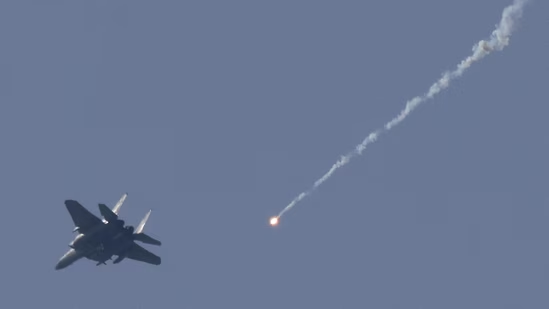
The Iran war, launched by the US and Israel on February 28, has been on hold since April 8, with one round of peace talks having taken place in Islamabad since then.
The Strait of Hormuz has been a major sticking point in the talks, with Iran proposing to reopen the key global oil shipping route as part of a ceasefire, while the US insists that any agreement must address Tehran’s nuclear programme.
The official told PTI that the fresh Iran proposal is a phased de-escalation framework, seeking to separate immediate conflict management from the more complex and long-standing dispute over Tehran’s nuclear programme.
“The first component of the plan focuses on urgent de-escalation measures. Iran has indicated willingness to ease tensions in and around the strategic Strait of Hormuz, provided Washington reciprocates by scaling back its military posture and easing economic pressure, including restrictions affecting Iranian oil exports,” he said.
Tehran views confidence-building steps as essential before entering substantive negotiations, the official believes.
“Secondly, Iran is seeking to decouple the restoration of maritime trade and oil flows from nuclear negotiations, arguing that economic normalisation should precede any binding commitments on its nuclear activities,” he said.
“On the third component, Tehran has signalled conditional flexibility on the nuclear front. While reaffirming its position on the right to peaceful nuclear energy, Iran has indicated openness to discussing limits on uranium enrichment and enhanced monitoring mechanisms – but only within a broader agreement that guarantees tangible sanctions relief.”
Another source said Iran is also seeking formal recognition of its nuclear rights under international frameworks, alongside assurances that any agreement would be durable and not subject to unilateral withdrawal.
“The proposal further includes demands for security guarantees, reflecting heightened concerns in Tehran over the risk of future military action,” he said and added that Iran has sought commitments that would prevent renewed strikes or escalation by the US or its regional allies.
Pakistan’s role has been described by officials as facilitative rather than substantive, with Islamabad relaying messages and exploring the possibility of hosting indirect talks.
While no formal talks have been scheduled, it is believed that both sides have not ruled out an Islamabad-hosted engagement if initial understandings are reached between the US and Iran.
“At this moment, I’m not satisfied with what they’re offering,” President Trump said in reaction to Iran’s fresh proposal. Asked why he was unsatisfied with the Iranian offer, he said: “They’re asking for things that I can’t agree.”
Trump was asked what he would do if there was no deal but refused to say whether he would launch more strikes.
“Do we want to go and just blast the hell out of them and finish them forever – or do we want to try and make a deal? I mean, those are the options,” he said and added that he would “prefer not” to launch a huge offensive.
Trump said Iran had “made strides in negotiations”, but added that there was “tremendous discord” in the Islamic Republic’s leadership and warned: “I’m not sure if they ever get there.”
Iranian authorities insist that their latest proposal placed priority on halting hostilities and creating space for a broader political process, before engaging on more contentious issues.
Responding to Trump’s remarks, Iran said that it is up to the US if it wants to pursue a negotiated settlement or return to war.
“Now the ball is in the United States’ court to choose the path of diplomacy or the continuation of a confrontational approach,” Iran’s Deputy Foreign Minister Kazem Gharibabadi said.
“Iran, with the aim of securing its national interests and security, is prepared for both paths,” he added.
Pakistan hosted the first round of direct talks between Iran and the US in Islamabad on April 11, but the two sides failed to reach an agreement to end the war.
Last week, Trump extended the two-week ceasefire with Iran indefinitely to give Tehran more time to prepare a unified proposal to end the war.
This article was generated from an automated news agency feed without modifications to text.