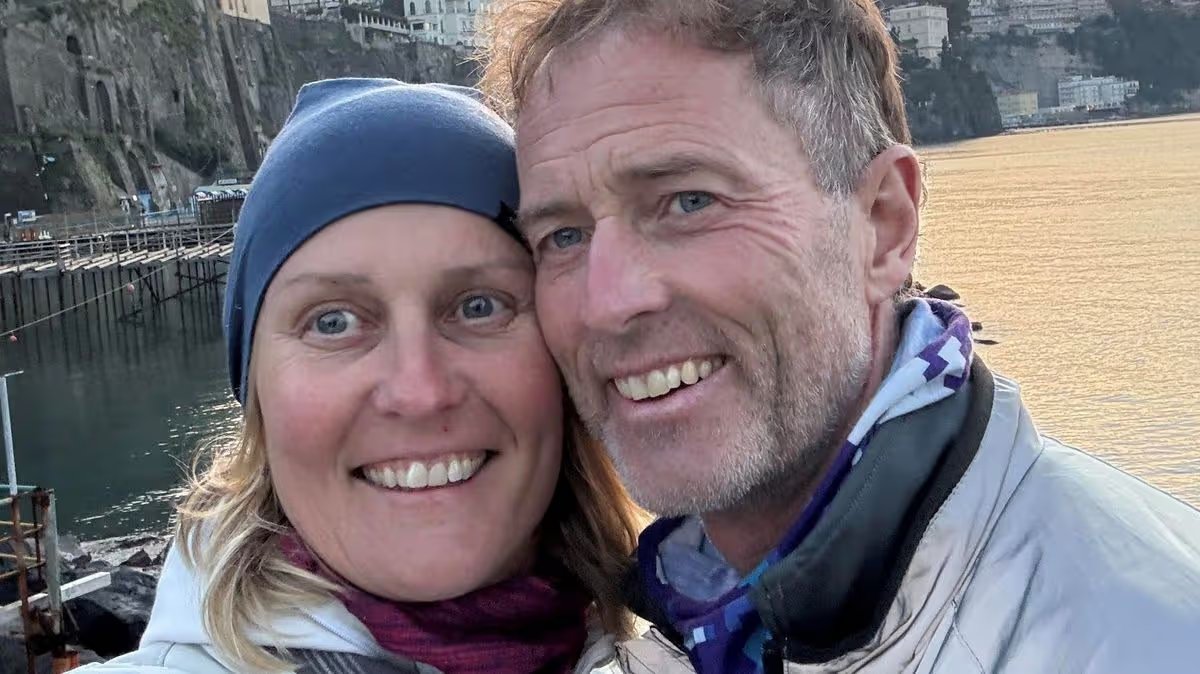
Lindsay and Craig Foreman, a British couple trapped in Iran’s notorious Evin Prison, have spoken out for the first time about their horror conditions in a heartbreaking interview
A British couple detained in a ‘horrific’ Iranian prison say they are ‘rotting away’ as they speak out from their cells for the first time. Lindsay and Craig Foreman, both 53 from East Sussex, are 15 months into a 10-year sentence in Tehran’s notorious Evin Prison. They were convicted of espigonage in a ‘sham trial’ on February 17, where they were not allowed a defence.
The pair were first arrested in January 2025 while they were on what was supposed to be the adventure of a lifetime, as they travelled across the world on motorbikes.
For months, their family had zero contact and no proof the couple were even still alive. Since then, Lindsay’s sons, Joe Bennett, 31, and Toby Rutland, 19, and Craig’s children Kieran, 27, and Chelsea Foreman, 30, have fiercely campaigned for their release.
READ MORE: Brit dad locked in Iran jail suffers ‘health emergency’ as son begs for release
Now Lindsay, a psychologist, and Craig, a carpenter, have described the harrowing conditions of their captivity in a joint interview. Speaking over a prison payphone patched through to Lindsay’s son Joe, the mum says she that doing laps around the prison yard is ‘keeping her sane’.
No one in her cell speaks English, and though her background in mental health work has given her tools to cope, there are moments where it all becomes too much to bear. Breaking down in tears over the “unfair” treatment of inmates, Lindsay told the BBC: “I’m dealing with the realisation that we’re likely to be here for a long time”.
Her partner Craig, locked up in a separate wing with other foreign nationals, can hear her distress through the speaker of another phone of Joe’s. “We can do this,” he said to Lindsay, jumping in to comfort her. “We will do this. We’ll get through it together and, sometime, I hope soon, we will be on the other side of these walls. So stay strong, my love.”
Last week, the Mirror revealed that Craig, who is suffering from an untreated tooth abscess, needs urgent medical treatment. He says fights regularly break out amongst inmates, who create their own handmade weapons, and that he is forced to try and stay out of the way of the frequent violence.
When the couple were first arrested, they were questioned in the city of Kerman, where they were kept in solitary confinement. During this time, Craig was blindfolded during extensive interrogations, which he calls a “horrific” experience.
Even more terrifyingly, four of his cellmates have been executed during his time in Evin Prison, led away, he says, under the false promise of a visit with their family and then killed. Craig says that day after each execution, he found out his cellmate was dead on prison television, when their faces appeared reporting the news.
According to the Center for Human Rights in Iran, (CHRI) “at least” 22 people have been executed in Iran in the last six weeks, in what they called an “extraordinary increase in the use of the death penalty as a political tool of repression”.
The CHRI says that ten of these executions were people detained during the uprisings against the Islamic Republic that swept across Iran early this year. They claim that many of the families and lawyers of the executed were not told about the death penalty beforehand, and that the killings took place in secret, often after “unfair trials” that rely upon “forced ‘confessions’ extracted under torture.”
Criminal psychologist Alex Iszatt tells the Mirror that mental torture is being used in cases like these on the population at large. “For the family, the suddenness is also a psychological weapon, a power play by the state. It reinforces their complete lack of control while simultaneously signalling that the same fate could happen to others.”
“This behaviour is a recognised tool of political terror, designed not only to break the individual’s sense of self but to project power outward,” Iszatt says. “The psychological suffering inflicted forms a central part of the punishment itself rather than an unintended consequence.”
Iran has been accused of holding the couple to use as bargaining chips with the West, with the Foreign Office calling the case “appalling” and advising Brits against travelling to the country. Last month, Minister Hamish Falconer said in Parliament: “This is a terrible case. It is absolutely obvious that they were innocent tourists. That is clear to all concerned. We have made that point repeatedly to the Iranian regime. We will continue to pursue this case. It is an injustice.”
Anoosheh Ashoori, a former Iranian hostage, gave the Mirror a “glimpse” of his “unbearable” experience inside Evin Prison, something that is still hard for him to discuss. “The food was foul and sub-standard, especially for those who couldn’t afford to pay for slightly better meals through the prison shop,” he said.
“The rooms were cramped – around 15 people per room, though numbers would rise significantly during times of crisis. We battled constant infestations of bed bugs, cockroaches, and even rats. Sometimes, rat droppings and body parts of cockroaches would even end up in our food.
“Sanitation was poor, especially during the COVID-19 pandemic. Medical care was severely lacking – the so-called clinic was little more than a façade. Medicine was scarce. Prisoners had to rely on loved ones to bring medications, and even then, some of it would mysteriously go missing before reaching us.”
Anoosheh, who was released alongside Nazanin Zaghari-Ratcliffe after he spent nearly five years in prison on false espionage charges, continued: “The regime created an environment of chronic pressure. Tensions ran so high that arguments and fights among prisoners became common. I call it ‘passive torture’ – a method of inflicting suffering indirectly by fostering an atmosphere where inmates, under extreme stress, begin to turn on each other.”
“I was fortunate that, after being moved from the interrogation centre to the main prison, I could call my wife Sherry almost every day. But during interrogation, communication is nearly impossible.
“You are completely at the mercy of your captors. If you’re allowed a short call, a guard stands beside you, dictating what you’re allowed to say – and warning you about what not to say. Every word is monitored.”
Lindsay’s son, Joe Bennett, 31, has given up his normal life and career to campaign for his mum and step-dad’s freedom full time. He told the Mirror it has been “incredibly difficult” amid the ongoing conflict between the US and Iran. “
“You are watching a conflict unfold, hearing reports of strikes near where your family is being held, and at the same time you are trying to stay composed and keep pushing for help,” he says. “There have been moments where it feels overwhelming, but we have never had the option to stop. Every day matters when people you love are in that situation, so we have just kept going.”
A spokesperson for the FCDO said: “Since Lindsay and Craig’s arrest last year, Britain’s Ambassador to Tehran, diplomats and officials in London have been working to provide consular assistance. This includes the ambassador visiting them in prison and facilitating calls with their family back in the UK.
“The Foreign Secretary last met the family on 17 March. She set out to them personally how unjustified and appalling their incarceration continues to be. The UK Government continues work to safely return Craig and Lindsay to the UK.”