Naim Aburaddi was homesick.
It was 2022, and it had been about seven years since he last saw Gaza. As a graduate student in media studies, cut off by a long siege on the enclave, home had become but a memory.
So as an intrepid observer of new media technologies, he discovered another way to get in.
Aburaddi sent a 360-degree camera to Gaza, where a local journalist friend took it to all the places he longed to see: the souks, the busy streets and squares of Gaza City, the 1000-year-old Turkish hamam, and the sea.
It took six months for the camera to reach Gaza. But once it did, the 360-degree experience became a kind of portal allowing him to bypass Israel’s grip on Gaza’s borders and return to his homeland, if only virtually.
CLICK FOLLOW: TO FOLLOW US
Sign up to get the latest insights and analysis on
Israel-Palestine, alongside Turkey Unpacked and other eSPORTY
The footage that returned made him weep.
Together with Ahlam Muhtaseb, a professor of media studies at California State University in San Bernardino, and the team of researchers at the X-Real Lab, they decided to expand his project.
They hired Ahmad Hasaballah, a videographer in Gaza, to capture more footage between July 2022 and July 2023.
The project evolved into a larger journey to give Palestinians living in the occupied West Bank and elsewhere around the world an opportunity to “experience” Gaza through a whole new set of technologies, including VR and augmented reality, collectively known as XR, or extended reality.
Generations of Palestinians forced from Gaza during the Nakba, after all, have never been able to return. Others outside the enclave only knew it through the lens of a jaundiced media.
The experience would offer, at least in theory, a fleeting moment to experience Gaza – a chance to immerse themselves in a place and space they have been deprived of seeing, and crucially, on their terms.
But then the events of 7 October 2023 took place. The Hamas-led attacks on southern Israel that day led to the subsequent war on Gaza, where over 72,000 Palestinians have been killed by Israeli attacks. Numerous human rights organisations, genocide scholars and the United Nations declared a genocide was happening in the besieged enclave.
Aburaddi watched as the same places – the mosques, the streets, the apartment buildings, the schools, the universities – the banalities of life as captured on 360-video began to crumble.
Hasaballah, their videographer, fled to the south of Gaza and the 360-degree camera got buried under the rubble during the genocide. His father was killed, too.
Stunned by the grotesque and inconceivable destruction to life, property and society in Gaza, the project wouldn’t launch until early 2024, when the duo snapped out of of a daze and realised they were in possession of the largest repository of 360-degree video from Gaza. It was a rare and invaluable archive of everyday life and cultural heritage; a time capsule that had survived the annihilation and acts of genocide.
“We had wanted to show the culture and the history. We never thought in our wildest dreams, in nightmares, that we were capturing history, and that everything we were creating and we were capturing was going to be like a memory,” Aburaddi, now a PhD candidate at the University of Colorado-Boulder, told Middle East Eye.
The project, he said, would function as a counter-claim to Israel’s effort to erase a people: that Gaza exists and its people remain.
Aburaddi named it, The Phoenix of Gaza XR.
“The people in Gaza, again, will be like a phoenix that will rise from under the rubble and they will rebuild Gaza again,” he said.

‘Confronting’ Palestinians
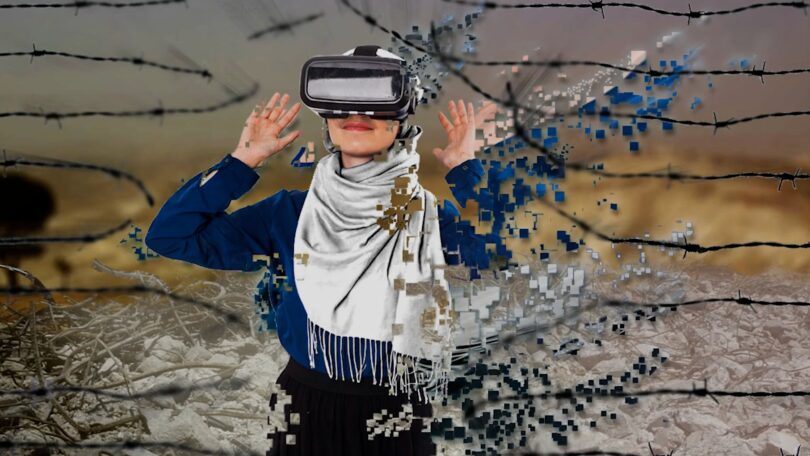
Over the past several weeks, the extraordinary exhibit has travelled to universities across the US, inviting visitors to wear VR headsets and immerse themselves in Gaza as it existed before the genocide.
Visitors are able to situate themselves in different parts of Gaza, such as standing aside as a skateboarder roars by in a refugee camp; taking a first-person tour of the Church of Saint Porphyrius (the third-oldest Greek Orthodox church in the world); marvelling at the Great Omari Mosque; or walking through one of the historic markets of Gaza City.
The XR experience allows visitors to tilt their gaze towards the sky, stand beside children as they paddle in the Mediterranean Sea, listen to the hum of daily traffic, or turn to study a sculpted figure inside a historic church behind them.
They are able to stand next to a young man as he harvests figs, grapes, or dates, or sit in a car as it zigzags along Al-Rashid Street by the beach.
The mix of immersive video and audio provides a sensory experience like no other.

In places where 360-degree photographs were taken instead of video, visitors are given a front-row seat at a mosque where two old men sit and read the Quran, while a young boy prepares to perform his ablution ritual at the water fountain.
By mid-October 2023, however, many of these sites were either destroyed or badly damaged.
The Church of Saint Porphyrius, for instance, became a site of refuge for hundreds of people from Israeli air strikes.
On 19 October 2023, Israel bombed the church, destroying much of the building and killing 18 Palestinians.
In the months that followed, the fate of those in the videos and photos would become unknown.
The exhibit’s unadulterated portrayal of Palestinian humanity, set against the backdrop of live-streamed carnage in Gaza, compels visitors to reckon with the images of everyday life in the besieged territory before October 2023 and the devastation that followed.
“It made me wonder how and what it would be like if we were in that situation,” a 19-year-old student, who visited the exhibit at Hunter College, told MEE.
It is this power of “confrontation” that Aburaddi hopes will function as a lever for social change for those who experience it.
But the project didn’t stop there.
Months into the genocide, the team reconvened, found a way to dig up the camera from under the rubble, and asked Yahya Sobeih, a local journalist in Gaza, to revisit some of the sites that they had captured the year before.
The IDA B Wells Data Lab at Princeton University came on board to support the project.
The exhibit now gives visitors the option to walk amidst the rubble and debris.
Shardi Marji, an activist in New York City, who helped take the exhibit to different venues, said the project had the potential to be the type of art that moves people to act. “You are transported to the place to bear witness to what was destroyed,” she told MEE.


Likewise, Ali Bashar, 26, who visited the exhibit in New York City, said he found the experience moving, even though he considered himself desensitised to the footage from Gaza.
Bashar said the immersive nature of the experience made it harder to look away or emotionally escape.
“I felt I could watch it over and over and still learn or see something new,” he told MEE.
Rebuilding Gaza
Conservative estimates suggest that more than 200,000 Palestinians have been either killed or injured in Israel’s genocide in Gaza.
As genocide scholars have long emphasised, the crime of genocide is not primarily about the scale of deaths, but the intention to annihilate and erase a history and culture.
This project offers a window into the scale of that intent.
“The magnitude of destruction in Gaza has prompted allegations of domicide, urbicide, scholasticide, medicide, cultural genocide, and ecocide,” UN special rapporteur Francesca Albanese wrote in her October 2024 report, Genocide as Colonial Erasure.
“As Israeli leaders promised, Gaza has been made unfit for human life,” Albanese added.


Muhtaseb, of California State University, San Bernardino, addressed a crowd of more than 100 visitors at Hunter College in New York City earlier this April.
She explained that the project – originally conceived to document Palestinian history, culture, and everyday joy as a counterpoint to portrayals of Gaza solely as a place of war and hardship – had become an act of resistance against erasure.
Muhtaseb choked up as she narrated how Sobeih, who captured much of the footage for the XR Project during the genocide, would himself be assassinated by Israel.
Sobeih was 32 years old when he was killed on 7 May 2025, as he sat in a restaurant celebrating the birth of his daughter, Sana.
He is one of around 270 journalists killed over the course of the genocide.
Months later, his wife, Amal, a photographer, insisted on joining the project to continue her late husband’s work.
![Yahya Sobeih was killed on 7 May 2025 in Gaza [Supplied]](https://www.middleeasteye.net/sites/default/files/Yayha.jpg)
Aburaddi said the project takes him back to why he wanted to study media in the first place: to challenge and push back at the tropes about his home.
As a young man growing up in Gaza – he lived in a one-room tent dwelling – he saw how the international media misrepresented his home and people.
In 2014, he moved to Turkey to study journalism and later, as a graduate student at California State University, San Bernardino, he studied how Palestinians were being represented in the media.
Now he hopes that the immersive, 360-degree footage could be helpful to lawyers investigating war crimes in Gaza, as well as to urban designers looking to build 3D models to support reconstruction efforts in Gaza, especially at sites of historical importance.
Amnesty International has already approached the XR team, while it is currently working with urban designers at Brown University and computer engineers at Boston University on the rebuilding process.
Since 2022, the project has reached audiences in Uganda, Italy, Canada, the Netherlands, Norway, and over 50 colleges and community spaces across the US.
The project recently toured several universities on the US’s East Coast in mid-April, stopping at Hunter College in New York, Brown University in Providence, and MIT in Boston.
Later in April, the Fisk Planetarium at the University of Colorado Boulder held a special viewing.
In June, it will travel to South Africa, and later Japan and Spain.
“Here we are preserving these memories. We are preserving them in virtual reality, in immersive media, where Israel cannot attack them, and a lot of people across the world can visit and access, and we are preserving this for the next generation,” he added.
“They were able to attack the locations, they were able to kill a lot of people, but they couldn’t kill the memory,” Aburaddi said.