WASHINGTON—How to protect the president in the event of a White House attack isn’t a topic the government typically wants to discuss in public, but Trump administration officials are offering an unusual window into national-security planning as part of their bid to save the construction of President Trump’s planned ballroom.
The administration, facing a legal challenge to the project, has argued for months that the ballroom is necessary to protect the president’s safety. But a public submission to an appeals court this month raised eyebrows among former national-security officials regarding its specificity.
In it, Army Secretary Dan Driscoll mapped out in detail how an underground bomb shelter would structurally withstand a precision drone strike on the White House. He also suggested that the president would be kept on-site in a bunker during a threat to national security instead of being evacuated.
“Securing this reinforced subterranean node is essential to ensure uninterrupted command and control in place,” Driscoll said in a court declaration. Relying on evacuation of the president to an off-site location during an attack or global crisis is “tactically flawed,” he said.
Some national-security experts said the amount of information the administration disclosed was surprising.
“None of this should be openly discussed,” said Bill Gage, a former Secret Service special agent who agrees the president needs a secure location to hold events. “I’m a little surprised this wasn’t filed under seal.”
One former high-level national-security official who worked across several recent administrations said the disclosures involved some of the most sensitive security information handled by the White House and could help adversaries formulate countermeasures.
White House spokesman Davis Ingle said: “While we don’t comment on sensitive or classified facilities in or around the White House complex, we can assure the American public that the East Wing Modernization Project will be equipped with world-class protection and security, as President Trump has said.”
The legal battle has taken on a new dimension since a suspected gunman tried Saturday to enter a hotel ballroom at which Trump, other top officials and more than 2,500 guests had gathered for the White House Correspondents’ Dinner. Though the event isn’t hosted by the White House, the administration quickly cited it in support of its security arguments.
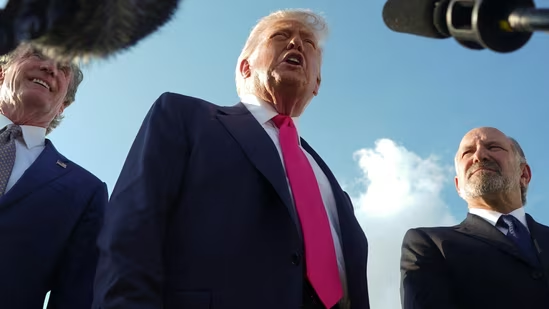
The incident “would never have happened with the Militarily Top Secret Ballroom currently under construction at the White House,” Trump said in a social-media post Sunday.
The administration tore down the White House’s East Wing in October to make way for a 90,000-square-foot ballroom that is expected to hold 1,000 people and eclipse the main building of the White House.
In late March, U.S. District Judge Richard Leon ruled Trump likely lacked the legal authority to build the ballroom without congressional approval and ordered aboveground work to stop. Leon later clarified that the administration could continue to work below ground on national security-related facilities. The government argued that wasn’t good enough.
“Together, the ballroom and secure facilities throughout the Project—including bomb shelters, a state-of-the-art hospital and medical facilities, military installations, and more—form a single integrated, complex unit that is vital for the national security of the United States,” the Justice Department told the U.S. Court of Appeals for the District of Columbia Circuit.
Shortly after the department submitted the filing with Driscoll’s declaration, the appeals court issued an order that allows construction to continue until at least early June while it decides whether Trump has the legal authority to build the ballroom, using private donations. Arguments are scheduled for June 5.
After Saturday’s dinner debacle, the administration filed a new request with Leon to end the litigation. Trump personally posted the legal submission online.
The ballroom litigation had already been top of mind for Trump, who repeatedly railed against Leon for blocking construction, saying the judge doesn’t want to accept a “GIFT to America.” Leon for his part said in one court order that he had “no desire or intention to be dragooned into the role of construction manager” but said “national security is not a blank check to proceed with otherwise unlawful activity.”
The bunker under the East Wing dates back to 1942, when Franklin D. Roosevelt added it after the attack on Pearl Harbor. Presidents including Trump have been whisked to it when there have been threats to national security and in times of civil unrest.
Vice President Dick Cheney helped direct the government’s response to the 9/11 attacks from the bunker while President George W. Bush, who was traveling at the time, was taken to a secure location. Trump was moved underground during his first administration in the midst of protests over police brutality after the killing of George Floyd in 2020.
There are secure alternative locations elsewhere in the country that the president can be moved to depending on the severity of a threat. Driscoll’s declaration suggested that option isn’t the best. He also said that “legacy campus infrastructure” wasn’t sufficient “as modern asymmetric threats have rapidly evolved.”
The ballroom, he said in technical language, would harden the East Wing and provide the physical layers to shield the bunker from a strike by an unmanned aircraft system with explosives.
“From a civil engineering perspective, this outer layer forces the detonation to occur at a designated distance, creating a critical air gap known as standoff or ‘attic depth,’” he wrote.
William Banks, a Syracuse University law professor who specializes in national-security matters, said one open question was whether the administration was divulging actual operational plans or instead searching for a winning legal justification for the construction.
“If it’s accurate, I think it borders on irresponsible,” he said.
Write to Lydia Wheeler at lydia.wheeler@wsj.com