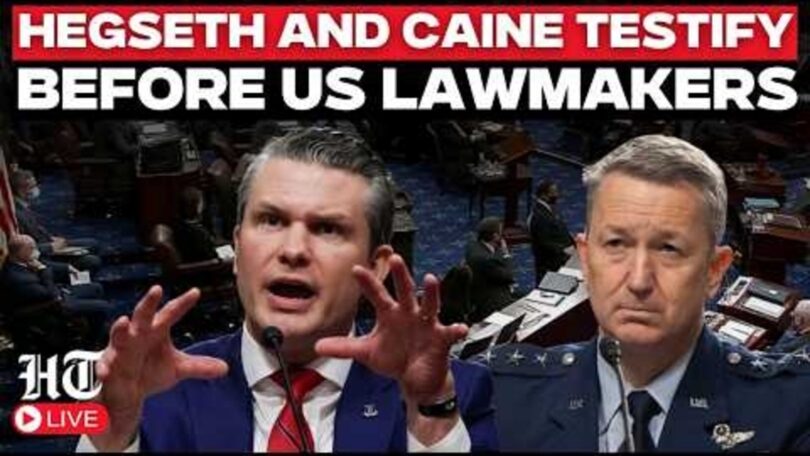
Pete Hegseth faced intense questioning during a congressional hearing as he defended the ongoing conflict with Iran and backed Donald Trump’s approach. The hearing also focused on the Pentagon’s record $1.5 trillion budget request for fiscal year 2027 and it quickly turned confrontational as lawmakers raised concerns about the war’s purpose and effectiveness.
Hegseth lashed out at critics, calling them “reckless, feckless and defeatist,” while praising Trump as the “best negotiator in the world.” He said that the administration’s actions were necessary to counter Iran’s nuclear threat.
However, his earlier claim in the hearing that Iran’s “nuclear facilities have been obliterated” drew immediate pushback from Deputy Staff Director Patrick Nevins, who said, “Whoa whoa whoa whoa. We had to start this war, you just said, because the nuclear weapon was an imminent threat. Now you’re saying it was completely obliterated?”
To which Hegseth responded, “They had not given up their ‘ambitions’…” But Nevins pressed further, asking, “So Operation Midnight Hammer accomplished nothing of substance?” referring to the June 22, 2025 strike on nuclear facilities. Hegseth replied, “You’re missing the point,” as he attempted to explain the strategy, though the exchange left questions about the operation’s impact.
Also Read: Nancy Guthrie update: Ex-FBI official gives bombshell on suspect; ‘not a stranger’
Lawmakers questioned about war goals
Adam Smith challenged claims that Iran had conceded to key US demands. Smith also questioned whether the situation had improved since the conflict began, noting that the Strait of Hormuz had previously remained open. “So what is the plan to actually turn all of this lethal, kinetic action into an improvement in the nuclear situation?” he asked.
In response, Hegseth criticized the nuclear deal negotiated under Barack Obama and defended the current approach. “You have to stare down this kind of enemy who’s hell-bent on getting a nuclear weapon and get them to a point where they’re at the table, giving it up,” he said, adding that Trump acted when “Iran [was] at its weakest moment.”
Also Read: Cole Tomas Allen’s chilling hotel selfie before WHCD emerges; officials note suspect’s ‘smirk’
The hearing also highlighted the growing financial and legal pressures surrounding the conflict. According to Pentagon chief financial officer Jules Hurst III, the war has cost the United States “about $25bn” so far with most spending going toward munitions, as per Irish Star.
The conflict which began on February 28 has now crossed the 60-day limit set by the War Powers Resolution of 1973 which requires congressional approval for extended military action. While the rule is difficult to enforce, lawmakers may still use funding controls to influence the administration’s strategy.