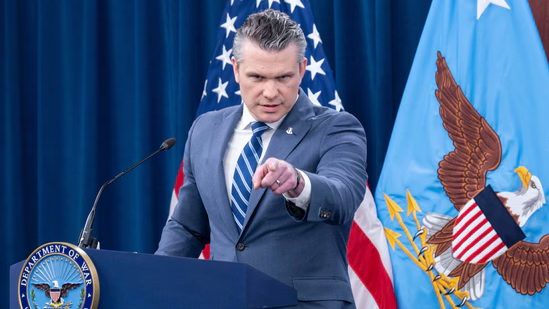
US Defense Secretary Pete Hegseth lashed out at critics of the Iran war during a congressional hearing, calling them “reckless, feckless and defeatist” as he defended Donald Trump’s strategy and took aim at lawmakers questioning the conflict.
Hegseth praised Trump as the “best negotiator in the world” before facing questions from members of Congress. Among the sharpest critics was Representative Adam Smith, who challenged claims that Iran had conceded to key US demands.
Smith pointed out that Tehran had publicly denied such assertions and argued that previous administrations had prevented Iran from acquiring nuclear weapons without resorting to war. He also raised concerns about the current trajectory, saying that the Strait of Hormuz had been open before the conflict began and questioning whether the situation had improved.
“So what is the plan to actually turn all of this lethal, kinetic action into an improvement in the nuclear situation?” Smith asked during the hearing.
Also Read: Pete Hegseth’s wife WHCD gown sparks political debate; Laura Loomer reacts
Nuclear ambitions
In response, Hegseth criticised the Iran nuclear deal negotiated under Barack Obama and defended the administration’s approach. He said the strategy was aimed at forcing Iran to fully abandon its nuclear ambitions.
“You have to stare down this kind of enemy who’s hell-bent on getting a nuclear weapon and get them to a point where they’re at the table, giving it up,” Hegseth said, adding that Trump had acted when “Iran [was] at its weakest moment.”
The hearing also revealed the financial scale of the conflict. Pentagon chief financial officer Jules Hurst III told lawmakers the war has cost approximately $25 billion so far, largely for munitions, amid reports the administration could seek significantly more funding.
Also Read: Did Kid Rock take Apache helicopter ride with Pete Hegseth at Fort Belvoir? New claim surfaces
A three-week ceasefire has helped reduce immediate costs, though rising global oil prices have pushed up fuel costs for US consumers.
The conflict, which began on February 28, has now crossed the 60-day threshold outlined in the War Powers Resolution of 1973, a limit that requires congressional approval for prolonged military engagement. However, the rule has historically been difficult to enforce, leaving Congress to rely on its control over funding to exert pressure.