STEP BY STEP, Emmanuel Macron has been executing what looks like a plan to protect France’s institutions in case the populist right wins next year’s presidential election. The president has named a new armed-forces chief (General Fabien Mandon) and head of the state auditor (Amélie de Montchalin). He is due soon to replace ambassadors to Berlin, London and Washington. François Villeroy de Galhau, governor of the Bank of France, has said he will step down ahead of schedule in June, letting Mr Macron appoint a successor to serve six years. Last year Mr Macron named Richard Ferrand, a political ally, as head of the Constitutional Council, the highest constitutional body (the president names three of its nine members, each for a nine-year term).
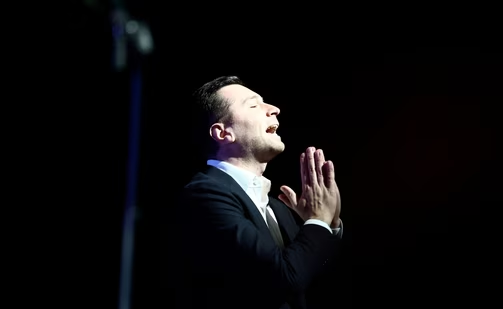
French far-right Rassemblement National RN party’s President Jordan Bardella gestures on stage during a party rally following the results of the first round of France’s 2026 municipal elections (AFP)
Already this effort has infuriated the populist-right National Rally (RN). Its leaders, Marine Le Pen and Jordan Bardella, top the polls for the first round of the presidential vote that is due in April 2027. Mr Macron, protested Mr Bardella, is “trying to lock down our institutions in order to keep control”.
If France’s president is worried about the potential for state capture, it is with good reason. Few European countries vest so many powers in the hands of the head of state. France’s president can send troops into battle, appoint the top general, press the nuclear button, name the prime minister, dissolve parliament, declare a state of emergency, pass decrees and pick the heads of public bodies. New rules constrain some of these powers. But they constitute an unusually formidable set of tools. Since Mr Macron cannot stand for a third consecutive term, the next person to wield them may be Ms Le Pen or Mr Bardella, whichever ends up as the RN candidate. Liberals fear they are populist strongmen in the making.
Securing nominations to key posts is one thing. Protecting entire institutions from democratic backsliding, however, is another. An illiberal crony state grew up in Hungary under Viktor Orban as the accumulated effect of technically legal changes, such as the naming of judges or the firing of bureaucrats. That is far harder to protect against.
Besides familiar worries about political nominations to the civil service and security apparatus, three areas of concern stand out in France. One is the potential use of the Fifth Republic’s constitution to challenge democratic norms. Article 16, for instance, gives the president the right to exercise “emergency powers” if the country is under “serious and immediate threat”. Since 1958, when the constitution took effect, this article has been invoked only once—by Charles de Gaulle, after an attempted putsch in 1961 during the Algerian war. But the precedent exists. Few European constitutions, says Benjamin Morel, a constitutional-law professor at Paris-Panthéon-Assas university, enshrine the right to exercise such sweeping powers.
Another is Article 11, which governs legally binding referendums. These can be used to pass legislation, but constitutional changes require parliamentary approval as well. Mr Bardella, though, says he wants to put “national priority”—the primacy of French law over European law—in migration policy to a referendum, without submitting it to parliament. This would in effect mean a breach of European treaties, and so require a constitutional change.
The constitutional council would be “the last rampart” against such a challenge, says a former member. Would it reject an attempt to modify the constitution via Article 11, made by a freshly elected president who campaigned on the issue? “In calm times,” says Mr Morel, “the French constitution is a marvellous instrument, but in difficult times it could be dangerous.”
A second area of concern is judicial independence. When a court last year barred Ms Le Pen from standing for public office over the misuse of European Parliament funds (a ruling she has appealed against), the RN leader denounced it as a “political decision” and deplored the “tyranny of the judges”. The language was Trumpian. Indeed Donald Trump called the ruling a “Witch Hunt against Marine Le Pen”.
France’s investigating magistrates are not too vulnerable: they are independent from the justice ministry and enjoy strong powers to conduct pre-trial investigations. They have successfully taken politicians to court, among them Nicolas Sarkozy, a former president. A hostile government could try to intimidate them, but as with judges, their nominations are protected by an independent council. Prosecutors, by contrast, report to the justice ministry and are appointed by the president on non-binding advice from the council. That creates clear potential to sway the system.
The third area is the media. Mr Bardella may have 2.3m followers on TikTok, but the RN is fixated on public-service broadcasting, which Ms Le Pen says has “a clear problem with neutrality”. Last autumn the populist-right UDR party, the RN’s main ally, set up a months-long parliamentary inquiry into the public broadcaster and its impartiality. Convinced of a left-wing bias, the RN wants to largely privatise it. The party is clearly happier with friendly private media outlets, notably those belonging to Vincent Bolloré, a right-wing business magnate who owns CNews, dubbed “France’s Fox News”.
Inside the public broadcaster, says a reporter, “we all have in mind the possibility of an RN victory and need to be extremely vigilant about freedom of expression.” Since 2013 an independent body, not the president, has named the services’ heads. The television head’s term runs until 2030. But that of radio is up for renewal in 2028.
RN figures deny any anti-democratic intent. The party is close to Mr Orban, but does not embrace his vision of “illiberal democracy”. Indeed the RN may even gain support by claiming that it is Mr Macron who is stitching things up before he leaves office in order to limit the party’s options in power. Despite weaknesses, France’s institutions are generally robust, as is its culture of protest and cross-party tradition of respect for the state.
Yet democratic backsliding in one of the European Union’s two biggest powers would have immense repercussions. Complacency would be unwise. The sobering lesson from Hungary and America is that if laws and institutions fail, norms are not enough to protect democracy.