THE BINHAI library, often called China’s most beautiful, is breathtaking. Swirling shelves of books rise in gravity-defying stacks to a high ceiling in a light-dappled room: a modern cathedral to learning. No wonder the library, in Tianjin, an eastern city, has become a favourite photo stop for glammed-up young folk posting to social media. But it does not take long in the library to see that there is less than meets the eye. Most of the books are just pictures of spines glued to the wall. And most of the visitors are glued to their phones, not perusing books.
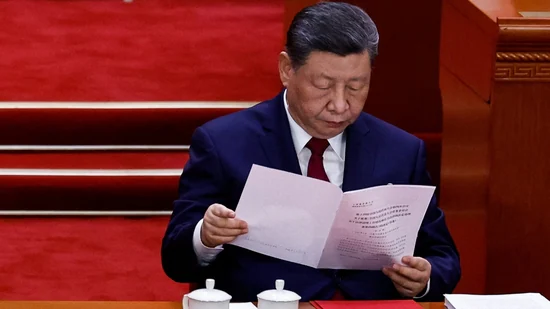
State media is full of discussions about how to get people to put down their phones and pick up a book. And Mr Xi has given it all his imprimatur. (REUTERS)
It is the perfect backdrop not just to photos but also to one of China’s new official obsessions: how to get people to read more, and to read more deeply. Since its founding, the Communist party of China has treated literacy as a core objective. For Mao, briefly a librarian before becoming a revolutionary, the motivation was decidedly not bookish: he wanted to build a proletariat conscious enough to overthrow its feudal overlords. Yet literacy campaigners can appreciate his results. He helped propel China from a literacy rate of less than 20% at the start of the People’s Republic in 1949 to about 60% at his death in 1976—and approaching 99% today.
Xi Jinping has revived the cause, with a twist. In February a new regulation that aims to promote reading went into effect. On April 26th the country concluded its first-ever national reading week. State media is full of discussions about how to get people to put down their phones and pick up a book. And Mr Xi has given it all his imprimatur. In the latest issue of Qiushi, the party’s leading theoretical journal, he pronounced on the value of reading and quoted a line attributed to Mao: “One can go a day without eating, a day without sleeping, but not a day without reading.”
Part of this is China’s response to a global phenomenon in the digital age. Chinese adults read on average 4.8 physical books a year, according to a national survey. Similar surveys have put American adults at about 13 books a year. Scepticism of that American figure is warranted, but Chinese reading of physical tomes is clearly down. On Chinese trains, planes and subways, it is rare to see anyone with a paperback. People do still look at text, just mostly on their phones. Wu Shulin of the Publishers Association of China has branded online reading as time-killing rather than knowledge-building—a gripe familiar to teachers and parents anywhere.
What makes the reading campaign unique to China is how it reveals two of Mr Xi’s preoccupations. The first is techno-nationalism, a belief that China’s future depends on mastery of the industries of tomorrow. In a widely circulated essay, Cui Haijiao of the Chinese Academy of Press and Publication argues that deep reading breeds innovation. Mr Xi himself has called for reading the classics to grasp why things are as they are. (For the most part China’s culture vultures encourage the perusal of international fare, and want everything from Tang poetry to Twain and Tolstoy appreciated.)
The second is Mr Xi’s veneration of traditional Chinese culture, in which reading is a core tenet of what it means to be Chinese. There is indeed much history to this. “In books there are houses made of gold,” reads a famous poem attributed to an emperor of a thousand years ago, a time when books in Europe were hand-copied parchments kept in monasteries. Mr Xi wants China to become a “cultural powerhouse” by 2035, and the revival of reading is one of its pillars.
How, then, to do it? Here, good intentions meet practical limits. The party knows it cannot simply force people to read. The new regulation is largely about fostering conditions that would encourage more reading. It urges officials to build better public reading-spaces, for instance. Yet it is easy enough to imagine cadres, ever glad of an excuse to pour concrete, putting up libraries and then losing interest. The Binhai library is a case in point: the newspaper-reading room offers a meagre selection, and by late afternoon had yet to even stock that day’s papers. The regulation gestures at supporting bricks-and-mortar bookshops but does little. One shop owner laments the absence of bolder measures, such as Japan’s fixed-price system, which prevents online discounting.
China’s marginalia
Any discussion of reading must also consider what is being read. The new regulation calls for the reading of more “good” books. Chaguan popped into a recent book fair in Tianjin to see what was selling. Many stalls were devoted to Chinese medicine, children’s gadgets and craft jewellery rather than books. One stall manager said people just do not want to spend money on literature—partly because there is so much to read online for free.
Indeed, some of China’s most original literature in recent decades has appeared online. Outsiders may assume that this reflects political censorship, and books critical of the party or unorthodox on history are indeed blocked from print. Some officials have learned to their personal cost the danger of such fare: reading of literature containing “serious political problems” has been cited as a reason in multiple purges in recent years. But more readers are almost certainly affected by crackdowns on unapproved, highly popular genres, especially danmei books, which depict male same-sex romance, and supernatural fiction. “If you want to publish in print, you have to cut or change things,” says a bookseller.
Another trend has been the rise of independent Chinese bookshops outside China. Jifeng, a liberal one, was forced to close in Shanghai in 2018 and re-opened in Washington, DC, in 2024. Causeway Bay Books, known for political contraband, moved from Hong Kong to Taipei in 2020 after five of its employees were arrested. Mainland intellectuals have also opened small independent bookshops in Tokyo, Chiang Mai, Amsterdam and beyond.
So, taking a wider lens, you can argue that Chinese reading is in decent shape, though mostly online and abroad. Absent from China’s new campaign for books are the things that would make it a truly valuable exercise: open publishing, diverse formats, intellectual risk. The party wants people to read more. It just does not want them to read too widely.
Subscribers to The Economist can sign up to our Opinion newsletter, which brings together the best of our leaders, columns, guest essays and reader correspondence.