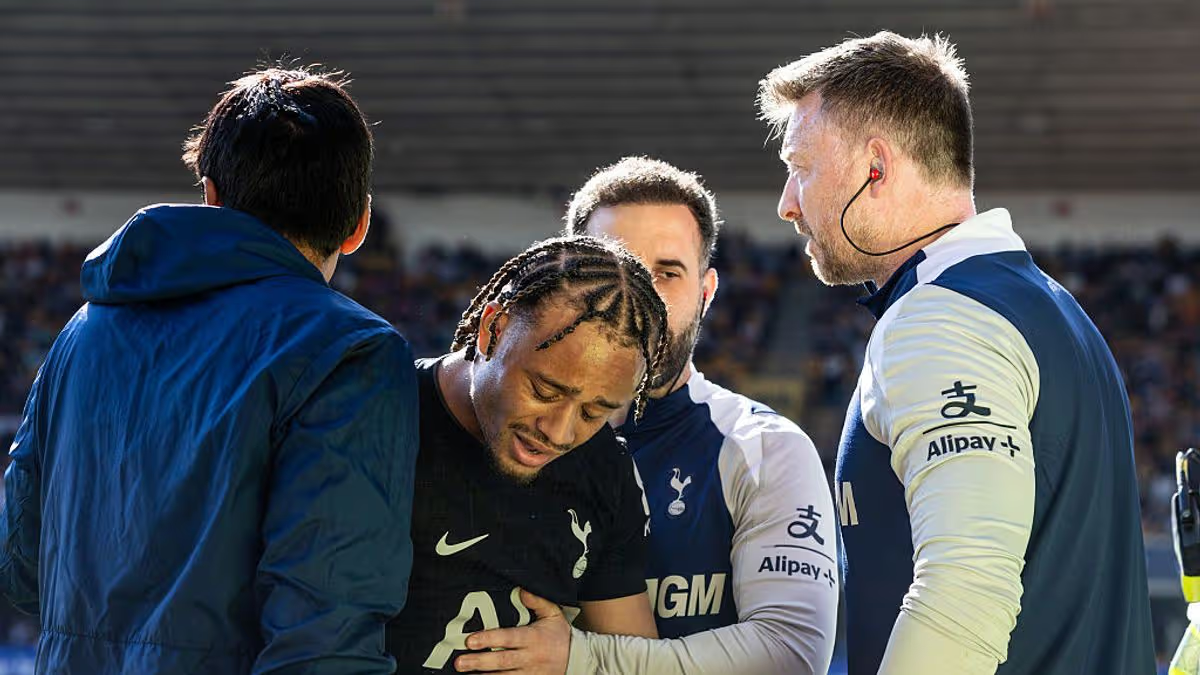
Xavi Simons’s ruptured Anterior Cruciate Ligament was Tottenham’s 36th separate injury of this disastrous season and parts of the Spurs fanbase have been scrutinising the role played by the medical staff during Saturday’s game.
Shortly after the 23-year-old midfielder fell to the ground, he climbed to his feet and attempted to run off the injury. Xavi collapsed in front of the Spurs medical staff and subsequently left the field on a stretcher.
Videos of this incident have been posted on social media by Spurs fans, with many joining in a debate over why their side have been dogged by serious injuries across consecutive seasons.
On Monday morning, the north Londoners confirmed that the Netherlands international will undergo surgery in the coming weeks before beginning a rehabilitation programme. Simons has become the fourth Tottenham player to rupture an Anterior Cruciate Ligament since the start of last year, and the seventh to suffer a knee injury during the same period.
This is the second successive season Tottenham have had a crippling injury list, spanning three different permanent managers and playing styles, under Ange Postecoglou, Thomas Frank and Robert De Zerbi – with a handful of matches under interim Igor Tudor as well.
Speaking to football.london, Ben Dinnery of PremierInjuries.com has broken down the numbers around Tottenham’s two seasons of injury woe and explained why there are multiple factors to consider.
FOLLOW OUR TOTTENHAM FB PAGE! Latest Spurs news, analysis and much more via our dedicated Facebook page
What is the key injury data?
Premier League – 2024/25
- Only Brighton chalked up more days lost to injuries (1944) than Tottenham (1553) in the Premier League.
- The Seagulls were also the only team to suffer more time-loss injuries (48) than Spurs (41).
Premier League – up until gameweek 32 of 2025/26
- Only Arsenal have suffered as many injuries as Tottenham (32). However, Spurs have since sustained five more, losing Cristian Romero, Destiny Udogie, Pape Matar Sarr, Dominic Solanke, and Simons to the treatment room.
- Of the 37 injuries this season, at least 22 were muscle injuries and strains or knee injuries.
- The Lilywhites have tallied more days lost due to injury (1278) than any other club; they’re closely followed by Newcastle United (1106) and Arsenal (974).
When quizzed on the social media criticism of Tottenham staff, injury analysis expert Dinnery said: “It’s something that’s always levied at the backroom team when we see high amount of incidents.
“Initially, when people see a high number of injuries, they instantly default back to the club’s medical staff.
“The reality of the situation is depending on the types of injury and depending on the mechanism of that injury, i.e. how it happened, it will have little or absolutely nothing to do with the medical staff. For the most part, they’re reactive.
“So, injury occurs, they are then passed on to physiotherapists and club doctors. It’s just people not really understanding the whole process.”
According to Premier Injuries, only Brighton chalked up more days lost to injuries (1944) than Tottenham (1553) in the Premier League last season. The Seagulls were also the only team to suffer more time-loss injuries (48) than Spurs (41).
Dinnery highlighted the case of Dejan Kulusevski, saying: “Long-term injuries, the road to recovery is rarely smooth and straight.”
The Tottenham midfielder suffered a complicated knee injury during a clash against Crystal Palace back in May 2025, and hasn’t featured since. Speaking to reporters ahead of the clash against Wolves, Roberto De Zerbi described Kulusevski as one of his ‘perfect players’.
“There will be peaks and troughs, setbacks along the way,” added the injury analysis expert. “Obviously, some injuries are a little bit more complicated than others.
“There’s definitely been a move away from sort of time-based recovery programmes. So, in the past, you may have seen things around, players with an ACL injury will look to maybe that 12-week mark for running. Now, it’s a lot more criterion-based, where they will look at certain activities, certain exercises for players to move and progress on to.”
Dinnery also pointed out that recovery time varies from player to player. He said: “It’s based on the individual, how their response is to that treatment and whether they suffer any reaction along the way. If all is well and they progress and they move and they get a green light, then they move on to the next stage of that recovery and rehab programme.
“If it’s not, if there’s an adverse reaction, they take a step back. So, we’re moving away from those sort of set-in-stone timelines. We have a good understanding of how long, in theory, these recovery timelines should take based on big data sets.
“But like I said, it’s down to the individual. The Kulusevski one was a fairly complex injury. And again, if you were to look at that, then people can look at maybe the James Madison one, if you want to think about those timelines.
“And based upon what we’ve seen across the Premier League over the last maybe 15 years, then James Madison has returned ahead of schedule. Around sort of two to three weeks [early].”
Maddison, who ruptured the anterior cruciate ligament in his right knee in the summer, has only recently returned to first-team action. The 29-year-old midfielder has been named in the matchday squad in each of Spurs’ last two Premier League games, but he’s yet to take to the field.
Dinnery continued: “I think Maddison has done maybe 250-ish days for an ACL recovery, whereas Premier League averages in the 270 to 280 range. There’s never one magic bullet that solves everything. They are typically multifactorial.
“There will be several influencing factors. And so to sort of generalise across the board is probably a little bit lazy and a little bit naive. If you’re going to start taking aim, then really you need to understand the types of injuries, where they occurred and how they occurred.
“And look at the likes of player loading, et cetera. Because, like I say, football ultimately still is a contact sport, so there are going to be injuries.
Dinnery added: ” Take Destiny Udogie. One of the biggest risk factors or predictors of injury risk is history, so you tend to see players who’ve had injuries in the past will be more susceptible and carry a significant risk of suffering injuries in the future.
“Dominic Solanke. He’s coming back as well off several injuries this season and getting himself back up to full fitness. Pape Sarr, that was a shoulder injury. The initial problem was done while on international duty.”
Managerial change can increase injuries
Last month, De Zerbi became the third head coach to take the hot seat at the Tottenham Hotspur Stadium this season.
In terms of playing styles and intensity, Tottenham have lurched between approaches, with Postecoglou’s high-press style frequently blamed last season as a key factor for muscle injuries.
There have also been changes behind the scenes with managers or head coaches bringing in their own backroom teams.
Dinnery said: “There was a body of research that was done with regards to managerial changes or the replacement of key staff within the clubs, and the impact that it would have on injury incidents and specifically they looked at hamstring injuries, and they did vary.
“Ultimately, there was an increase. How big that increase was would be dependent upon at what point the new head coach came on board, so Thomas Frank before the start of the season.
“Those [injury] numbers will grow further if those new coaches brought in new heads of fitness or performance or doctors, head of medical departments, etc.
“The obvious one for performance is the old ‘we need the players to work harder’ edict, so you’re talking about different methodologies, different philosophies, the physical demands placed upon the players, slightly different roles, all of those are considerations to make.
“Then, if you’re talking about [a change of] head of medical, head of performance, it just takes time to build up those relations as well with the players and understand where they are, their needs, and there needs to be that level of trust.
“So again, all of these things seem to be coming together to create that little bit of a perfect storm…”