WARNING SENSITIVE CONTENT: A British mother spent a whole week thinking her son was missing. When the police eventually tracked him down, they shared a devastating truth: her son, a talented chemistry teacher, had gone to an assisted dying clinic in secret
A British teacher told his mother that he was in Paris visiting a friend, when in reality he was in Switzerland preparing to die.
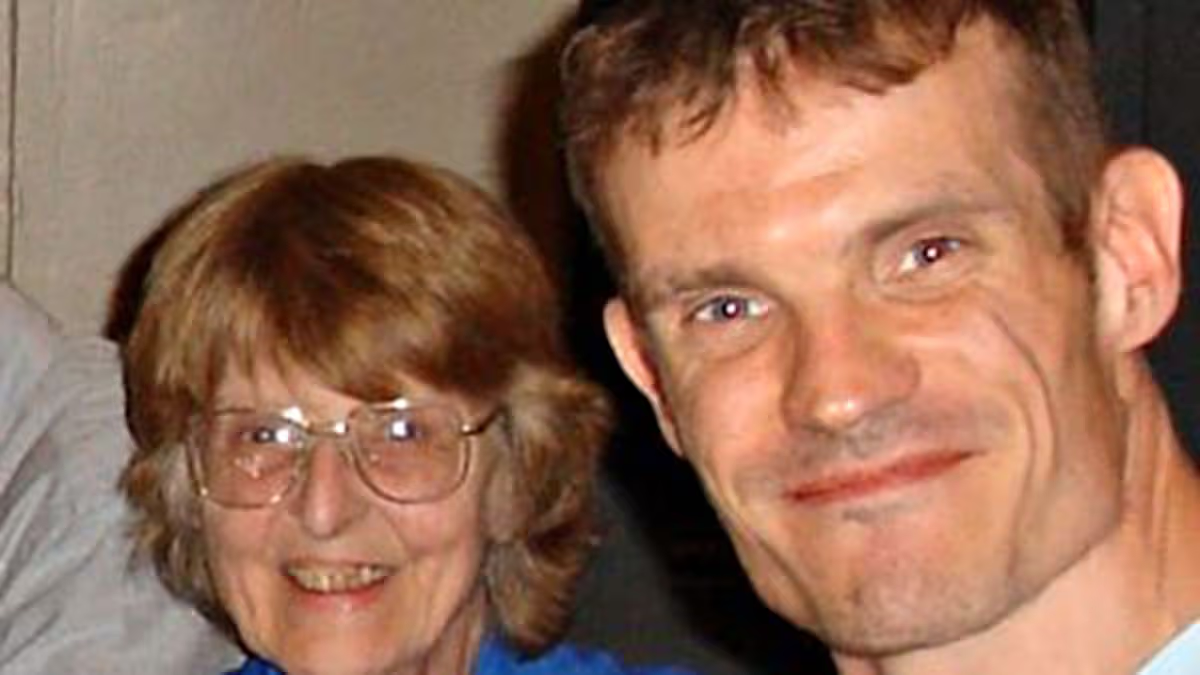
Judith Hamilton, 84, spoke to her son Alistair during his trip and even asked what his plans were in the French capital. She had no idea that the 47-year-old, a brilliantly clever chemistry teacher, had actually travelled to a suicide clinic in secret. It would turn out to be the last conversation they’d ever have.
Alistair, from Hampton, south west London, had been struggling with physical health issues but had no confirmed diagnosis before he died at Pegasos Clinic in Basel, Switzerland, 2023 – the very same place that Wendy Duffy – a healthy mum – ended her life last week. But unlike Wendy, he didn’t tell any of his family of his plans. And devastatingly, no-one at the clinic informed them either.
After Alastair’s calls and texts suddenly stopped, Judith spent a whole week agonising over her son’s whereabouts – and only found out about his death when she reported him missing to the police.
READ MORE: Wendy Duffy’s heartbreaking final requests before taking her own life at Swiss clinicREAD MORE: Healthy mum’s heartbreaking final acts before ending her life at Swiss clinic
Recalling her final conversations with her son, Judith, from London, told the Mirror: “He told me he was going to visit a friend in Paris and I spoke to him when he’d been there a couple of days. He said he was going to stay on for a couple more days and I was asking him where he’d visited. A few days went by and he didn’t reply to calls or text.
“We contacted the police and they found out from his bank records he’d actually gone to Pegasos. They had to get Swiss police involved, the British Embassy was involved, and Interpol. It was a nightmare for us to get any information.”
Pegasos’ own guidelines state that the clinic “requires that you inform your family at some point, even if you know that they will not be supportive.” But Judith says this procedure was not followed in Alastair’s case. The clinic claims they were told that Alistair’s friend had informed the family. They did not carry out any further checks to confirm whether or not this was the case.
As part of a 2024 investigation for ITV, Judith and her two sons Toby and Bradley travelled to the haunting industrial site where Alastair spent his final moments to confront the clinic. A Pegasos representative met the family and apologised, vowing that in the future, anyone arriving to die would be asked to contact their family in the clinic’s presence to confirm they were aware of their plans.
Pegasos told ITV: “We would like to tell the family once again that we are very sorry that our communication caused them further distress last year. We were not sure how to deal with the situation in terms of communication and legally and therefore did not act as we would today.” There is no suggestion of wrongdoing by Pegasos.
However, since that meeting, Judith claims she is aware of two other cases where individuals from the UK and Ireland have died at the clinic, without their families’ knowledge.
And Wendy’s assisted death – driven by the sudden loss of her 23-year-old son – has brought fresh “heartache” for Alastair’s distraught mum, who remains haunted by the goodbye she never got and questions the rules around healthy people being allowed to end their lives.
After Alastair’s death, she spoke with a “lovely lady” from Dignitas who, according to Judith, confirmed they would never have accepted Alastair because he was still mobile, social and undergoing medical investigations.
“It’s just such a heartbreaking scenario for these the families left behind,” says Judith. “I am nothing like the woman I was before he died. It’s just a permanent sadness in my heart and although I’ve got other children and grandchildren it doesn’t make up for the one that’s not here.”
“You just feel as if you could grab hold of them, hold them tight for two or three years – maybe their outlook on life would have changed. We were robbed of that chance.”
Alastair had been losing weight before his death, and was suffering from abdominal pain. Despite meeting numerous consultants, no cause had been found. It had a huge impact on him and he moved back home just months before travelling to Pegasos, after cutting down on how many days he worked.
The family were unable to get a post-mortem after his death to find out what had actually been wrong. Judith said: “His health was very important to him and the rapid decline had stopped him having the life that he enjoyed. He loved going to the gym and walking and things like that. That was his main joy, not having children of his own. I think he just I thought, ‘Well, I haven’t even got my house now, what have I got?'”
Reflecting on Wendy’s struggle, the mum adds: “It’s very sad. It was her only child. I mean I have other children and grandchildren, which she didn’t have. She just had that one beloved son. It seems she had a large family who loved her and cared for her, but I can understand her sadness.
“It doesn’t get any easier. I can understand Wendy’s depth of loss and emptiness now he’s gone – I just wonder if more support could have been given to people like her and my son.”
Last week, the Terminally Ill Adults (End of Life) Bill, fell without a vote in the House of Lords, following a similar rejection of legislation in Scotland last month.
While she agrees with the type of legislation discussed in Parliament, Judith is adamant that it should look “nothing like Pegasos.” While Alastair died on a grim industrial estate, the company has since moved to what Judith describes as a “beautiful place in the country.” Describing the estate, she said: “Oh God, what a place to be your last view of earth. In fact, it made me cry.”
Judith wants families to be told so they can have the chance to offer support. “If they’re in agreement with the loved one’s choice, then they can go there and sit by their side as they die. Or they can go there and persuade them to not go through it and bring them home again. We were robbed of that chance.”
“I have no arguments against Dignitas and their modus operandi,” she says. “Whereas with Pegasos, their selling point is: as long as you’re over 18, of sound mind and you can pay. That seemed to be their whole way of business,” she claims.
The clinic’s written requirements on their website are as follows: “While it is not necessary to be terminally ill to be accepted for a VAD at Pegasos, careful review is always required in order to accompany people on their last journey.” Their ethos statement praises “the ability to choose a gentle end of life is a human right that should be made truly accessible to all rational adults of sound mind.”
Questioning Pagasos’ new location, she continued: “This is supposed to be a non-profit-making organisation. Where did the money come from this beautiful building? It looks like a hotel with an annexe.” Pegasos charges an estimate of CHF10,000 (£9414.10) for assisted dying, which they say covers, “paperwork, consultations, the VAD appointment (including drugs), cremation, and the couriering of ashes.”
A representative from Pegasos told The Mirror this week that “the premises belong to the Pegasos Swiss Foundation and not Pegasos Swiss Association” and that the “foundation’s assets come from donations made by individual supporters.”
“We are aware that the right to die with dignity is still a controversial issue, and that some people have reservations about it. We deeply regret any distress caused to families and friends in the past.
“The Pegasos Swiss Association takes all allegations seriously. We firmly reject any insinuations of unlawful conduct. Our organisation and its staff have always acted in accordance with Swiss law and will continue to do so.
“We are very conscious of our great responsibility not only to our patients, but also their loved ones. Although there is no legal obligation according to Swiss law to do so, we always did our best to ensure that our patients inform their relatives of their plans to die.
“We had become aware of a few instances, where we had credible assurances by the patient that they had informed family members, when in fact they had not as it later turned out. We therefore made changes to our processes.”
Meanwhile Alistair Thompson, a spokesman for Care Not Killing, tells the Mirror he believes that the focus should be on getting better care for the dying so that they don’t feel forced to take matters into their own hands.
“What we should be doing is discussing how we can urgently improve care for those suffering, whether from a terminal disease or mental health illness such as depression. But the sad reality, are not doing this,” he said.
“The NHS is in crisis – one in four people who would benefit from palliative care aren’t getting it, while trying to access NHS counselling or psychiatry is virtually impossible in all but the most acute situations. We need to talk about how to sort out the lack of funding and getting more clinical staff into these services if we are to prevent more tragic cases. This is what we should be talking about. We need much more care, not killing.”
Dignitas has been contacted for comment.
For mental health support, contact the Samaritans on 116 123, email them at jo@samaritans.org or visit samaritans.org to find your nearest branch.