Coltin Stidham wanted to be a pilot, but his eyesight didn’t make the grade. Now, the high-school junior is training for another six-figure aviation job even more in demand.
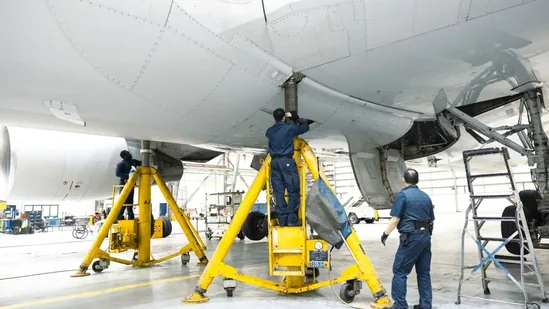
Inside an 8,500-square-foot hangar at Middletown Regional Airport in southern Ohio, the 17-year-old is learning to become an aircraft maintenance technician—a job that doesn’t require a college degree, is AI-proof and, within several years, can earn more than $100,000.
Plus, Stidham adds: “It’s pretty cool watching an airplane that you fixed fly out.”
If only the aviation industry could find more recruits like him. It’s running out of the people who keep planes flying safely and on time—the result of a ticking demographic time-bomb in the field.
More than 40% of America’s aviation mechanics are over 60 and fast approaching retirement, according to a report from Oliver Wyman management consultants and the Aviation Technician Education Council, or ATEC. And because airlines face a massive backlog of new plane orders, these air mechanics are maintaining some of the oldest passenger and cargo fleets in decades. That means the work is steadily mounting.
It’s a perfect storm that has made recruits like Stidham highly sought after. Next year, the labor shortage is projected to hit nearly 7,000 certificated mechanics in North America, 12% fewer than the industry actually needs, according to the industry report. That doesn’t include an estimated shortfall of 15,000 noncertificated maintenance personnel.
As a result of the squeeze, entry-level salaries have soared about 50% since 2020, says Anthony Sanzone, a director at Aerotek, a staffing firm that works in the aviation industry.
“We try to market it as a path to a six-figure career,” says Crystal Maguire, ATEC’s executive director.
Stidham still has another year to go at Middletown’s Butler Tech Aviation Center, a vocational high school. But he’s already passed an important exam needed for certification and has a verbal offer to complete his apprenticeship at nearby Air Transport Services Group after graduation. There he could start at $27 an hour, depending on the level of certifications he has under his belt by the time he graduates.
Knowing he’ll have a job lined up after school motivates him. But Stidham says he also likes the work. In class, he has practiced tearing down and rebuilding engines.
The shortage in aircraft maintenance technicians took root more than two decades ago. Airlines slowed hiring even before the global financial crisis, as they underwent restructurings and bankruptcies, says Brian Prentice, a partner in the transportation practice at Oliver Wyman. The shortage began to appear in the late 2010s; then, in the pandemic, many senior technicians were laid off or took voluntary retirements.
With the field’s looming wave of retirements, “even if we can replace them all one for one, we’re going to lose a lot of experience and skill,” Prentice says.
Major airlines, which have ramped up their own training programs, are the top employers of choice for many aircraft technicians. And carriers like United have offered signing bonuses of as much as $75,000 to recruit workers for harder-to-fill hubs in recent years.
At United, licensed entry-level technicians make about $81,000, says Magda Moiras, a managing director who oversees talent acquisition. After eight years, the wage tops out, and technicians make roughly $135,000 before overtime. She says the airline has a strong pipeline and staffing has stabilized.
Yet pay increases and other incentives have contributed to a Catch-22, the industry report found: Maintenance technician schools say the biggest challenge to expanding their programs is the inability to hire and retain instructors—who can get paid much more working in the industry instead of teaching.
Meanwhile, one-third of seats in U.S. aviation maintenance technician schools remain empty. Lack of awareness is one reason, the report found. So is the number of enrollees who drop out before completing an airframe-and-powerplant training program, which takes an average of 21 months.
Regional facilities that handle plane inspections and rebuilds feel the squeeze the most.
Some suppliers to GE Aerospace, for instance, are still recovering from the pandemic, limiting their ability to attract workers, says Christian Meisner, GE Aerospace’s chief human resources officer. (Through its foundation, GE Aerospace has pledged $30 million to workforce training, including funding for aviation maintenance instructors, as well as training equipment and student scholarships).
Duncan Aviation, which services private business jets from its locations in Nebraska, Michigan and Utah, says it is 10% short of the technicians it needs to grow. It has leaned into recruiting military veterans, which now make up 25% of its workforce, says Jeremy Rangel, the company’s vice president of aircraft services. Duncan Aviation, like other companies, pays workers while they go through its apprenticeship program and covers their testing costs.
Other employers are trying to improve the job’s work-life balance. AAR, an independent maintenance, repair and overhaul provider with global operations, rotates weekend shifts so technicians aren’t always working Saturdays and Sundays. Some of the company’s technicians have trained with augmented reality and others have learned about drone technology.
“You’ve got to make it cool to work in aviation,” says Tom Hoferer, AAR’s senior vice president of repair and engineering.
Mentorship helps, too. Kayler Randall, 25, got into the field through a robotics program at his high school in Oregon. But he wasn’t sure when his instructor suggested he might enjoy working with planes, too. “It seemed like a stretch to me,” he says.
He ended up at Portland Community College, where he was assigned a local technician from Horizon Air, a regional airline owned by Alaska Air Group, to help him study for his certification. Now Randall is at Horizon Air and mentors up-and-coming students himself.
“Some days I’ll be doing something simple like checking tire pressure or filling up the oil and other days, like today, they send me off to a different part of the country, a different airport to fix an airplane with a hydraulic leak on the engine,” he says. “Every day is something new, every day is something different.”
Write to Allison Pohle at allison.pohle@wsj.com