Hezbollah continues to resist the Israeli invasion while Lebanon’s official leadership moves towards negotiations with Israel, exposing two sharply opposed visions within the country.
Despite the 10-day ceasefire that came into effect on 16 April, Israeli forces have continued their operations, with Hezbollah maintaining its retaliation. Thirty-seven Israeli soldiers were wounded in 24 hours, and two were killed.
Israeli troops have drawn what they call a “yellow line” – described as a forward defensive perimeter – stretching from the Bekaa Valley to the coast and extending into Lebanese territorial waters. Within this buffer zone, which includes around 55 towns and villages, a systematic campaign of destruction is underway.
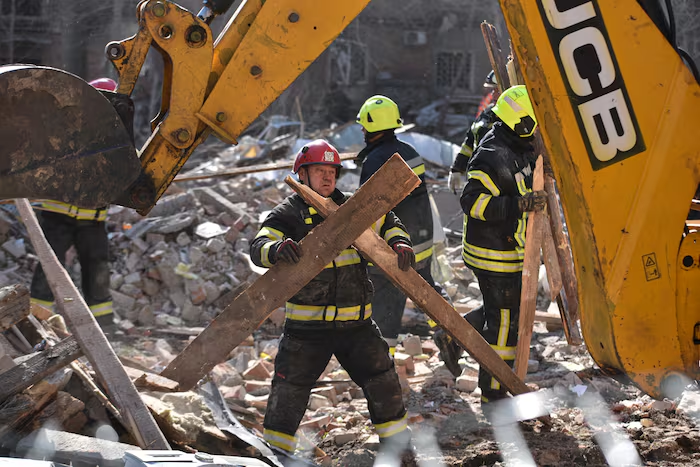
Over the weekend of 18-19 April, blasts from controlled demolitions echoed across southern Lebanon as dozens of military and privately contracted bulldozers razed entire neighbourhoods.
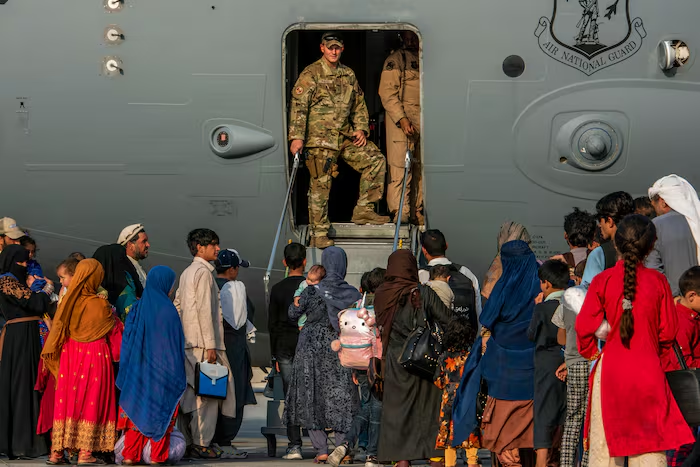
Amid this climate of insecurity, Hezbollah and the Lebanese army urged residents who had returned home after the announcement of the temporary ceasefire to leave again after checking their property. Heavy traffic was reported on roads heading north.
CLICK FOLLOW: TO FOLLOW US
Sign up to get the latest insights and analysis on
Israel-Palestine, alongside Turkey Unpacked and other eSPORTY
The ceasefire agreement, published by the US State Department, appears heavily skewed in Israel’s favour. It provides for a 10-day halt to hostilities, which began at midnight on 16 April.
Unequal terms
The text stipulates that Israel “shall preserve its right to take all necessary measures in self-defence, at any time, against planned, imminent, or ongoing attacks”, and that this right “shall not be impeded by the cessation of hostilities”.
Lebanon’s right to self-defence is not mentioned anywhere – a notable departure from the November 2024 agreement.
No document was submitted to the Lebanese Council of Ministers for review. Several sources in Beirut say the country’s leadership was not informed of the content and was presented with a fait accompli.
The announcement has triggered strong political backlash across Lebanon, with rival camps scrambling to claim ownership of the ceasefire.
Despite the scale of the damage…Lebanon’s leadership has not shifted course
The stakes are high. The official leadership, led by President Joseph Aoun and Prime Minister Nawaf Salam, has clearly opted to align Lebanon with US policy, seeking above all to deny Iran – and by extension Hezbollah – any diplomatic or military credit.
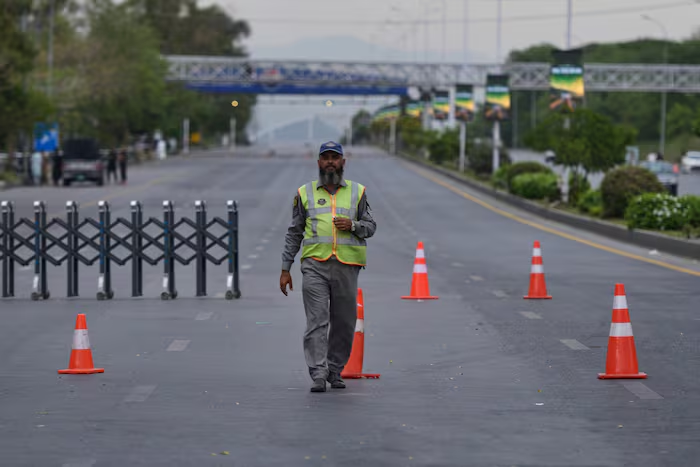
Iran, however, had explicitly set a ceasefire in Lebanon as a precondition for entering into renewed talks with the US in Islamabad.
“The resistance of Hezbollah to the Israeli invasion is probably one of the factors that accelerated the ceasefire,” said Qassem Qassir, a Lebanese researcher specialising in Islamist movements.
He added: “Iran also played a role in halting the hostilities, even if the Lebanese government and the United States do not want to credit the Islamic Republic with this outcome.”
It is precisely to avoid such attribution that US President Donald Trump himself announced the ceasefire and informed Aoun in a phone call on 16 April.
“The mere fact that Hezbollah accepted a ceasefire despite its reservations, and while some clauses of the agreement are unfavourable to it and benefit Israel, indicates that Iran had weight in the negotiations,” said Lebanese journalist and writer Sami Kleib.
Negotiating under fire
Despite the scale of the damage – more than one million displaced, nearly 5.8 percent of national territory occupied, and around 50 towns and villages systematically destroyed – Lebanon’s leadership has not shifted course.
Instead, it has pressed ahead, opting for direct negotiations with Israel while increasing pressure on Hezbollah.
That pressure peaked on 2 March, just hours after the outbreak of the war, when the government, convened in emergency session by Prime Minister Salam, declared illegal Hezbollah’s military activities.
This goes beyond a political rebuke. It is part of a broader effort to strip Hezbollah of its status as a “resistance” force and as a “defender of Lebanon against Israeli aggression”.

Lebanon: How Hezbollah is rising from the ashes
Read More »
In the eyes of the authorities, Hezbollah’s armed wing is now outside the law, even though the party holds two ministerial posts, commands a significant parliamentary bloc, and continues to enjoy substantial cross-sectarian support.
“Mr Aoun and Mr Salam have chosen to negotiate with Israel under fire because they believe it is the only option and that they lack leverage,” said Qassir.
“The president reportedly told someone who met him recently that, since Hezbollah was unable to do anything against the Israelis, the only remaining solution is negotiation. This policy has failed in the past.”
The authorities are invoking “constitutional and institutional legitimacy” to justify their position.
A Hezbollah source told Middle East Eye that he rejects the argument outright, describing negotiations with Israel as “illegitimate”, noting that “the Constitution and the Taif Agreement clearly consider Israel an enemy,” and that Lebanese law prohibits “any direct contact with Israelis and any normalisation with the Israeli state.”
According to the same source, “before entering into a negotiation process, the legal framework would first have to be amended. It is they – the leadership – who are in contradiction with the law, not Hezbollah.”
Popular legitimacy
Facing attempts to isolate it politically, Hezbollah is emphasising its “popular legitimacy”. In the 2022 elections, its candidates secured 370,000 votes, making it one of the most popular political forces in the country, while outperforming all Christian parties combined.
At this stage, there is no serious indication that the Shia community, or Hezbollah’s supporters in other communities, have distanced themselves from the group.
The prospect of a split between Hezbollah and Parliament speaker Nabih Berri also appears unlikely. The Amal movement remains engaged in defending southern Lebanon, and its rescue workers and paramedics have already paid a heavy price.
Amid this tension, Hezbollah MP Hassan Fadlallah has proposed holding a referendum on negotiations and any potential peace agreement with Israel.
Rather than fostering national unity, the war has deepened internal divisions.
In a televised address on 17 April, Aoun reaffirmed his position: “I am ready to go wherever necessary to liberate my land, protect my people and save my country,” he said, making clear he would not reconsider direct negotiations with Israel.
Without naming Hezbollah, he added: “To the reckless adventurers who gamble with Lebanon’s fate and the lives of the Lebanese, I say: enough. Only the project of the state is the strongest, the most durable and the safest for all.”
He also thanked the US and Saudi Arabia for their role in securing the ceasefire, making no mention of Iran.
Hezbollah secretary general Naim Qassem responded the following day, rejecting what he called “the humiliation of Lebanon through direct negotiations with the Zionist entity”.
He said his fighters would continue to respond to Israeli attacks and outlined five priorities: a complete halt to Israeli aggression across Lebanese territory; the withdrawal of Israeli forces from occupied areas up to the border; the release of prisoners; the return of displaced residents; and reconstruction with international and Arab support under national oversight.
The positions of the various actors appear irreconcilable.
Fragile equilibrium
The option of using force to disarm Hezbollah is now openly discussed within political circles.
According to informed sources, Prime Minister Salam asked army chief General Rodolphe Haykal during the 2 March cabinet meeting to enforce the decision declaring Hezbollah’s military activities illegal. Haykal refused, arguing that such a move would be inappropriate in wartime and beyond the army’s capacity.
According to a ministerial source, the exchange between Haykal and Salam was tense.
Experts warn that any attempt to disarm Hezbollah by force could fracture the army itself, whose ranks are roughly 35 percent Shia.
Meanwhile, the spectre of civil war is re-emerging in political discourse.
Two competing visions are emerging: Hezbollah claiming victory against Israel and rejecting any gratuitous concessions, and its critics who are determined to anchor Lebanon firmly within the western camp
“Fears of provocations and internal tensions are serious,” Qassir warned. “There is information from European sources that certain parties are sending weapons into Lebanon to incite Lebanese factions to fight each other, as the Israelis have failed to break Hezbollah militarily.”
“At this stage, the internal situation remains under the control of the Lebanese army,” he added. “However, things could deteriorate if the Lebanese government decides to use force against Hezbollah, as was hinted during the meeting in Washington between the Lebanese ambassador and her Israeli counterpart on 14 April.”
For his part, Kleib said that “no major actor currently appears willing to plunge the country back into civil war,” noting that such a scenario would require both internal alignment and substantial external backing – “two conditions that are not met at this stage”.
Wafic Safa, one of Hezbollah’s top political and security officials, has also dismissed the prospect of civil war. In an interview with the BBC on 17 April, he stressed that “a civil war requires two sides. The one that could wage it – Hezbollah – does not want it.”
While the scenario of a civil war appears unlikely at this stage, rising political and popular tensions are clearly palpable.
Two competing visions are emerging: Hezbollah claiming victory against Israel and rejecting any gratuitous concessions, and its critics, who are determined to anchor Lebanon firmly within the western camp.
“The standoff is set to intensify, with a risk of sporadic incidents. The country’s stability will depend largely on the ability of the Lebanese army and security forces to contain tensions,” said Kleib.
Much will depend, however, on whether the political leadership refrains from crossing a red line: deploying the army against a segment of its own population.
The views expressed in this article belong to the author and do not necessarily reflect the editorial policy of Middle East Eye.