
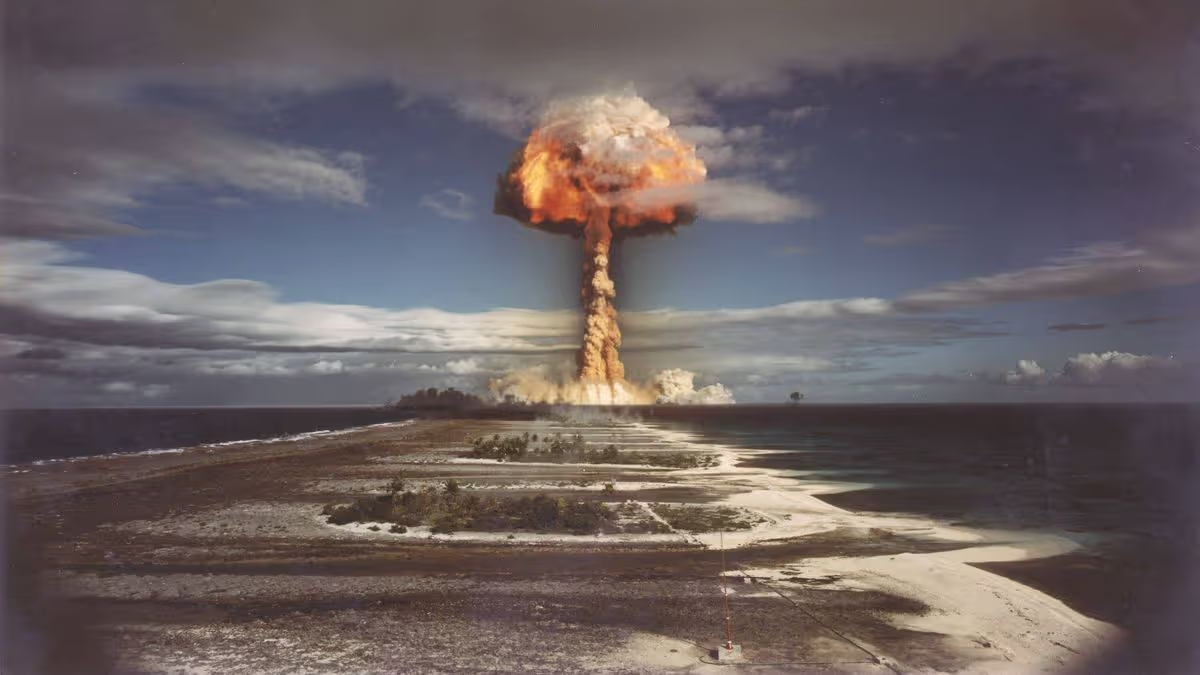
Rafael Grossi, the head of the UN’s atomic agency, has expressed concern over talk of ‘friendly nuclear proliferation’ in ‘a few important countries’
Leaders in six countries without nuclear weapons have openly discussed developing their own, as the head of the UN’s atomic agency warns the world is at risk of a fresh nuclear arms race.
Rafael Grossi, the director general of the International Atomic Energy Agency, expressed concern that some of the 191 signatories of the 1970 Nuclear Non-Proliferation Treaty (NPT) could begin breaching the pact, potentially triggering a “domino” effect in which as many as 20 states could pursue a bomb.
Officials in countries including Poland, South Korea and Japan have debated obtaining their own nuclear arsenal, while those in Turkey, Saudi Arabia and Sweden have openly said they may pursue nuclear weapons in the face of a destabilised world and the weakening of NATO.
Grossi told The Telegraph in an interview published this week: “There’s been a few important countries … in Europe, in Asia Minor, in the Far East that have mentioned [it] and where a public discussion is taking place about this possibility.
“There is talk about ‘friendly proliferation’. There are all these things which fill me with concern because I believe that a world with 20 nuclear weapon states or more would be extremely dangerous.”
READ MORE: Iran war live: Iran soldiers seen storming Hormuz ships despite Trump blockadeREAD MORE: North Korea dictator Kim Jong-Un in terrifying weapons threat to US and UK
He acknowledged that a nuclear arms race was his “worst fear”, telling the newspaper: “At some point, we are going to see a crack in the system. And then we’ll have a domino [effect]. It is a very, very fragile position.”
The US, Russia, the UK, France and China are the only five countries recognised by the NPT as nuclear-weapon states. Of the world’s more than 12,300 nuclear warheads, Russia holds 5459, the United States 5277 and the United Kingdom 225, according to the International Campaign to Abolish Nuclear Weapons.
Poland
Polish Prime Minister Donald Tusk suggested in March that his country will eventually try to obtain its own nuclear weapons. He said Poland would not be “passive” as it expands its nuclear energy capacity, adding that the country “takes nuclear security very seriously”.
Last year, Warsaw signed a treaty with France opening the door to Poland receiving potential protection from French nuclear missiles.
South Korea
As many as 76 per cent of South Koreans support developing a nuclear arsenal, according to a survey conducted in March 2025. This was highest level recorded since the Asan Institute for Policy Studies began its surveys in 2010.
Former president Yoon Suk-yeol said in 2023 that the country would consider it “if North Korean threats [became] more serious”.
However, Foreign Minister Cho Hyun said on April 1 that Seoul has no intention of pursuing nuclear weapons, saying his country’s commitment to non-proliferation is not a “legal constraint but a strategic choice”.
Japan
In December 2025, a senior Japanese security official suggested that Japan should acquire nuclear weapons amid a worsening security environment, Japan’s public broadcaster NHK reported. The unnamed official was described as being from Prime Minister Sanae Takaichi’s office.
Chief Cabinet Secretary Minoru Kihara later said that Japan’s nuclear policy has not changed, but declined to comment on the remarks or whether the official would keep their post.
While Japan is a key signatory to the NPT, the country has refused to sign the newer Treaty on the Prohibition of Nuclear Weapons (TPNW), which came into force in 2021, following a decades-long campaign aimed at preventing a repeat of the US atomic bombings of Hiroshima and Nagasaki at the end of World War 2.
Commenting on the decision, Chief Cabinet Secretary Yoshimasa Hayashi said in March 2025: “Under the severe security environment, nuclear deterrence is indispensable to defend the people’s lives and assets, as well as Japan’s sovereignty and peace.”
Turkey
Turkish Foreign Minister Hakan Fidan said in February that global developments could prompt Turkey to consider nuclear weapons.
Amid doubts among US allies in Europe and Asia over the reliability of US security guarantees and given Turkey’s geographical position, Ankara is concerned about a potential nuclear arms race in the Middle East, according to the Centre for Eastern Studies.
As many as 71 per cent of Turks support developing a nuclear programme, while only 18 per cent oppose it, according to a Research Istanbul poll conducted in July 2025 following Israel’s Twelve-Day War on Iran.
Saudi Arabia
The Saudi crown prince has repeatedly said that his country would seek to acquire a nuclear arsenal if Iran developed one.
Mohammed bin Salman told Fox News in September 2023: “We are concerned of any country getting a nuclear weapon,” adding that if Iran did successfully develop a weapon “we will have to get one”.
Prince Mohammed made a similar warning in 2018, telling CBS News: “Saudi Arabia does not want to acquire any nuclear bomb, but without a doubt if Iran developed a nuclear bomb, we will follow suit as soon as possible.”
Sweden
While Swedish Prime Minister Ulf Kristersson has ruled out having nuclear weapons stationed in Sweden in peacetime, he has said the situation could change if the country is dragged into war.
“If there were to be a war that somehow affected us, then it would be a completely different situation,” Kristersson said in late February during a visit to the French aircraft carrier Charles de Gaulle, which was visiting Sweden.
Asked about the possibility of his country hosting French nuclear arms, he said: “We have a clear doctrine in Sweden, which we most recently reiterated when we joined NATO. This states that we do not have permanent foreign troops or nuclear weapons stationed on Swedish soil in peacetime.”
But he added: “If there were to be a war that somehow affected us, then it would be a completely different situation.”