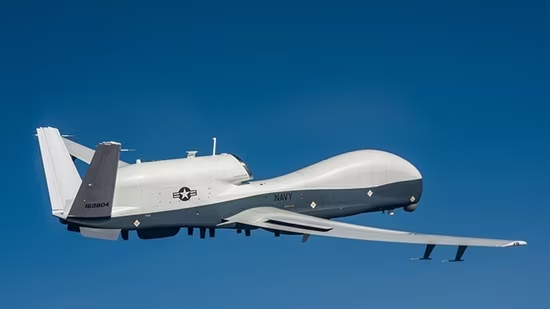
An MQ-4C Triton crash amid the Iran war has been confirmed through data from the United States Navy and publicly available flight logs.
The Naval Safety Command’s latest aviation mishaps report noted a Triton crash on April 9 but did not disclose the location, Axios reported.
The drone disappeared from flight-tracking platforms while operating near the Persian Gulf, as first reported by The War Zone. Data indicated it rapidly lost altitude shortly before vanishing from public tracking.
Also Read | MQ-4C Triton, US’ $200 million drone, vanishes over Hormuz after distress signal? What we know
What is happening?
At roughly $240 million a unit, the Northrop Grumman-made maritime surveillance drone ranks among the most expensive losses linked to the Iran conflict.
The large unmanned aircraft, with a wingspan of about 130 feet, can fly above 50,000 feet for over 24 hours.
It is also designed to operate alongside Boeing P-8 Poseidon aircraft, which are used for anti-submarine warfare.
A $200 million US Navy MQ-4C Triton surveillance drone has reportedly gone missing over the Strait of Hormuz, sparking speculation and raising unanswered questions.
Several social media users, citing open-source flight tracking data, claimed the high-altitude drone lost altitude rapidly after declaring an in-flight emergency and transmitting the universal “7700” distress code.
Some reports suggested it may have veered slightly toward Iranian airspace before descending sharply and disappearing from public tracking systems.
Follow here for live updates on US-Iran war
Online claims fueled
The incident had fueled online claims, with some users alleging that Iran may have shot down the aircraft. However, there was no official confirmation from the US military or Navy, and the exact circumstances surrounding the drone’s disappearance remain unclear.
The MQ-4C Triton is one of the most advanced and costly unmanned aerial vehicles operated by the US Navy, with each unit valued at over $200 million. Developed by Northrop Grumman, it is designed for high-altitude, long-endurance intelligence, surveillance and reconnaissance missions over maritime regions.
Derived from the RQ-4 Global Hawk, the Triton is built to operate for extended periods—often exceeding 24 hours—at altitudes above 50,000 feet. Its primary role is to monitor vast ocean areas, particularly critical chokepoints such as the Strait of Hormuz.