If a player’s status in the history of a major club were determined by personal statistics alone, then James Tavernier’s place in the pantheon of Rangers’ greats would be beyond dispute.
It’s certainly safe to say that in the 562 appearances, 144 goals and 148 assists the right-back has totted up since he was signed for just £200,000 from Wigan Athletic in 2015, Rangers have received plenty of bang for their buck.
Yet in the case of the 34-year-old who has announced he will be leaving Ibrox at the end of the season, those remarkable numbers can never tell the whole story.
For many observers, including some Rangers supporters, Tavernier’s 11 seasons in Glasgow are ultimately defined more by the amount of silverware he collected. By that metric, even the man himself would surely be forced to concede his time in Scottish football has not delivered all that he would have hoped for.
Most players, of course, would be thrilled to finish their careers with the complete set of domestic honours — Scottish Premiership, Scottish Cup, Scottish League Cup — on their CV. For a Rangers captain, which Tavernier has been for the last eight seasons, collecting just one winners’ medal in each of those competitions during that period of time has to be regarded as underwhelming.
During an era when Tavernier and his team-mates have largely failed to disrupt Celtic’s unprecedented dominance of the game in this country, the tag of serial loser has been an easy one for his critics to regularly lob in his direction.
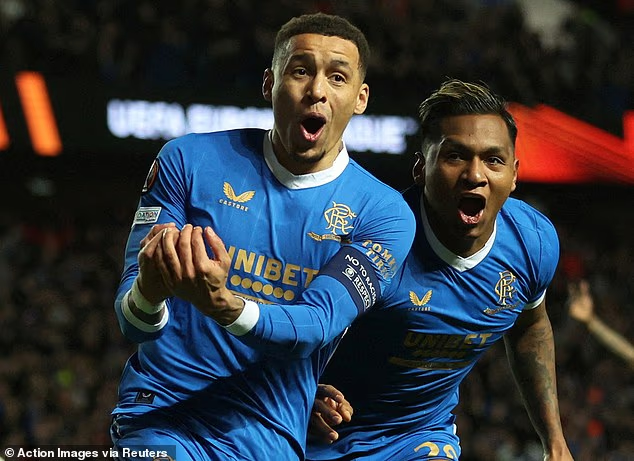
James Tavernier celebrates one of his 21 European goals for Rangers with Alfredo Morelos
It’s the harsh reality of life as the on-field leader for Rangers, even for someone like Tavernier who took on the role while the club was still very much in the process of recovery after its financial crash of 2012.
Tavernier arrived three years later, shortly after Dave King had seized control of the Ibrox boardroom, as one of Mark Warburton’s first signings. The then 23-year-old was a product of Leeds United’s youth academy before joining Newcastle United, where he managed just 10 senior appearances in five years.
Warburton, appointed as manager after Rangers’ journey back to the top flight of Scottish football had stalled when they failed to win promotion from the Championship at the first attempt, identified Tavernier as an athletic and attack-minded full-back who could hit the ground running at Ibrox.
He duly made a spectacular debut, scoring a stunning free-kick in a 6-2 win over Hibs at Easter Road in a first round Challenge Cup tie. It was a first indication of the exceptional set-piece prowess which Tavernier has repeated regularly ever since, whether from corners, free-kicks or penalties.
Rangers romped to the Championship title under Warburton and also lifted the Challenge Cup that season with Tavernier a durable and reliable performer who contributed 15 goals in 50 appearances.

Tavernier’s high point came with the club’s celebrated 55th league alongside Steven Gerrard
Yet it was a campaign which ended in dismay for Rangers, who wasted their good work in shocking Celtic in the semi-finals of the Scottish Cup by losing out to Hibs in the final at Hampden. It wouldn’t be the last time Tavernier found himself unable to get the job done when Rangers seemed to have major silverware within their grasp.
Rangers’ first season back in the top flight proved a chastening experience as they finished a distant third to a Celtic side whose monopoly of silverware was reinforced and taken to a whole new level by their appointment of Brendan Rodgers as manager.
For Tavernier, who scored just twice in 44 games, it was a brutal lesson in how challenging it would be to restore Rangers as credible and consistent rivals to their Old Firm foes.
A painful couple of years which saw Warburton’s dismissal, the hapless tenure of Pedro Caixinha and two caretaker stints by Graeme Murty as Rangers struggled to find their way was followed by the promise of greater stability and higher expectations when Steven Gerrard was named as manager in the summer of 2018.
The former Liverpool and England icon paid Tavernier the ultimate compliment by handing him the captain’s armband. The highlight of his first season in the role was creditable and valuable progress to the Europa League group stage, while Rangers mounted a more sustained title challenge before ultimately finishing nine points behind Celtic.

Tavernier came so close to becoming only the second Rangers captain to lift a European trophy
After Covid brought an abrupt end to the 2019-20 campaign, the success which Gerrard had been recruited to deliver was finally achieved in 2020-21. Undefeated in the Premiership, Rangers became Scottish champions for the first time since 2011 and, just as significantly in the eyes of their supporters, denied Celtic a record-breaking 10th consecutive domestic crown.
Tavernier enjoyed an exceptional season, scoring 19 goals in 46 appearances and being named Player of the Year by PFA Scotland.
Even as he celebrated the high point of his Rangers career, however, some critics sought to diminish a success which was delivered against the surreal backdrop of empty stadiums as Covid restrictions remained in place.
Tavernier and his team-mates, according to their detractors, had benefited from the lack of intensity and pressure caused by the absence of fans.
It’s a curious argument which ignores the fact all teams were playing under the same conditions but one which, due to the failure of Rangers to back up that title win since then, continues to have adherents.

Tavernier joined Rangers in 2015, helping them win the Championship alongside Kenny Miller
Gerrard’s own concerns over the club’s inability to build on that success saw him quit for Aston Villa three months into the 2021-22 season. Giovanni van Bronckhorst succeeded him and Tavernier remained a key figure as Rangers went on a memorable run to the Europa League final.
Some of his finest displays for Rangers have been on the continental stage. Tavernier made 109 European appearances for the club, scoring 21 goals. On that charge to Seville, he found the net in every knockout round tie as Borussia Dortmund, Red Star Belgrade, Braga and RB Leipzig were all seen off.
In the Ramon Sanchez Pizjuan Stadium on May 18, 2022, Rangers immortality was tantalisingly within reach for Tavernier. He was poised to become only the second man after John Greig, perhaps the most revered captain in the club’s history, to lead them to a European trophy success.
Tavernier did his bit on a sweltering night, scoring Rangers’ first penalty in the shoot-out after a 1-1 draw against Eintracht Frankfurt, but Aaron Ramsey’s fateful miss saw the German side claim the silverware.
The image of Tavernier’s bowed head after he collected his runners-up medal is one which perhaps best sums up the ‘what if?’ nature of his 11 years at Rangers.

Tavernier’s iconic ‘golf swing’ celebration will be a big miss to the Scottish game and Ibrox fans
A Scottish Cup final win over Hearts just days after that Seville disappointment and then a League Cup triumph against Aberdeen under Philippe Clement’s management in December 2023 saw Tavernier complete that set of domestic prizes.
He still has an opportunity to bow out on the highest possible note as we enter the final phase of a compelling three-way battle for this season’s Premiership title. If he is clutching the trophy after Rangers’ last game at Falkirk on May 16, then he will walk away from Ibrox with his head held high.
Will he do so as a club legend or underachiever? His legacy, it seems, will always be subject to debate.