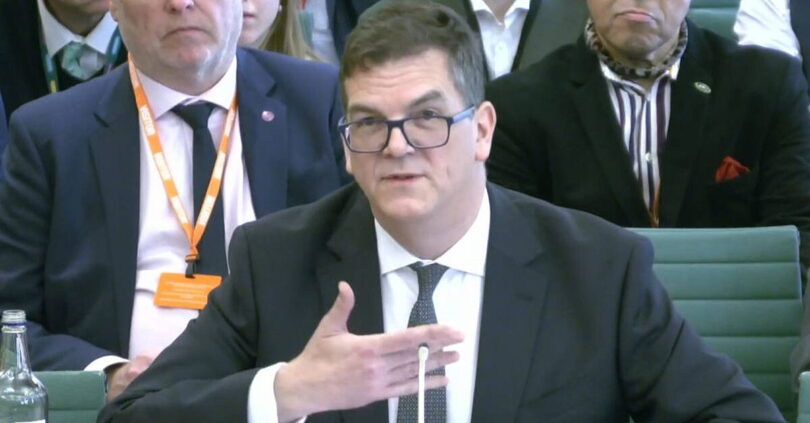
Former UK Foreign Office chief Olly Robbins said there was a “dismissive approach” to Peter Mandelson’s security vetting from No 10 with an “atmosphere of pressure” to get the appointment through.
Robbins was sacked by the UK prime minister last week for not disclosing Mandelson failed security checks but was granted developed vetting (DV) clearance anyway by the Foreign Office.
He insisted that only the final outcome of the vetting process – which was that Mandelson was granted security clearance – should be shared with ministers, rather than the concerns raised.
The Whitehall veteran said he does not “fully understand” the reasons why he was sacked and is “desperately sad” about it.
The initial announcement that Mandelson was being sent to Washington as UK ambassador was made before Robbins took up the role of permanent under-secretary at the Foreign Office in January 2025.
By that time the process of clearing the peer was already well under way – and there had been questions from the Cabinet Office about whether he needed to go through the formal vetting process at all.
When Robbins took over in the Foreign Office on January 20th, Mandelson had already gone through the Cabinet Office’s “due diligence” process, approval had been given by King Charles, the US had agreed to him, he was already allowed in the building and was being granted access to “highly classified briefings” on a case-by-case basis – without his security clearance being confirmed.
The former official said all those factors “resulted in a dismissive attitude to DV” from No 10 but “despite this atmosphere of pressure” he insisted the Foreign Office’s civil servants carried out the process as normal.
“I was very conscious that if we went through the rigour of our process and decided against granting clearance that would have caused a real problem for the Government and a problem for the country,” Robbins told the Foreign Affairs Committee.
“I was conscious of that without letting it influence my judgment, let alone transferring any of that atmosphere on to the people charged with actually making that assessment,” he added.
MPs on the Foreign Affairs Committee said UK Security Vetting (UKSV), the agency responsible for checks on candidates for sensitive posts, had ticked two red boxes on Mandelson’s form – meaning they had “high concern” and recommended “clearance denied or withdrawn”.
Robbins said he had never seen that form when making the decision on Mandelson’s clearance, but had instead been briefed by Foreign Office security staff that “UKSV considered Mandelson a borderline case and that they were leaning towards recommending that clearance be denied”.
He said he was told the risks in his case did not relate to Mandelson’s relationship with paedophile financier Jeffrey Epstein.
Robbins said: “I was told that UKSV acknowledged, I don’t know in what way, but acknowledged that the Foreign Office might wish to grant clearance with appropriate risk management.”
He told MPs:
– The normal vetting process was carried out only because the Foreign Office “put its foot down” after the Cabinet Office suggested Mandelson’s status as a member of the House of Lords and a privy counsellor meant that was unnecessary.
– Dropping Mandelson as the nominee for the Washington post would have caused “quite an issue” with Donald Trump’s incoming administration in January 2025.
– No 10 had considered trying to find an ambassadorial post for Starmer’s former communications chief Matthew Doyle.
During a two-and-a-half hour session in the Commons on Monday, Starmer said he challenged Robbins over why he went against the recommendation of UKSV after finding out about it last week.
“I did ask him and I didn’t accept his explanation,” Starmer said. “That’s why I sacked him.”
But Robbins insisted that the confidentiality of the vetting process was “designed to protect UK national security”.
Robbins received the formal letter confirming he had been fired on Monday and has “sought advice” on it, indicating there could be a legal battle to come.
He told MPs: “I don’t fully understand the reasons that I’m in the position I am in, but that is for a separate process for me to try to get to the bottom of.
“As a human being, I’m desperately, desperately sad about it.”
Tory leader Kemi Badenoch claimed Robbins’ evidence showed the prime minister had misled parliament.
“The evidence from Olly Robbins is devastating to Keir Starmer,” she said.
“It is clear that No 10 not only made the appointment before vetting was completed, but that Mandelson was already acting as the ambassador before the vetting – even seeing highly classified documents.
“With this, and the ‘constant pressure’ No 10 applied to the appointment and their ‘dismissive attitude’ to vetting Mandelson, it is now absolutely clear that full due process was not followed.
“Keir Starmer has misled the House.”