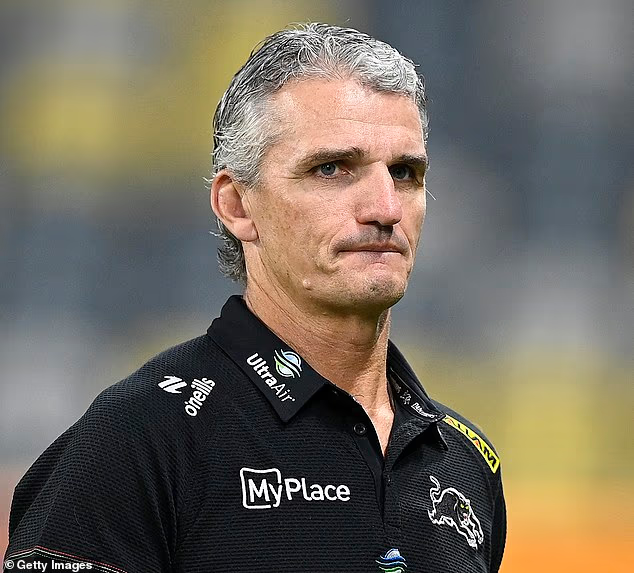
Penrith coach Ivan Cleary has described new guidelines designed to protect players from concussion at training as ‘dangerous’.
The NRL told all clubs at the start of the season that contact at training is to be capped in a bid to reduce injuries and concussions.
All 17 NRL clubs were told at the start of the season that players can’t engage in more than 100 minutes of contact on a seven-day turnaround.
For five and six-day turnarounds players can’t have more than 50 minutes of contact at training.
It includes wrestling sessions.
The NRL also told clubs to limit total contact training to no more than 200 minutes per week after Christmas, avoid high-intensity contact training on consecutive days and schedule no more than three consecutive days of contact training without a recovery day.
Ivan Cleary isn’t sure new protocols designed to protect players will actually do so

Players can’t engage in more than 100 minutes of contact at training between matches

The NRL has put many things in place in recent years to combat concussion
But Cleary, a four-time premiership winning coach, argued that contact at training was essential for player safety in games.
‘I think it’s a very dangerous thing to do because contact is a part of preparing and conditioning,’ Cleary said.
‘The more you absorb those types of collisions, the better you get at absorbing them.
‘If you take too much of the contact out of training then it’s just going to be a bit more violent on the weekends, I think, where players aren’t so used to it.’
Cleary admitted his club hasn’t ‘changed anything’ when it came to contact sessions in 2026.
He said clubs generally did most of their contact in the pre-season.
‘Once you start the season, you’re actually not going to do crazy levels of contact. It happens more in the pre-season when you have a lot of time and don’t play on the weekends,’ he said.
‘Over the years we’ve done more than we used to and I feel that our concussion rates have definitely gone down.’

Luke Keary has long called for a reduction in contact at training

CTE was found post-mortem in the brain of Rothmans medal winner Paul Green
Neurologists have been calling for the NRL and AFL to limit contact at training to protect players from concussions and sub-concussions.
World Rugby and the NFL have had similar limitations in place for several years.
The AFL has not implemented contact restrictions in training even though a coroner recommended they do so in 2023.
Former Roosters and Souths premiership winner Luke Keary previously called for the restrictions to have been put in place years ago.
‘We should have had less contact five years ago,’ Keary said in 2023.
‘They do it in the NFL. I don’t know how we haven’t done those studies and tests. I just don’t know how it hasn’t happened.’
The NRL is desperate to protect players from head knocks to avoid them getting chronic traumatic encephalopathy (CTE) later in life.
CTE is a progressive, degenerative and incurable brain disease linked to repeated head trauma, often seen in athletes who play contact sports.
Former Manly and Australian fullback Graham Eadie told Daily Mail last June about living with CTE.
‘It’s hard. It’s a thing that I’ve got to react to. You can have these problems when you play a game like that,’ he said.
‘It’s difficult to comprehend what happens to you in your later life after getting knocked around. Graeme Langlands was one bloke that had a problem and I know Wally (Lewis) has a bit of a problem.’
CTE has been found post-mortem in the brains of Paul Green and Steve Folkes.
The problem for the football codes is that CTE isn’t a result of players suffering heavy concussions.
Dr Rowena Mobbs, a neurologist and the founder and director of the Australian CTE Biobank, told Daily Mail it’s the sub-concussions players get, which have no symptoms, that are the issue.
Meanwhile, Penrith hooker Mitch Kenny underwent surgery on Tuesday after breaking his ankle in Friday’s win over the Dolphins. He’s expected to be out for 12 weeks.