A researcher who has devoted years to scanning a mysterious boat-shaped rock formation in Turkey believes he is closing in on proof that Noah’s Ark was real — and plans to send a robot into the tunnels he has found beneath it.
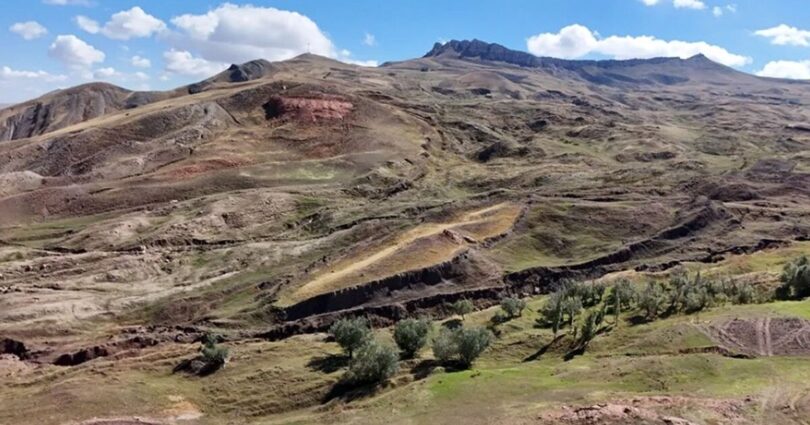
Andrew Jones, of Noah’s Ark Scans, has focused his work on a site high on Mount Ararat, where a curious formation first came to the attention of scientists in 1959. At roughly 6,500 feet altitude, the rocks take on the unmistakable outline of a vessel. When Jones measured the structure, it came in at 515 feet — a figure that aligns precisely with the dimensions laid out in Genesis chapter six, once converted from Egyptian cubits.
Fresh scans and soil analysis have now produced what Jones describes as “exciting” new results that he believes bring the biblical story closer to reality.
Using ground-penetrating radar, Jones and his team have mapped a network of subterranean passages running through the formation. Channels cut straight through the centre, others trace the inner edge of the ship-shaped outline, and all of them converge on a hollow space at the core that Jones has named the atrium.
According to a report, he drew a direct parallel with the biblical description of the Ark, which records three internal decks designed to house Noah, his family and the animals he was commanded to save.
“God told Noah to bring the animals in. And so these animals would have stayed there, plus Noah and his family. What’s interesting is that these voids are lining up below the ground – and they’re not just random,” Jones told GB News.
“These tunnels are also following a pattern. GPR is just a way to look below the soil using radar. There’s also been studies done with IRT, which is another geophysical technique – and they’re showing a ship-shaped hull still preserved deep in the soil.”
What the soil reveals
Working entirely without excavation, the team has gathered chemical evidence that the formation may not be a natural geological feature. Eighty-eight soil samples collected in 2024 from positions both inside and outside the ship-shaped boundary produced a striking contrast.
“What they showed was that the soil inside the ship shape had three times more organic matter than right outside, and 38 per cent more potassium.
“What that shows is that the soil is unique. And the grass, in the fall, it has a yellower colour just inside.”
Jones believes the explanation lies in the gradual decomposition of an ancient wooden structure. A timber vessel buried for millennia would break down entirely, but the process would leave a lasting imprint on the chemistry of the earth around it — and that, he argues, is precisely what the data is showing.
“It’s exactly the link given to the Bible. It’s 300 Egyptian cubits. For us, these are all positive lines that we’re pursuing, and it’s showing that there’s more to be found,” he said.
Shells on the mountaintop
Jones also cited the presence of marine fossils in the surrounding rocks as supporting evidence. Coral and shellfish remains discovered at that altitude point, he contends, to a time when the entire region was submerged — consistent with the biblical account of a worldwide flood.
Mainstream geology offers a different answer: the fossils reached their current elevation not through any flood but through the slow upward movement of tectonic plates over many millions of years, gradually pushing ancient seabed to mountainous heights.
Jones is not content to stop at surface-level scans. His next objective is to physically enter the tunnels and document what is inside them.
“We have a team that is designing a robotic remote-controlled device that could go down inside the holes and explore the tunnels,” he said. Perhaps like the famous children’s song, one day robots instead of animals will enter the site two-by-two.