
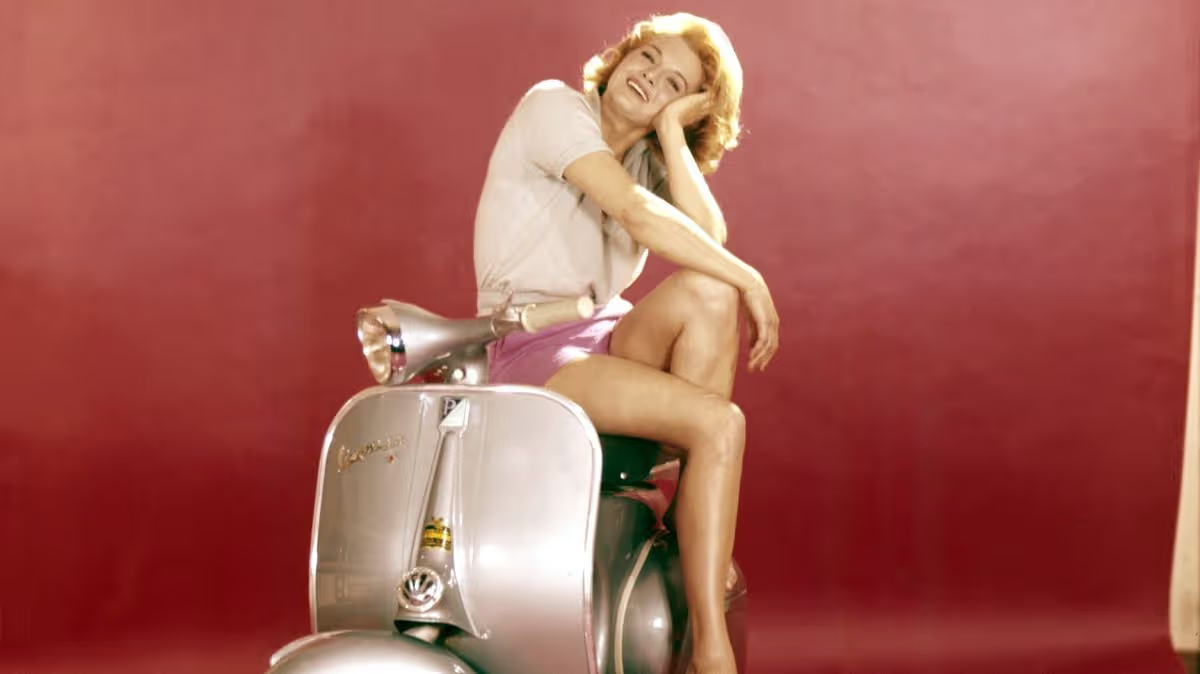
As Vespa turns 80 next week, the Italian scooter remains a design classic that refuses to go out of fashion. Not bad for a budget bike born out of the ruins of World War 2.
It was the movie moment that transformed a cheap motor scooter into a global style icon – and one of the world’s most enduring symbols of cool. Few can forget the sight of Audrey Hepburn – a runaway princess in the movie Roman Holiday – effortlessly gliding through the streets of Rome on a Vespa with Gregory Peck.
Hepburn won an Oscar for the 1953 film – but what most transfixed cinema goers was the sleek Italian machine the pair were riding. “That Oscar should have gone to the other ‘female star,’ Forbes magazine later wrote. “While Gregory Peck was courting Hepburn, the whole world fell in love with the metallic green Vespa 125.”
The iconic scenes meant the Vespa – originally conceived as a cheap and easy way to get around Rome’s bombed out roads – became instantly popular around the world. Over the next eight decades it remained one of youth culture’s coolest accessories, loved by everyone from movie stars to Mods and music legends. And as Vespa turns 80 next week, the Italian scooter remains a design classic that refuses to go out of fashion.
READ MORE: Driving my 19ft-long 1967 Cadillac in drizzly Britain was a Hollywood fantasy
Celebrations in June will see the Vespa back on the streets of Rome, when tens of thousands of ‘Vespisti’ – the affectionate name for Vespa owners – will recreate Hepburn and Peck’s two-wheeled adventures as they swarm around the Eternal City during “four days of partying”. Italian makers Piaggio will also be releasing 80th anniversary special editions, including the new Primavera (50cc/150cc) and GTS (Tech models), featuring a pastel green paint reminiscent of the original 1940s Vespa colour – bound to create a clamour among fans.
The first Vespa was unveiled in Rome on April 23, 1946, made at Piaggio’s Tuscany factory as a budget, low-powered alternative to the automobile, as Europe recovered from the Second World War. Piaggio was – and still is – an aircraft manufacturer, and Vespa’s designer, Corradino D’Ascanio, designed the world’s first helicopter. But with its bomber factory destroyed and aircraft production restricted by the Allies, the company had to think of another way to continue production.
Bill Jenkins, from the Auto Storia podcast, believes that was the secret to the Vespa’s success. “The Vespa’s design was directly influenced by Piaggio’s aviation background. Post-war Europe needed transportation that was reliable and affordable, and the Vespa fitted that need perfectly. They used a unibody design, rare for motorcycles back then. Most had separate frames and bodies but on the Vespa the body was the frame, like an airplane fuselage, strong and lightweight, perfect for navigating those post-war roads.”
When owner Enrico Piaggo first heard the distinctive buzzing of the bike’s engine he exclaimed, “Sembra una vespa!” – it resembles a wasp – and the name stuck. It nearly had a different animal name though. The prototype, known as the MP5, had originally been nicknamed ‘Paperino’ – the Italian for Donald Duck – but Piaggio asked D’Ascanio to rename it. Women, in particular, loved the design. As well as being cheap and reliable, the Vespa’s step-through frame meant that women could ride it in skirts, which its concealed engine kept oil, grease and dirt from chic Italian clothes.
The first Vespa sold 2,500 units in 1947, and more than 10,000 a year later. Following its appearance on Roman Holiday, though, sales skyrocketed, with estimates suggesting over 100,000 units were sold immediately after the film’s release. By 1960 two million scooters had been built, passing four million by 1970. By the mid-1950s demand was such that Vespas were being manufactured not just in Italy but also under licence in German, France, Spain and, in the UK, by Douglas in Bristol. Before long, the Vespa was everywhere. Famous owners included Ursula Andress, Louis Armstrong and Charlie Chaplin.
John Wayne and Marlon Brando were also pictured on them, as was Charlton Heston – in between takes while filming Ben Hur in 1959. Another Vespa enthusiast, artist Salvador Dali, added his own touches to his scooter in 1962, and his signature. Now on display at the Piaggio museum in Pontedera, it is thought to be the most valuable Vespa in existence.
Spanish holiday resort Benidorm may also owe its success to the mechanical wasp. In 1953 the town’s mayor, Pedro Zaragoza Orts, famously rode his Vespa all the way to Madrid to convince dictator Francisco Franco to support tourism, including allowing bikinis on beaches. Franco was charmed, and gave him the green light – transforming the small fishing village into a tourist hotspot.
In 1959 Piaggio came under the control of the Agnelli family, owners of Fiat, giving the company the financial muscle to survive the harder times of the late 1960s and early 1970s which saw another Italian scooter maker, Lambretta, go bust. In 1979, another film sparked a surge in Vespa’s popularity. Quadrophenia saw Sting, as Ace Face, riding a highly customised Vespa GS 160.
The cult classic triggered a Mod revival and saw sales soar in Britain, as scooter-riding Mods once again descended on seaside towns often ending up fighting Rockers on motorbikes. “The Vespa was perfect for them,” says Bill Jenkins. “Clean lines, easy to customise. It became more than just a scooter to them, it was a statement.”
Many more Hollywood appearances followed. Gene Kelly rode one in 1957’s The Happy Road, while Angie Dickinson helped cement its sexy image in the 1962 Sicilian romcom Jessica. Decades later, Matt Damon cruised the Amalfi coast in The Talented Mr. Ripley, and Alfie in 2004 saw Jude Law tearing through New York’s city streets on an old geared Vespa – although most of the Vespa scenes were actually filmed in Manchester, Liverpool and London.
The iconic scooter has also proved it’s not just for short city journeys. In 1951 Italian student Giancarlo Tironi rode his Vespa to the Arctic Circle. In 1953 Pierre Delliere, a Sergeant in the French Air Force, left Paris on his, travelling through Afghanistan and reaching Saigon in 51 days.
Italian journalist Giorgio Bettinelli spent years riding around the world on his Vespa PX, covering 160,000 miles and visiting 134 countries while writing books about his travels. His journeys included from Melbourne to Cape Town and Alaska to Tierra del Fuego – the southernmost tip of Chile.
The Vespa remains as popular as ever — synonymous with style icons from George Clooney and Gwyneth Paltrow to Sarah Jessica Parker and Mod legend Paul Weller. In 2024, the brand was valued at more than one billion euros for the first time in its history.
And this year, as it celebrates 80 years, Piaggio posted global sales of over 265,000 Vespas, and net profits of over 34million euros. Not bad for a budget bike born out of the ruins of World War 2.
READ MORE: ‘Grand Prix driver could feel his feet frying before he realised his car was on fire’