When we think about the Nuremberg Trials, it tends to be about stories of men. But many women played an absolutely vital role too, and a new book shines a light on their brilliance
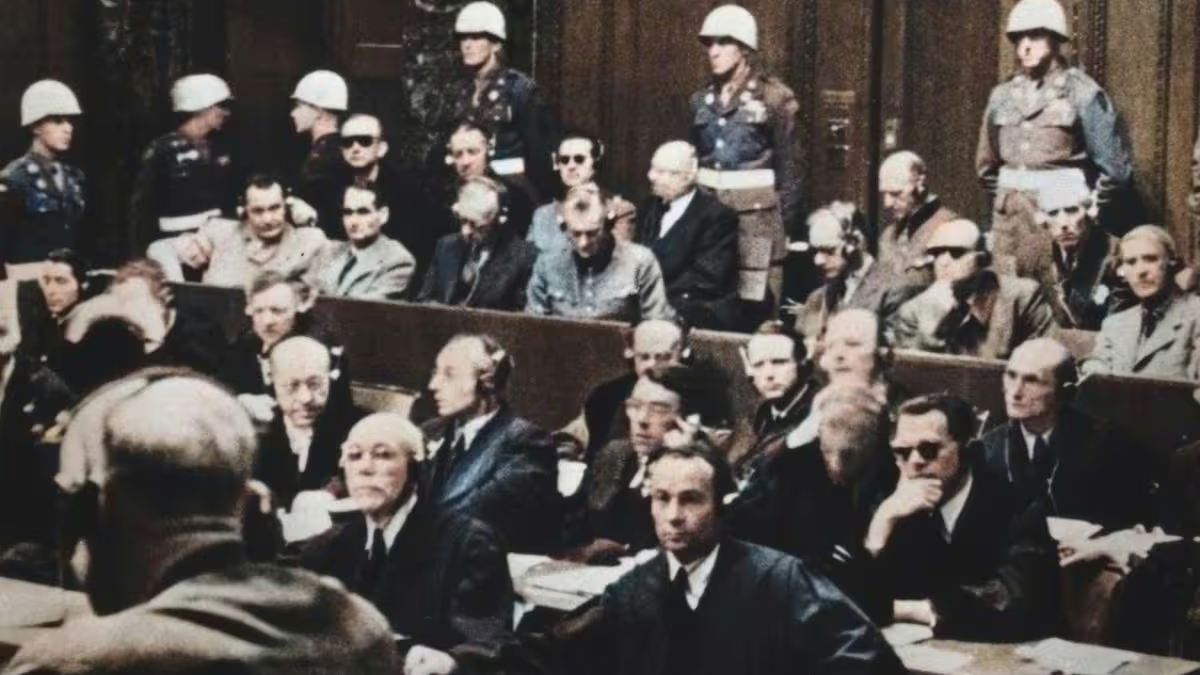
Dame Laura Knight’s famous painting of Courtroom 600 hangs in the Imperial War Museum – a chilling depiction of the Nuremberg Trials. The artist’s vision of the austere courtroom, where the Nazi leaders responsible for the Holocaust were tried for their despicable crimes, shows a sea of men. But the fact it was painted by a woman inspired historian Natalie Livingstone to uncover the stories of the women who played a pivotal role in the process that saw 199 defendants tried, 161 convicted, and 37 sentenced to death – including Hermann Goring, Hitler’s deputy.
Author of a new book, The Nuremberg Women, she says: “When we think about the Nuremberg trials, it’s a story about men, of men, for men, by men. Yet so many women were absolutely crucial.” A key player was Harriet Zetterberg, one of the most brilliant minds in the American legal team who put together the case that convicted Hans Frank, the Butcher of Poland. A high-ranking Nazi official, as Governor General of the occupied Polish territories during WWII, he was responsible for 4 million deaths of Polish civilians and Jews.
READ MORE: Titanic’s forgotten women revealed for first time – £1m gift to ‘missing’ star mystery
Mum-of-three Natalie, who lives in Notting Hill, west London, with her property developer husband Ian, 63, says: “She was utterly brilliant.” A highly trained lawyer, Harriet was the first woman to win the Yale Sterling scholarship. Natalie continues: “It was really hard to study law as a woman. The ratio was one woman to ten men.”
Yet, Harriet made it to Nuremberg and her 18-page dossier was integral to convicting Hans Frank. As a woman, however, she was not permitted to advocate in court. And Natalie, only found out about her after spotting Harriet’s name in a footnote in the memoir of a male judge.
After unravelling her story, Natalie says: “If she’d wanted to advocate she would have had to attain a waiver of disability. The disability was that she was a woman.” Determined to give the women of Nuremberg the recognition they deserve, Natalie says: “I went to Courtroom 600. It’s hard to find the words to describe the weight of the pure evil that was in the room. I went to see the villa which housed the female journalists reporting on the trials, too, which accommodated up to 30 women and was only plumbed with one urinal. The male journalists, on the other hand, were housed in a castle.”
The historian’s focus turns to Marie-Claude Vaillant-Couturier, whose mother edited Vogue. She says: “A fearless French resistance fighter, Marie-Claude was a photojournalist and lived a very glamorous life.” But with the rise of the Nazis, she developed an acute political consciousness and joined the resistance. Natalie says: “She risked her life delivering letters, smuggling arms, doing whatever she could to help the cause.”
Arrested by the Gestapo in 1942 and sent to Auschwitz in 1943, she spent a year there – one of only 49 of the 260 women in her convoy to survive. She was then moved to Ravensbruck, the largest concentration camp built specifically for women, where she remained for two months after its liberation, caring for those who were too sick and weak to travel.
At the Nuremberg trials on January 28 1946, she delivered two hours of devastating testimony. Leaving the court room in shocked silence, she revealed the true horrors of the concentration camps and the despicable treatment of all prisoners, but in particular Jewish prisoners and women.
Concentration camp prisoners were tattooed with a number. But, by telling their stories calmly, carefully and in unflinching detail, she restored their identity and transformed the trial, which had been a sterile legal event. Marie-Claude made it about human beings and broke the true and shocking story of the Holocaust. Once finished, she took several minutes to look each of the defendants in the eye.
Poised and courageous, she returned to France and devoted the rest of her life to fighting Holocaust denial. Turning to Ingeborg Kalnoki, Natalie says: “A beautiful, seductive, glamourous Hungarian countess, Ingeborg was an artist in Budapest and very much high society.” Her husband Hugo wrote for an anti-Nazi newspaper and became a wanted man when the Nazis invaded Hungary, meaning she had to flee with her three children.
Pregnant at the time, she and her children stayed in various safehouses throughout war-torn Europe until she reached Germany. Nine months pregnant, she knew if her baby was born in territory now being encroached on by the Russians, she would be returned to Hungary, where she’d face a terrible fate as an aristocrat. Natalie says: “The Russian soldiers were brutal. There were mass rapes and their treatment of aristocratic women was particularly terrible. She had to make a terrible decision to be taken on her own by an American officer into Nuremberg.”
Two days after having her baby, another American officer visited her saying they wanted someone multilingual, to run a house used to accommodate witnesses appearing at the Nuremberg Trials. Agreeing to take the job, she was reunited with her children a couple of days later and moved into what became known as The Witness House.
Natalie says: “She found herself in this unimaginable position of hosting Nazi perpetrators, Germans who had come to testify for the defence case, like the first head of the Gestapo, Rudolf Diels. At the same time, she had to host Holocaust survivors. There were scenarios where the former head of the Gestapo would be having breakfast in the same room as someone who had been in a concentration camp and she had to preside over this unbelievable situation.”
Keeping a diary during the extraordinary period, Ingeborg later turned it into a book called The Witness House, which remains one of the very few female accounts of that time. Natalie adds: ”Every single word is a revelation and astonishing.”
Erika Mann was the daughter of Nobel Prize winning journalist Thomas Mann, author of Death in Venice and is described by Natalie as a “phenomenal, fiery powerhouse of a German journalist.” She says: “When she was born, it was into this gilded lifestyle in Germany. She was the ‘it’ girl of her time. She loved drinking, partying, and racing cars. A darling of German high society. But she couldn’t ignore what was going on in Germany in the 1930s. She became politicised and realised her raison d’etre was to fight Nazism.”
As part of her protest, she produced an amazing cabaret satirising the rise of Hitler, and was exiled from Germany. Stateless, she formed a marriage of convenience with the poet WH Auden. Natalie adds: “He was, of course, homosexual. She then dedicated the entire war to reporting from the front. She risked her life. And she arrived in Nuremberg burning with anger and determined to avenge these people who had ruined her country and her family.”
Writing extraordinary articles, Natalie says one of the most memorable was before the Nuremberg Trials. She was the only female journalist who was chosen to meet 53 Nazis who were imprisoned in Mondorf-les-Bains in Luxembourg. Natalie says: “She actually came face to face with them, these men who had ruined her country.” Her brilliant article for London’s Evening Standard and Liberty Magazine brilliantly described how it felt as a German woman to come face to face with evil.
*The Nuremberg Women: At the Trials that Brought the Nazis to Justice by Natalie Livingstone, £25, is published by John Murray on April 23
READ MORE: ‘I’m 106 and saw horror of Nazi Holocaust – Mum’s decision saved my life’