
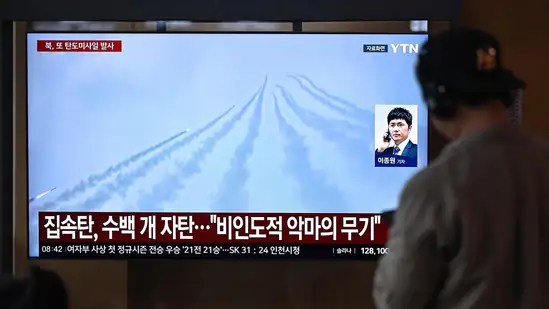
Tensions are brewing in East Asia after North Korea reportedly launched multiple ballistic missiles towards the sea, prompting a high alert in Japan and South Korea on Sunday. This comes days after after the United Nations’ nuclear watchdog warned that North Korea was making “very serious” advances in efforts to build nuclear weapon.
Following the missile launch from North Kora, Japan activated its top-tier crisis management protocols for public safety and regional stability in the face of the renewed provocation.
The missiles were launched from the eastern coastal city of Sinpo at approximately 6:10 am local time (21:10 GMT on Saturday), Al Jazeera reported, citing South Korea’s military.
Japanese Prime Minister Sanae Takaichi provided details on the early morning escalation. In a post on X, she said, “At around 06:00 today, what may be multiple ballistic missiles were launched from North Korea.”
Highlighting the current trajectory and the subsequent international response, Takaichi said, “The items that may be ballistic missiles are believed to have already fallen outside Japan’s EEZ, and at present, Japan, the United States, and South Korea are closely coordinating to analyse information.”
South Korea’s presidential office also said its National Security Council plans to hold an emergency meeting to discuss the launches, the Associated Press reported.
North Korea last week said leader Kim Jong Un supervised missile tests and the week before that, North Korea said it had three days of testing activities to examine ballistic missiles armed with cluster-bomb warheads and other new weapons systems. In March, it said it tested an upgraded solid-fuel engine for missiles capable of reaching the US mainland.
This incident as such marked North Korea’s seventh ballistic missile launch of the year and its fourth such test in April alone, according to Al Jazeera.
Amid these escalating tensions, South Korea’s presidential office convened an emergency security meeting, as media reports indicated growing concern over Pyongyang’s relentless weapons activity. These launches stand in direct “violation of United Nations Security Council resolutions” that prohibit North Korea’s missile programme.
Al Jazeera reported that Pyongyang has consistently rejected these restrictions, however, arguing that they “infringe upon its sovereign right to self-defence.”
The timing of these tests is particularly significant, occurring ahead of a planned summit in mid-May between Chinese President Xi Jinping and US President Donald Trump, where North Korea is expected to be a primary focus.
This diplomatic friction is compounded by technical warnings. Earlier this week, IAEA head Rafael Grossi cautioned that the North has made “very serious” progress in its nuclear capabilities, including the likely “addition of a new uranium enrichment facility.”
This assessment follows recent rhetoric from North Korean leader Kim Jong Un, who reiterated last month that his country’s position as a nuclear-armed “state” is irreversible. He stressed that expanding a “self-defensive nuclear deterrent” remains critical for national security, a stance that continues to test the resolve of the international community. (ANI)