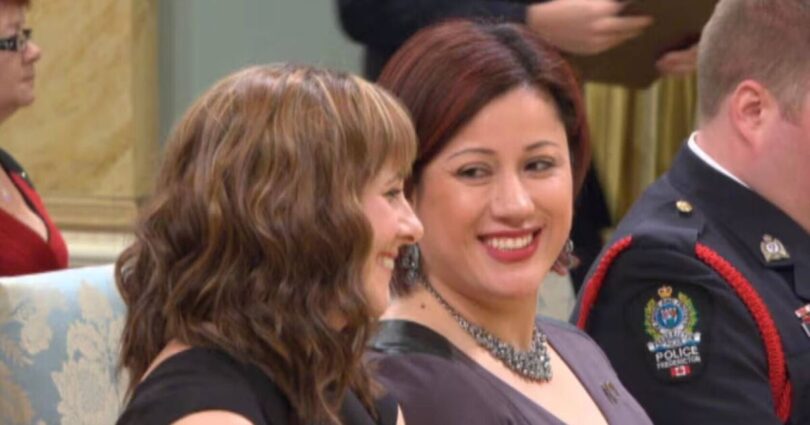
Two flight attendants received medals for their bravery (Image: CBC)
“All of us who were on board Flight 918 a few days ago have had to live through one of the worst nightmares of every passenger, pilot and flight attendant,” shared Captain James Murphy.
And once the harrowing details of their terrifying ordeal are laid bare, most would find it hard to disagree with his assessment.
The year was 2009, the flight was CanJet Flight 918, the aircraft was a Boeing 737-800 built in 2000. Yet on this occasion, it was neither a fatal plane crash nor a runway collision which had people talking — it was an eight-hour hijacking carried out by a single armed gunman.
Following the nightmare ordeal, the entire crew’s remarkable courage was recognised by the Canadian Prime Minister, with two flight attendants receiving awards for their exceptional bravery.
On April 19, 2009, CanJet Flight 918 was scheduled to depart from Jamaica’s Sangster International Airport in Montego Bay, destined for Halifax Stanfield International Airport in Halifax, Canada, reports the Mirror US.
Read more: Key Kremlin ally reveals KGB spy helped Russia hijack Ryanair flight in 2021
Read more: Worst plane crash in history and harrowing final moments of 520 on board

CanJet Flight 918 was hijacked in Jamaica for eight hours by a lone gunman (Image: Wikimedia Commons)
What unfolded on that terrifying day
The aircraft was carrying 159 passengers and 8 crew members (some reports place the passenger figure at 174), all Canadian, with departure from Sangster International Airport scheduled for 11:00pm.
The crew aboard the flight were Captain James T Murphy, First Officer Glenn Johnson, Lead Flight Attendant Heidi Tofflemire, flight attendants Nicole Louise Foran, Carolina Sanitzo Arriola, Tony Bettencourt, Anu Goswami, and Security Officer Joseph Marc Garry Knickle. By 10:30pm, the flight was boarded by one Stephen Fray – a 21 year old man from Montego Bay who called himself ‘Rico’.
Stephen was tall, dressed in a shirt, shorts, and shoes, and as it was later revealed, the son of a prosperous Jamaican businessman. What set him apart, however, was the fact that he was wielding a firearm.
Boarding the Canada-bound flight, Stephen had with him a licensed .38 Smith and Wesson revolver (which actually belonged to his father) and he wanted to be taken to Cuba, so he could defect there.
Flight attendant Carolina recalls turning the corner into the aircraft’s galley and instinctively smiling at the hijacker who was holding a gun to the captain’s neck. The hijacker smiled back.
Then the nightmare began.
The flight crew’s courage
Stephen held at least six of the eight crew members of Flight 918 hostage for over eight hours, and he would’ve done the same to the passengers as well, were it not for the remarkable bravery of flight attendant Carolina, who managed to persuade the gunman to release the passengers.
She achieved this over the course of roughly an hour, at times with the gun aimed directly at her head as the hijacker’s primary hostage.
Carolina negotiated with Stephen, who was later described as “mentally challenged”, and convinced him to let the passengers go.
The entire flight crew remained composed and steadfast, with Carolina and Nicole tirelessly working to negotiate with the hijacker to free people unharmed. Nicole reportedly attempted to gather all the children aboard the aircraft and escort them to the rear of the plane, hoping to ensure their safety, all while maintaining a reassuring smile on her face.
Simple Flying reports a gun was held to Carolina’s head while she attempted to negotiate with the deranged hijacker, who also reportedly doused one of the flight attendants with a fire extinguisher.
He additionally demanded alcohol and Celine Dion’s music to be played, and attempted to incapacitate the male passengers by forcing them to consume prescription medicines found on board, in a bid to neutralise any physical threat to himself, according to The Globe and Mail.
Hostages were ordered to remain in their seats as the gunman aggressively wielded his firearm, his temperament swinging between agitated and composed — at one moment hammering on the cockpit door demanding to be “taken to America”, and at another, showing Nicole and Carolina photographs of his girlfriend.

Flight attendant Nicole Foran knocked the gun out of the deranged hijacker’s hands (Image: Handout)
The courageous flight attendants engaged the unstable gunman throughout, endeavouring to keep him placated and prevent the situation from deteriorating further.
Eventually, the hijacker was persuaded — all passengers would be released unharmed, along with the captain, under the guise of arranging fuel for the aircraft’s departure.
However, they were first required to surrender all their money and personal possessions on board. Passengers were instructed to place whatever cash they carried into a plastic bag, which was collected by flight attendant Nicole. Many of them reportedly wept as they departed, offering emotional apologies to the crew members who remained aboard the aircraft with the gunman.
Carolina went on to receive the Medal of Bravery, Canada’s third highest civilian honour for courage, for her “act of bravery in hazardous circumstances”.
In a rare interview with National Post’s Joe O’Connor back in 2013, flight attendant Nicole Foran said: “It is not easy to talk about. It was a terrible night.”
Nicole was awarded the Star of Courage, an even rarer distinction than the Medal of Bravery, and she was forced to confront her worst nightmare to earn it.
She told the publication: “You shut down and your survival instinct kicks in, and my thought was – how do we get all these people off the plane – and how do we survive this?”
In a bid to defuse the potentially lethal situation, Nicole recalled how the flight attendants spoke to the hijacker about Canada, about its breathtaking beauty and its bitter winters. They also chatted to him about their work. She said: “We just chit-chatted, just to keep his mind off things.”
Their composed exterior was entirely an act, however, as throughout the ordeal they were constantly contemplating how to escape the situation, what objects they could use to distract the hijacker, or overpower him with, in order to bring the nightmare to a close.
Nicole recalls spotting the military and police positioned outside the aircraft, wondering whether they would mount an assault on the plane. Eight hours later, the harrowing ordeal finally came to an end. Jamaican military commandos had stormed the aircraft, and that moment of distraction was precisely what Nicole had been anticipating.
“The gun was on me. So I reached out and turned his hands toward him and popped the gun out of his hands. I just took it from him.
“You watch his body language, and he looked stunned, and I figured that I hadn’t been shot for eight hours and I wasn’t going to get myself shot then – so I took the gun,” shared Nicole.
Injecting some humour into the circumstances, the courageous flight attendant told National Post that her family and friends “laughed when I told them, because they couldn’t believe it”. The reason? “Because I am a tiny person.”
Yet there was nothing diminutive about Nicole, Carolina, the remainder of the flight crew or the passengers’ actions on that terrifying day in April 2009, and their bravery will not be forgotten any time soon.
Stephen Fray was handed a 20-year prison sentence for the hijacking.