The UK government are planning ahead for shortages, with the threat of rising bills and the impact threatening to hit holiday flights within weeks
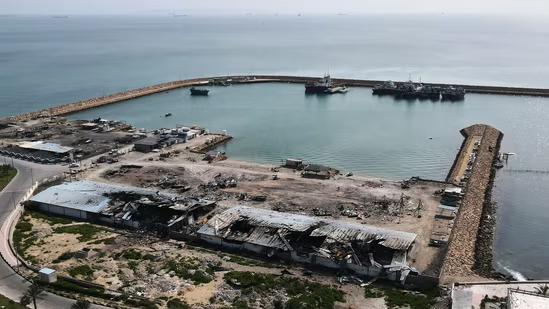
Iran has reclosed the Strait of Hormuz causing fears the ongoing conflict could cause a summer of misery for British families.
In a new statement on Saturday morning, the Islamic Revolutionary Guards Corps announced the strait will return “to its previous state”… “under strict management and control of the armed forces”. The statement, released via Iran’s Fars news agency, accused the US of “piracy”, claiming its “so-called blockade” amounts to maritime robbery.
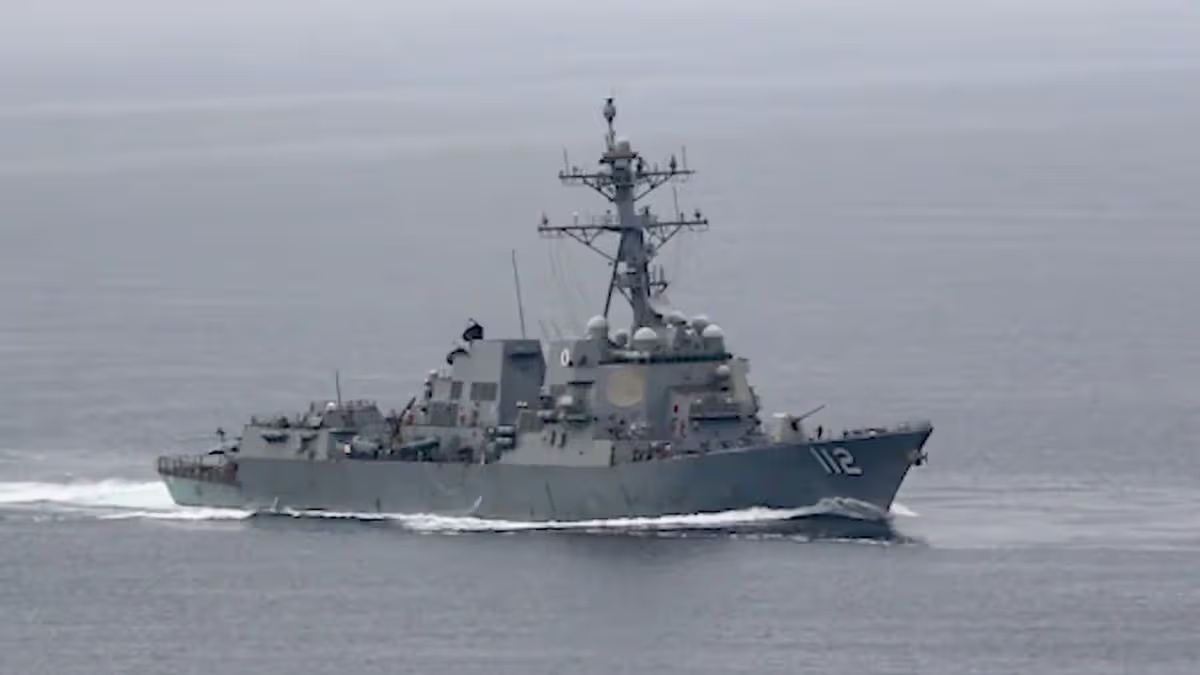
The move came after US President Donald Trump announced that despite the strait having reopened to commercial vessels on Friday, the US blockade would “remain in full force” until Tehran reaches a deal with the US, including on its nuclear program.
READ MORE: Iran war live: ‘Gunfire’ at tankers as Tehran closes Strait of Hormuz againREAD MORE: Donald Trump gives strongest hint yet about the next country he wants to invade
He also raised the spectre of further attacks on Iran. When asked what he would do if there’s no deal when a ceasefire expires next week, Trump said: “I don’t know. Maybe I won’t extend it, but the blockade is going to remain. But maybe I won’t extend it, so you’ll have a blockade and unfortunately we’ll have to start dropping bombs again.”
The ongoing dispute risks causing further problems for British households following advice to stock up on certain goods and “prepare for the unexpected” as the US-Iran war drags on. There are also fears of potential fuel shortages and rising bills.
Prime Minister Keir Starmer and French President Macron chaired a virtual meeting of about 40 countries on Friday focused on a global response to keeping the Strait open. Starmer says the UK and France will lead an international mission to protect freedom of navigation in the waterway “as soon as conditions allow, strictly peaceful and defensive”.
The impact is threatening to hit holiday flights within weeks. Two airlines have already cancelled flights amid warnings Europe has six weeks of jet fuel left. Germany’s Lufthansa is halting its CityLine services today, including flights to and from London, due to rocketing costs of kerosene, used in aviation fuel, and an ongoing trade union dispute. Netherlands’ airline KLM has also cancelled 160 flights over the next month, as the industry feels the impact of the closure of the strait.
The government has reportedly drawn up emergency plans for a “reasonable worst-case scenario” where the ongoing closure of the Strait of Hormuz leads to a shortage of carbon dioxide. It was claimed earlier this week healthcare and civil nuclear energy would be prioritised as CO2 is needed to cool blood supplies, organs and vaccines, as well as for electricity supply.
Other sectors also risk being left without, including farming, food and drink manufacturers, and hospitality. CO2 is used toincrease the shelf life of food such assalad, meats and baked goods, and isalso critical in animal slaughter. The gas is also used to make drinks fizzy – so supply disruption could even impact beer drinkers cheering on England and Scotland in the World Cup. The lack of fertiliser has also led to separate warnings from farmers about soaring costs which could prevent them growing new crops, and potentially higher prices.
International Energy Agency’s Fatih Birol has said the ongoing war is causing the largest energy crisis the world has ever faced, with Asian nations that rely on energy from the Middle East currently on “the front line”. He said Europe and the Americas would feel the impact by late May.
Around 20% of the world’s oil trade passes through the Strait of Hormuz, which has been blocked since early in the US-Israeli war on Tehran. In 2025, about 20 million barrels of oil and oil products passed through the waterway, which is only about 31 miles wide at its entrance and exit and connects the Gulf with the Arabian Sea.
Fuel prices fell for the first time since the start of the Iran war, RAC figures revealed on Friday. The average price of petrol was 158.1p a litre on Thursday, down from 158.3p a litre the previous day. Diesel fell from 191.5p a litre to 191.2p. But a litre of petrol and diesel still remains 25p and 49p more expensive respectively compared to when the conflict started on February 28.
Analyst Cornwall Insight forecast the household energy cap will rise by a less-than-previously-feared £196 a year from July. Its prediction for Ofgem’s cap from July to September now stands at £1,837 for a typical dual fuel household, an increase of 12% on April’s cap. Ofgem will announce the next price cap level by May 27.
Negotiations between the US and Iran are expected to continue on Monday, two days after President Trump gave a number of upbeat assessments about how the talks are going, claiming Iran had agreed not to enrich uranium and Iran has agreed to give up its stockpile of highly enriched uranium. All of his claims were later refuted by Iran’s parliamentary speaker, who said Trump had made “seven claims in one hour, all seven of which were false”.
Meanwhile, a ten-day truce between Israel and Lebanon, which was announced on Friday, so far appears to be holding. Mr Trump wrote on social media: “Israel will not be bombing Lebanon any longer. They are prohibited from doing so by the USA. Enough is enough. Thank you.”
It came after Israeli PM Benjamin Netanyahu, who has kept troops in south Lebanon, said the campaign against Hezbollah is not complete. Iran has previously said the strait is open to nations that liaise with its military, selectively preventing vessels from passing through and spiking oil prices in the process.