A village marked for demolition 10 years ago is still standing – and while developers have big plans, a few people have already moved in
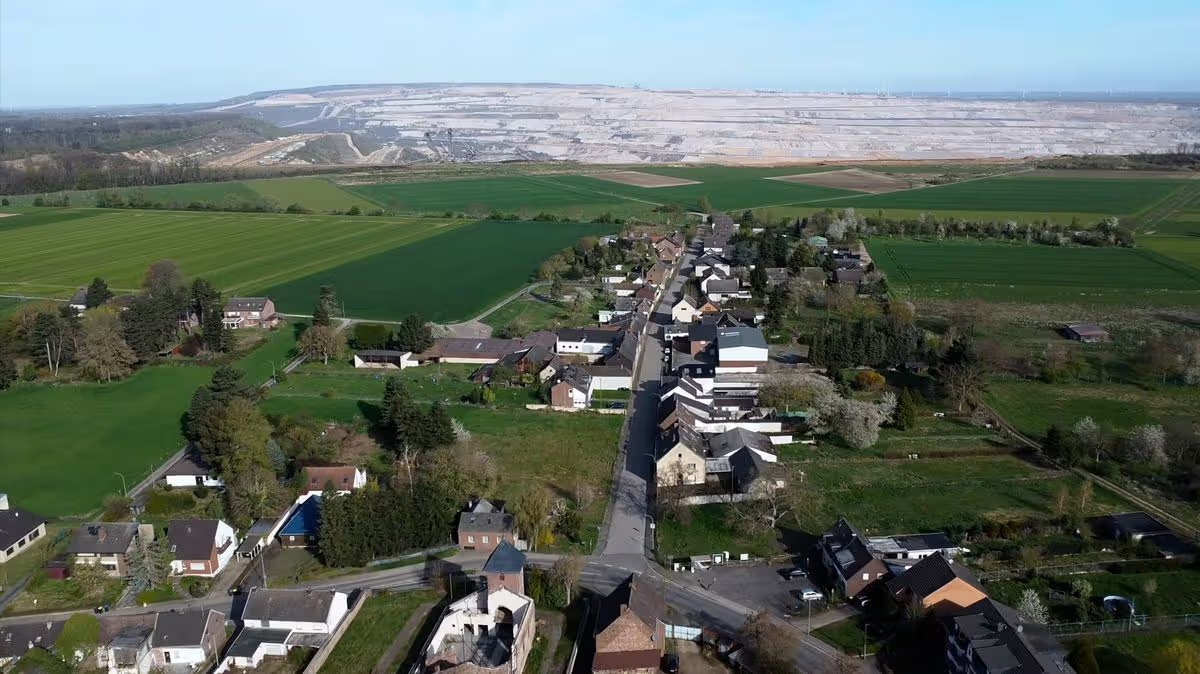
A village occupied for at least 1,000 years now stands totally abandoned after its residents were evacuated. In 2013, the decision was taken to move its 500 inhabitants about two miles up the road to a new town of the same name. The plans were to create a new giant open cast coal mine in the original village.
But while all of the village’s inhabitants had been rehoused by 2015, the German village of Morschenich-Alt (or Old Morschenich) still stands. The plans for a coal mine have since been scrapped. Instead the nearby Hambach open-pit lignite mine, a 300-metre-deep pit spanning over some 44 square kilometres has been abandoned instead.
Now there is talk of renaming the village and recreating it as a “village of the future”. However, for now these plans are on hold too and the village – which might one day be called Bürgewald – stands eerily empty, with most of its streets and houses abandoned and being reclaimed by nature. Despite the conditions, a small handful of people have even moved in to the eerie, desolate village.
Urban explorer Colin, who records his adventures on his Bearded Explorer channel, has toured the eerie “ghost town,” and even chatted to one of its few inhabitants.
But as Colin explored the deserted streets, he found one quite unexpected item, and discovered that a large part of the future plans for the village remains unexplained.
Colin explained: “It’s very eerie, it’ll be be interesting to see what they actually do with this place, but I guess only time will tell.” For now so much of the once-thriving town is completely overgrown – with weeds and grass bursting through paths and driveways and trees and hedges threatening to completely swallow the deserted houses.
The village’s church has been completely gutted by fire. “You can still see some of the beautiful walls inside there, but sadly, there’s really not much left of it anymore,” Colin added.
Most of Morschenich’s shops and houses have been sealed, in some cases with doorways completely bricked-up, making it difficult to see inside the structures. The villagers weren’t given much time to move out, with Colin explaining: “ You can imagine there’s quite a lot of angry residents who are probably wishing they’d never moved out in the first place.”
Colin commented that the streets were so eerily empty, it felt as if the world had come to an end and he was one of the last survivors. He went on: “It’s just so strange walking down a road that should be really busy this time of day, but it’s just not.”
Despite that fact that Morschenich is now almost completely abandoned, to his enormous surprise Colin managed to bump into someone who lives there.
Unfortunately the man spoke no English, but through a translation app managed to give an idea of what the village is like today. Colin continued: “He told us there are only eight families living in here now…five along this road. and two along the other half. That is just mind-blowing.”
The man added that there were none of the original German inhabitants left, and the tiny handful of residents living in the village today were from places such as Turkey, Afghanistan and Egypt.
Touring the village, Colin happens upon countless cases where buildings and pavements are beginning to give way, and only ten years have neglect have allowed nature to almost completely recolonise the area.
He explains that there are hopes of turning the now-defunct coal mine into a vast inland sea, but locals have questioned how that might be done: “While Mossnik became a ghost town, the decision to halt the mining expansion in the area has allowed the village to avoid total destruction and instead move forward to rehabilitation on a new development,” Colin explains.
“As of July 2024, the town was renamed Bürgewald, meaning place of the future. Its shift from planned demolition to revive the community and of course reversing the initial status of an abandoned village. There may be new hope on the horizon for the town, but what would happen to the mine? There are talks of flooding it and turning the 19 square mile pit into a lake. But where would the water come from? Only time will tell what the future truly holds for this place.”