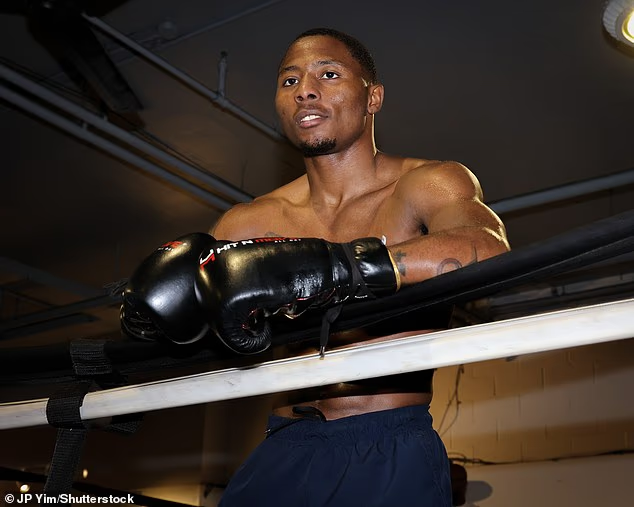
Jahmal Harvey doesn’t look like someone still introducing himself to professional boxing but in many ways, that’s exactly where he is.
At just 23, the Maryland-born switch-hitter has already lived a career most fighters spend a lifetime chasing: world amateur champion, Pan American Games gold medallist, Olympian, and now an unbeaten professional prospect signed to Most Valuable Promotions.
Yet as he heads into this evening’s bout at Madison Square Garden with Daniel Lugo, there’s still a sense that Harvey is only just beginning to show the full version of what he can be.
Part of that comes from how quickly everything has moved. He went from a football kid in Oxon Hill, Maryland, to taking up boxing in middle school, to competing on the international stage before most of his peers had even settled into senior amateur ranks.
By 18, he was already a world champion at the 2021 IBA World Championships in Belgrade, becoming the first American male elite gold medallist since 2007. Two years later he added Pan American Games gold in the 57kg division, and by 2024 he was a seeded fighter at the Paris Olympics, bowing out only in a narrow split decision quarter-final that could easily have gone the other way.
But even with that kind of pedigree, Harvey resists the idea that his identity is already fixed. He speaks more like someone still experimenting with who he is – inside and outside the ring – than someone trying to live up to a finished reputation.
‘I’m just a regular person. I do a lot of different things in my spare time. I like going on random side quests. I go bowling, like I said, I’m an activity-type person – anything active, whether it’s playing video games or bowling. I go to the studio, I make music, I do volunteer work and give back. I’m always moving, or even just going to see family or friends, showing them love, and just chilling. I’m simple.’
Jahmal Harvey (pictured above) doesn’t look like someone still introducing himself to professional boxing but in many ways, that’s exactly where he is
It’s that duality that defines him: elite-level fighter on one side, constantly moving, curious young man on the other. And it’s why, even as he enters the professional ranks with real momentum behind him, he still talks like someone building his story in real time rather than protecting a legacy already written.
That mindset extends to how he’s navigated boxing’s business side. His move to Most Valuable Promotions in 2025 wasn’t framed as a leap of faith, but something closer to recognition of environment, of structure, of how he wanted to be developed.
‘Their vision is crazy, in a good way. The things they do and the way they run their shows really stand out. I had just been to one of their events, and seeing the crowd and how everything operated showed me exactly how they work. Even though I wasn’t signed at the time, they flew me out, set me up with drivers, and made sure I had everything I needed.
‘I just liked how everything was already running so smoothly. And then there’s the comfort side of it. Mike Leonardi, coming up through the USA Boxing system and now partnering with Jake, I felt comfortable around him right away. It felt like I’d known him for years. At the end of the day, it’s all about being comfortable. I knew they’d move me the right way, so I was happy to put my trust in them.’
That comfort, for Harvey, matters as much as any contract or promotional platform. He has seen enough of elite sport already to understand how quickly careers can become transactional if the wrong environment is chosen too early.
It also explains his perspective on Jake Paul, one of the most polarising figures in modern boxing and the face of the promotion he now fights under.
‘Jake’s more of a promoter type. He’s a business guy, very cool and down to earth. He likes to give you game, teach you about social media and how to work it. He’s just a chill guy. He makes jokes, funny, might start singing or say something random. He’s just a regular person, living life and having fun.’
There’s no attempt from Harvey to overstate the relationship or build mythology around it. Instead, it fits into his broader approach to the sport: observe, take what is useful, keep moving.

Harvey will take on Daniel Lugo at Madison Square Garden in New York this evening
That same emotional distance is also how he views boxing itself. For all his achievements, he is clear that he refuses to let the sport become the entirety of who he is.
‘Boxing doesn’t make up even 50 per cent of me. I say that because when it’s all you think about, you get stressed and it starts to eat you alive. If you put everything into one thing, it can consume you. Nine times out of 10 in this world, you’re not going to get back what you put in, especially in a sport.
‘Look at Floyd Mayweather, Terence Crawford, they’ve done amazing things and don’t get the credit. Or even LeBron James, he’s achieved so much, and people still say, “Oh, you’re a bum”. There’s no point. I’ve seen it too many times. I’m not going to put my all into it like that, because a sport will never love you as much as you love it.’
Harvey has already lived through the demands of elite amateur boxing – the travel, the expectations, the physical toll of constant preparation. The Olympic cycle alone, he admits, was enough to change how he viewed long-term commitment to the amateur system.
‘I was going to go for another Olympic cycle, but life takes turns. Um, just things that I had gone through, things that were going on in my life at the time, I just felt like it was better to turn professional. I had to keep moving forward with life. I didn’t want to go back and waste another four years. The Olympics is a very hard task to accomplish. It’s a four-year cycle. Boxing is a 24-hour, all-year-round sport. Your body takes a toll, weight cuts, all the training, two or three times a day. The Olympics really took a lot out of me, I would say.
‘So once I was ready to get back up, and then with everything that was going on, I was like, let me just go ahead and start making my money now. I just had to live with it. I went to the Olympics, I did what I needed to do, I got me some gold medals along the way – just be happy with it. That’s where I’m at with life now.’
So instead, he stepped forward into the professional ranks, not as a gamble but as a recalibration. A decision to start earning, start building, and start shaping his own path without another multi-year waiting game.
Outside the ring, that philosophy becomes visible in the way he lives. Harvey describes himself as someone constantly doing something – never still, never locked into a single identity.

At just 23, the Maryland-born switch-hitter has already lived a career most fighters spend a lifetime chasing: world amateur champion, Pan American Games gold medallist, Olympian
Even competition outside boxing finds its way into his world. A bowling match against Paul during a media event turned into a genuine contest.
‘I went up against Jake in a bowling competition during the Mike Tyson vs Jake Paul event, and I beat him. But hey, Jake almost had me. He definitely had me nervous. Before they started recording, we had a little warm-up game. I was doing well, and Jake was doing bad, so I’m thinking, “Oh yeah, Jake doesn’t know how to bowl”. Then as soon as the cameras came on-strike. I was like, “Hold up, hold up”. It turned into a real competitive game. I had to dig deep in my bag to win.’
It’s said with humour, but it reflects something consistent in him: once there is competition, he engages fully, regardless of context.
Inside the ropes, that competitiveness takes a more technical form. Harvey is a 5ft 6in switch-hitter who built his reputation in the amateurs on timing, sharp counters, and the ability to change rhythm without warning. He is not a fighter tied to one identity in the ring, he is built around transitions.
‘I feel like I always want to showcase everything. When I fight, I get bored fighting just one way, that’s why I switch. It keeps me active and engaged in the fight. Switching puts me in a position where I’m always doing something, never getting lax, because I’m constantly adjusting.
‘I’m always thinking, “If I do this, I could get caught with that”, so I never get too comfortable. I don’t want to just stay in one stance and keep doing the same thing over and over until someone figures me out. By switching and fighting in different ways, I keep it unpredictable. I might come forward in orthodox, then switch to southpaw and fight off the back foot.
‘Then I might switch back to orthodox and fight in the pocket, or go southpaw and do the same. I could switch again and become more of a counterpuncher. I’m always changing styles. I want to show everything I can do. That’s why I need an opponent who can adapt and do everything too – someone who can bring out the best in me, so I can prove I can beat anyone in any kind of boxing style.’
Lugo offers the next test of that philosophy. A taller, rangier opponent who works behind a steady jab and fights at a consistent tempo, Lugo represents exactly the kind of structural challenge Harvey has been studying.
‘From what I’ve seen, he’s a little taller and rangy. He works behind his jab, so I’m going to have to negate that – find my range, figure out his timing, and take that away. I feel like once I take that away, everything else will fall into place, because he really builds everything off his jab. He’s not too fast or flashy, it’s more the same tempo and pace most of the time. I like that he works both up and down, so I’ll have to stay sharp with my defence, keep my hands up, and whenever I bring them down to catch a shot, bring them right back up, because he attacks both levels.

After the Olympic Games, Harvey decided to turn professional and sign with MVP
‘That’s why I like this matchup – it’s good competition. He has a pretty solid record, so I know he’s not going to be a slouch or a pushover. It’s going to be competitive, and I’m hoping he brings out the best in me so everyone gets a great fight and I can showcase my talent.’
Harvey’s mindset was shaped long before boxing, in a childhood defined by siblings, competition, and a family culture that treated toughness as expectation rather than exception.
‘I’ve got a lot of siblings and cousins. We were always big into wrestling and boxing, so we used to fight each other and always have each other’s backs. One thing my family – my aunts and uncles – always told us was, “Y’all better protect each other. All you’ve got is family”. So I’m big on family, that’s all I heard growing up.
‘In school, if something happened, I was never the type to be scared, and I always took things lightly. If you were messing with my big brother or my cousins, and I saw them mad or crying, like, “Oh yeah, he messed with me”, I’d be like, “Who did it?” I’m ready to fight. I’m ready to fight. So I will say, I did fight a lot in school.
‘If you weren’t my family, I didn’t really do friends like that. So I was just in school to do my work. So once you started joking with me, thinking it’s okay to play childish games – smacking people on the head and stuff – now you’ve got to fight me. Now I’m going to beat you up. So I got in a lot of fights just from kids messing with me, and me being like, ‘Man, I’m not playing with you – I’m trying to fight you.’
Even size and age were never deterrents, only variables to overcome.
‘At the time, I was fighting kids older than me, and it never mattered to them. I fought because my uncles always said, “Yeah, you fight somebody older than you – that’s teamwork. You’ve got family for that. But don’t be scared of nobody. If you lose, you better take your loss with dignity. Don’t let size affect you”. They always said none of that matters. I was small anyway, so I had to learn from a young age that size doesn’t mean anything. So I was never scared.’
Behind all of it sits a family structure that shaped both his fire and his restraint, especially his parents who still hover close to every fight night.

Harvey’s mindset was shaped long before boxing, in a childhood defined by siblings, competition, and a family culture that treated toughness as expectation rather than exception
‘Nah, they both like it. I learned how to fight from my mother – she’s the one who used to give me that fire, my motivation. My mother’s actually the fighter, not my dad. My mother’s the fighter. Even though she gets nervous, she’s still there, she still has that motherly instinct, but she just knows. She’s like, “Yeah, you better whoop him”.
‘She’s still on that motivation, like, “You got this, be bad, do this”. But at the same time she’s like, “Man, I don’t want you to get hit”, so she’s in the middle of it. But my dad is worse than her – I feel like he wants to be in my corner. He’d want to be right there. But you see him before my fight, he’s like, “You know I gotta take my little smoke break”. He’s got his bathroom breaks too. I’m like, “Pops, be good, Pops”.
Now, as he moves toward tonight, Harvey remains focused on the job at hand.