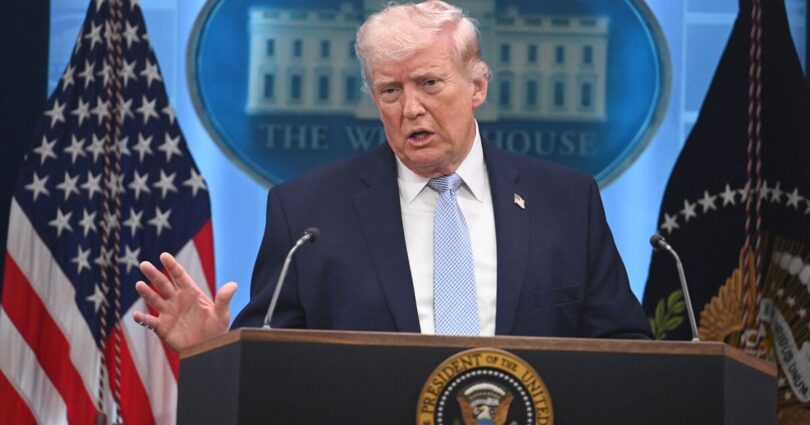
Trump insisted on Thursday historic talks between Israel and Lebanon would take place on Friday (Image: Getty)
Donald Trump has announced on Thursday he has brokered a landmark phone call between the leaders of Israel and Lebanon — which he says will be the first direct contact between the two nations’ heads of government in 34 years.
The US President revealed the breakthrough on Truth Social, writing: “Trying to get a little breathing room between Israel and Lebanon. It has been a long time since the two leaders have spoken, like 34 years. It will happen tomorrow. Nice!”
The development comes as Trump’s Iran war continues to reshape the Middle East, with the President juggling the Hormuz blockade and renewed diplomatic efforts across the region simultaneously.
From the timeline in relations between the two nations, which are officially still at war, it is not obvious what event 34 years ago Trump is referring to, particularly because Israel and Lebanon have never held direct leader-to-leader talks, according to the Times of Israel.
Read more: Trump undermined by his own Navy over Hormuz blockade
Read more: Trump’s AI Jesus image twisted into hellish beating scene by Iran embassy
The war between the two nations is bound by Lebanon’s 1955 Boycott Law, which largely prohibits any contact with Israelis.
High-level contact has happened, but always at arm’s length. In April 2026, Prime Minister Benjamin Netanyahu and Lebanese President Joseph Aoun authorised their respective US ambassadors — Yechiel Leiter and Nada Hamadeh Moawad — to meet directly, the first such contact in over 30 years.
Before that, the closest the two countries came was the May 1983 peace agreement, negotiated by high-level representatives in the shadow of the 1982 Lebanon War. Lebanese President Amin Gemayel drove the deal on Beirut’s side, but the two leaders never met — and the agreement collapsed a year later.
A 2022 maritime border deal, signed by Israeli Prime Minister Yair Lapid and Lebanese President Michel Aoun, marked another milestone — but again, no meeting took place. Documents were signed separately in each capital and exchanged through a US mediator operating shuttle diplomacy between the two sides.
The closest major diplomatic contact between Israel and Lebanon to match Trump’s 34-year timeframe ocurred during the Madrid Conference of October 1991, which brought Israeli and Lebanese representatives to the same table for the first time.
This effrot was as part of sweeping Middle East peace talks convened in the aftermath of the Gulf War. But even then, it was delegates and diplomats who sat across from one another — not the leaders themselves. The heads of government remained apart, the taboo unbroken, the boycott intact.
According to the Times of Israel, Benjamin Netanyahu’s security cabinet gathered on Wednesday night to weigh a temporary ceasefire in Lebanon, with senior Israeli figures privately acknowledging a truce may now be unavoidable under mounting US pressure.
“Our assessment is that within a few days, we will have no choice but to fully cease fire in Lebanon,” a senior Israeli political source told Channel 12.
The network reported that Washington is leaning on Israel to agree to a one-week ceasefire with Iran-backed Hezbollah, hoping the pause will give US-backed negotiations between Israel and Lebanon room to breathe — and bolster American efforts to secure a broader deal with Tehran to end the Iran war.