Tottenham were trying to become the first English team to win a European trophy, and Bill Nicholson was finding it difficult to be too positive in the dressing room because his team were going to play in the final without Dave Mackay.
The midfield warrior who many suspected to be the manager’s favourite was injured and Nicholson’s pre-match team talk was cautious, littered with warnings about Atletico Madrid players who posed a threat and must be stopped.
Once the boss had he disappeared though, Spurs captain Danny Blanchflower took it upon himself to set about his teammates and gee them up again, reminding them there was no reason to worry when they had Jimmy Greaves and Bobby Smith up front, Cliff Jones and Terry Dyson on the wings and John White in midfield.
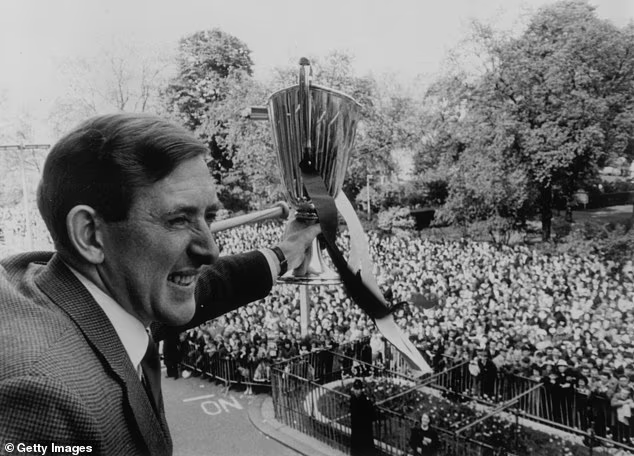
Spurs went out and won 5-1, and clinched their place in history and Blanchflower, who had played in the final despite injury, lifted the European Cup Winners’ Cup in Rotterdam, the last major trophy of his glittering career.
Now, as they flirt with relegation, so desperately short of on-field leadership, it is tempting to wonder what their greatest captain would have made of it all. These may be very different footballing times, but Richard Blanchflower suspects his father would have made a beeline for those at the top.
‘He’d have reflected on the owners and the board members,’ says Richard, who has written a foreword to a new biography about his father. ‘He wasn’t one to mince his words with that sort of thing which is why they feared him and didn’t want to make him the manager.’
Danny Blanchflower is one of Tottenham’s greatest heroes and most memorable captains
When Nicholson stepped down in 1974, his desire for Blanchflower to take over was ignored by the board. By this time, the former Spurs and Northern Ireland captain had not played for 10 years and was forging a career in the media where he enhanced a reputation for speaking his mind.
Once, commentating live on a game in the United States, he declared that ‘neither of these teams can play’. His producer whispered urgently into his earpiece, ‘Danny, you’ve got to be more positive’. Blanchflower paused and then told his audience, ‘I’m positive neither of these teams can play’.
For Richard, it is one of his favourite stories about his father, who died in 1993 at the age of 67. It captures his honesty. ‘He couldn’t sit there and say it was a good game if it wasn’t,’ says Richard. It also illustrates his waspish sense of humour and complete disregard for convention.
Blanchflower was first to reject the TV hit ‘This is Your Life’ in 1961, when at the peak of his fame as captain of the Double winners. He considered the show to be at best cringingly sentimental and at worst an invasion of privacy.
As a quick-thinking, ball-playing, tempo-setting midfielder, he was the brain of the team for club and country.
Off the pitch, he was opinionated and always open to potential for change and innovations to improve the game. He wanted to amend the offside rule, making it applicable only in the final 18 yards of the pitch, with a line extended across the pitch from the edge of the penalty area.
He claimed to have invented the defensive wall, albeit with a gap in the centre through which the goalkeeper could see the ball. Richard is certain, however, that his father would not have looked favourably on the advance of VAR. ‘He would have ridiculed it,’ he says without hesitation.
Blanchflower devised set-piece routines from throw ins, with simple signals for teammates hidden in the way he held the ball. If it was in his right hand, he was throwing it to his right. In his left hand, throwing to his left. In two hands, he was throwing straight.

After overseeing an era of successes it is tempting to wonder what a figure like Blanchflower – the subject of a new autobiography – would do this season
He also came up with the idea of passing a penalty kick rather than shooting and gave it a try, when Jimmy McIlroy played a short pass his way from the spot during Northern Ireland’s World Cup qualifier against Portugal in 1957, years before Johan Cruyff did it while playing for Ajax.
Blanchflower would accompany Northern Ireland boss Peter Doherty on scouting missions and Nicholson was always prepared to listen to his views and applauded his influence even while omitting him from his all-time Spurs XI.
‘I always say Bill cheated,’ says Richard. ‘When he named his best-ever Spurs side he had Ron Burgess, captain of the Spurs ‘push and run’ side which won the league in 1951 and which Nicholson played in, and Mackay in midfield. He cheated because he said Danny will skipper the reserves and they’ll probably beat us.’
Blanchflower was twice voted FWA Footballer of the Year. First, in 1958 when he led Northern Ireland to the World Cup quarter finals and again in 1961 after the Double.
Perhaps his most famous words still echo through Spurs with his quote about glory.
‘The great fallacy is that the game is first and last about winning,’ said Blanchflower. ‘It’s nothing of the kind. The game is about glory. It is about doing things in style, with a flourish, about going out and beating the other lot, not waiting for them to die of boredom.’
This used to crackle out over the speakers at White Hart Lane before the teams came out but not any longer, and the club has seemed unsure in recent years whether to embrace this as its raison d’etre or keep it at arm’s length to be eyed suspiciously.
Still, for all he achieved, Blanchflower’s standing as a true legend of British football in the 20th Century is easily forgotten.
Perhaps partly because he was Northern Irish not English. Or because his managerial career never really got going as expected to extend his legacy. Or because he passed away in his ’60s, halfway through the first season of the Premier League era, having lived his final years with dementia.
His image certainly does not jump out at the Tottenham Hotspur Stadium despite him being central to their finest era and the last time Spurs were champions. Unusually, it is a modern venue without statues because former chairman Daniel Levy, who oversaw the stadium design, was never one for putting heroes of the past onto pedestals.
Richard, a season ticket holder at N17, understands. ‘If you start there, where do you end?’ he says. ‘Jimmy Greaves was my favourite player, and Glenn Hoddle was magnificent. So many of the players we’ve had over the years have been terrific. Dave Mackay would have a good claim, and Bill Nicholson is the obvious one, having won the league as a player and then manager.’
Perhaps the new book published to coincide with the 100th anniversary of Blanchflower’s birth will help preserve a legend.
‘Danny Blanchflower: A Glorious Life’ by Mike Donovan with forewords by Pat Jennings and Richard Blanchflower is on sale now published by Pitch.