The blockade of Iranian ports on the Strait of Hormuz held up in its first 24 hours, the U.S. military said Tuesday, and the top diplomat at the United Nations indicated U.S.-Iran peace talks are likely to resume.
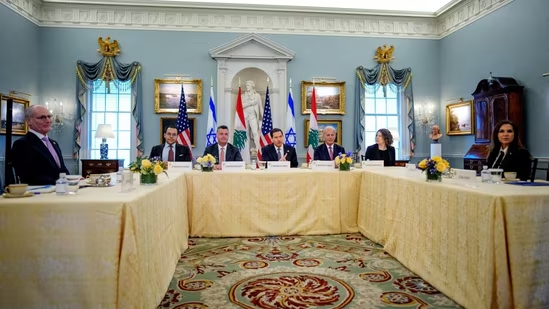
On another front in the Middle East, Israel and Lebanon said they have agreed to launch direct negotiations for a comprehensive peace deal, following rare, face-to-face talks in Washington, D.C.
A meeting involving ambassadors from Israel and Lebanon was held Tuesday with the participation of Secretary of State Marco Rubio and the U.S. ambassador to Lebanon, a joint statement said.
Yechiel Leiter, Israel’s ambassador to the U.S., said after the meeting that Lebanon and Israel were on the same side. “We must uproot the evil of Hezbollah from the Land of Cedars. We are united in the need and ability to do so,” he said.
Lebanese officials have previously said that the country’s precondition for negotiations is a full cease-fire; Israel, though, is refusing to commit to that. Hezbollah chief Naim Qassem has called the discussions “pointless” and said just talking to Israel is a surrender.
A group of nations including the U.K., France and Australia, called on Tuesday for Lebanon to be included in regional de-escalation efforts and urged all parties to pursue a lasting political solution, warning the continued war risks undermining broader stability.
The group condemned attacks by Hezbollah against Israel and Israeli strikes on Lebanon, stressing that civilians and infrastructure must be protected under international law. The group also denounced attacks on Unifil, the United Nations’ peacekeepers in Lebanon.
Lebanon’s health ministry on Tuesday said that 2,124 people have been killed and nearly 7,000 wounded since the latest round of fighting between Israel and Iran-backed Hezbollah.
Meanwhile, foreign ministers from Saudi Arabia, Egypt, and Pakistan plan to meet their Turkish counterpart in Turkey on Friday to discuss proposals presented to Iran to end its effective closure of the strait and reach a permanent cease-fire with Washington, regional officials familiar with the talks said.
Regional countries are racing to bring the U.S. and Iran back to the negotiating table after peace talks in Islamabad over the weekend ended without a deal.
“The indication we have is that it is highly probable that these talks will restart,” U.N. Secretary-General António Guterres said at U.N. headquarters after meeting with Pakistan’s deputy prime minister and foreign minister, Mohammad Ishaq Dar, noting that it would be unrealistic to expect such a complex problem to be settled in one round.
Guterres also appeared to criticize the U.S. blockade by saying, “International navigational rights and freedoms, including in the Strait of Hormuz, must be respected by all parties. It’s time for restraint and responsibility, it’s time for diplomacy, over escalation, and it’s time for renewed commitment to international law.”
Oil futures fell on Tuesday as the market keeps up hope for U.S.-Iran negotiations while the cease-fire in the Gulf holds. The International Energy Agency said it now expects global oil demand to fall by 80,000 barrels a day this year. WTI settled down 7.9% at $91.08 a barrel, while Brent fell 4.6% to $94.79.
The U.S. Treasury Department threatened secondary sanctions for financial institutions supporting Iran, saying it is aiming to impose maximum pressure on the regime.
Six merchant vessels obeyed direction from U.S. forces to reverse course and re-enter an Iranian port on the Gulf of Oman, Centcom said.
More than 10,000 U.S. sailors, marines and airmen were involved in the mission, as well as more than a dozen warships and aircraft, Centcom said. Warships involved include the USS Abraham Lincoln aircraft carrier, the USS Tripoli amphibious assault ship and several guided-missile destroyers.
The blockade doesn’t stop ships from traveling through the strait; it is designed to prevent vessels entering and leaving Iran’s ports and coastline.
More than 20 commercial ships, including cargo, container and tanker vessels, passed through the strait on Tuesday, two U.S. officials said. While commercial traffic is still a fraction of what it was before the war, the flow of vessels is an improvement through a critical chokepoint.
A Chinese tanker under sanctions with a history of evading U.S. restrictions on Iranian oil appeared to do a U-turn to sail back into the Persian Gulf after trying to exit through the strait.
European countries are putting together a plan for a broad coalition of countries to help free up shipping through the Strait of Hormuz, including sending mine-clearing and other military vessels. But the plan would only come after the war and might exclude one country in particular: the U.S.
President Emmanuel Macron of France said Tuesday that the plan is for an international defensive mission that doesn’t include the “belligerent” parties, meaning the U.S., Israel and Iran. The goal of the European plan is to give shipping companies confidence to use the strait after the fighting has ended, which officials said could be some time away.
Some Republican senators have expressed concern as the war in Iran drags on and higher gas and fertilizer prices hit their constituents.
“Every day that it drags on it makes it more and more and more difficult for people to understand why we’re there,” warned Sen. Jim Justice (R., W.Va.). Justice said there is growing concern in his state about energy prices. Asked if those higher costs could have implications for Republicans’ chances in this year’s midterm elections if the war doesn’t end soon, Justice laughed. “Are you kidding me?…That just compounded the whole situation,” he said.
But that doesn’t mean Republicans are ready to vote to rein in President Trump’s war powers in Iran when Democrats force another vote. “Not this week,” Sen. Thom Tillis (R., N.C.) said. “But we’ve got to start answering questions.”
Finance Minister Roland Lescure of France said the global economy can absorb the shock of the strait crisis if it is resolved in a matter of weeks—but not longer.
“If it lasts months, we’re all in trouble,” Lescure said in an interview in New York. “The Strait of Hormuz is the economical knot of this conflict, and we need to undo it.”
Write to Jennifer Calfas at jennifer.calfas@wsj.com, Lara Seligman at lara.seligman@wsj.com and Summer Said at summer.said@wsj.com