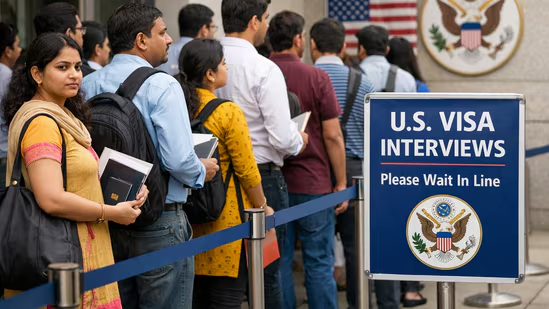
Amid Trump’s visa crackdown, a proposal in Iowa aimed at limiting the employment of specific foreign workers in colleges and universities is progressing through the state legislature.
House File 2513, which focuses on the utilization of H-1B visas within higher education, has successfully passed the Iowa House and has moved through the preliminary stages in the Senate. The bill was approval by a subcommittee and Senate Workforce Committee in March 2026. It is presently listed on the Senate calendar.
Also Read: H-1B visa stress: NRI’s post on returning to India after 11 years in US sparks debate; ‘Don’t come unless…’
What is House File 2513? A new setback for H-1B visa holders
The proposed legislation would prevent public universities, community colleges, and certain private institutions in Iowa from establishing new employment agreements with H-1B visa holders who are nationals of countries classified by the U.S. government as “foreign adversaries” or “state sponsors of terrorism.” The nations identified in this classification include China, Russia, Iran, North Korea, Cuba, Syria, and Venezuela.
The act follows a review by various Republican-led states regarding the application of the H-1B visa program in public institutions, with recent measures in Florida and Texas halting new hiring under this program.
What happens if Bill gets enacted?
If implemented, the Iowa legislation would take effect for new contracts starting in mid-2026, while current employees would generally remain unaffected.
The H-1B visa program permits employers to recruit workers in specialized sectors where there is a scarcity of domestic talent. This visa is usually granted for a duration of three years, with the possibility of extension for up to six years, and it can also facilitate a route to permanent residency. Although the majority of H-1B visas are subject to an annual cap, positions at universities are exempt from this restriction.
Impact on H-1B talent
The H-1B visa program is extensively utilized by businesses and individuals seeking employment in fields such as technology, healthcare, and engineering. Although the visa is temporary, it has the potential to pave the way for permanent residency.
Proponents of the legislation assert that it tackles issues related to national security and workforce priorities. Representative Taylor Collins informed Newsweek, “We don’t really want to roll the dice when it comes to that [espionage activities]. I think there’s honestly a case we made to not even have the H-1B visa program. Honestly, really, I would prefer that we’d be hiring Americans.”
The bill is yet to undergo a final vote in the Iowa Senate or receive the governor’s signature, resulting in an uncertain outcome.