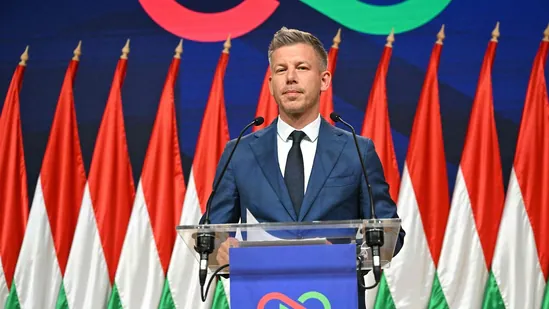
Hungarian prime minister-elect Peter Magyar pledged on Monday to usher in a “new era” after defeating nationalist leader Viktor Orban in elections seen as a blow to hard-right populism.
Orban, a self-described “thorn” in the European Union’s side who was backed by US President Donald Trump and Russian counterpart Vladimir Putin, was ousted in Sunday’s ballot after 16 years in power.
Hungarians fed up with corruption handed Magyar, a conservative former government insider, a decisive victory.
Also read: Push to roll out women’s quota in line with Opposition demands: PM Modi
Magyar, 45, said he would do “everything in our power to ensure that this truly marks the beginning of a new era”.
He urged President Tamas Sulyok, an Orban ally, to convene parliament “as soon as possible”. “Our country has no time to waste. Hungary is in trouble in every respect. It has been plundered, looted, betrayed, indebted and ruined,” he told reporters.
Magyar’s Tisza party won two-thirds majority in the parliamentary elections, which drew record turnout.
Tens of thousands of jubilant supporters poured into the streets to celebrate in the capital, Budapest.
Many EU leaders welcomed Magyar’s win.
German Chancellor Friedrich Merz called it a “heavy defeat” for “right-wing populism” and French President Emmanuel Macron hailed it as a victory for the “values of the European Union”.
Also read: Iran’s Ghalibaf drops a math equation in Hormuz blockade warning to Trump: f(f(O)) > f(O) | Here’s what it means
Kremlin spokesman Dmitry Peskov said Moscow hoped for “pragmatic” relations with Hungary’s new government, following the ousting of Orban, the EU’s most Russia-friendly leader. China, with which Orban had also fostered ties, congratulated Magyar.
Magyar thanked both Moscow and Beijing for “being open to pragmatic cooperation, just as Hungary is”.
Almost-complete official results showed Tisza securing 138 seats in the 199-seat parliament on 53% of the vote.
Orban’s Fidesz party retained 55 seats on 38% of the vote.
Turnout was a record 79.6 %.
Orban, 62, conceded defeat on Sunday, saying the message was “painful but unambiguous”.
Addressing the crowd, Magyar said voters had “liberated” the country of 9.5 million people and “said ‘yes’ to Europe”.
Orban, who was seeking a fifth straight term, has transformed his country into a model of “illiberal democracy”, clashing with the EU over rule-of-law issues and holding up EU aid for war-torn Ukraine.
Won’t block $105 billion EU loan to Kyiv: Magyar
Magyar said he won’t stand in the way of Ukraine receiving a €90 billion ($105 billion) loan from the European Union that was blocked by the outgoing Prime Minister Viktor Orban.
Magyar said at a news conference in Budapest on Monday that his country would maintain its opt-out from participating in the loan financially. That would allow the EU to waive through the loan.
Brussels wants to move swiftly to release the loan following Orban’s landslide defeat in Sunday’s election, which ended his 16 years in the office. Cyprus, which holds the rotating presidency of the EU and sets many policy priorities, will bring the issue up at a meeting of the bloc’s ambassadors as soon as possible, according to a Cypriot official.
Orban has repeatedly blocked EU moves to help Ukraine fight Russia’s invasion. He made Ukraine a central campaign issue, portraying Kyiv as “hostile” to Hungary.
Foreign interference in the election campaign
Ahead of the vote, both candidate’s camps had alleged foreign interference in the campaign. US Vice President JD Vance, one of the most fervent supporters of far-right parties in Europe, visited Hungary last week to attend a rally with Orban. His boss, Trump, had promised to back Hungary with the United States’ “economic might” if Orban’s party won.
And Vance accused EU “bureaucrats” of interfering in Hungary, a member of the bloc since 2004.
The election “could mark a real turning point for Donald Trump’s culture war in Europe”, said Pawel Zerka, senior policy fellow at the European Council on Foreign Relations.
It gave “confidence (to) pro-European forces across the continent” and meant that association with Trump’s culture war was now becoming “more of a liability than an asset”, he said.
Like Orban, Magyar opposes sending EU military aid to Ukraine or offering Ukraine a fast-track route to join the 27-nation bloc.
With inputs from Bloomberg