China openly defies America’s blockade of the Strait of Hormuz as Beijing warns Trump “not to meddle” in Its business with Iran
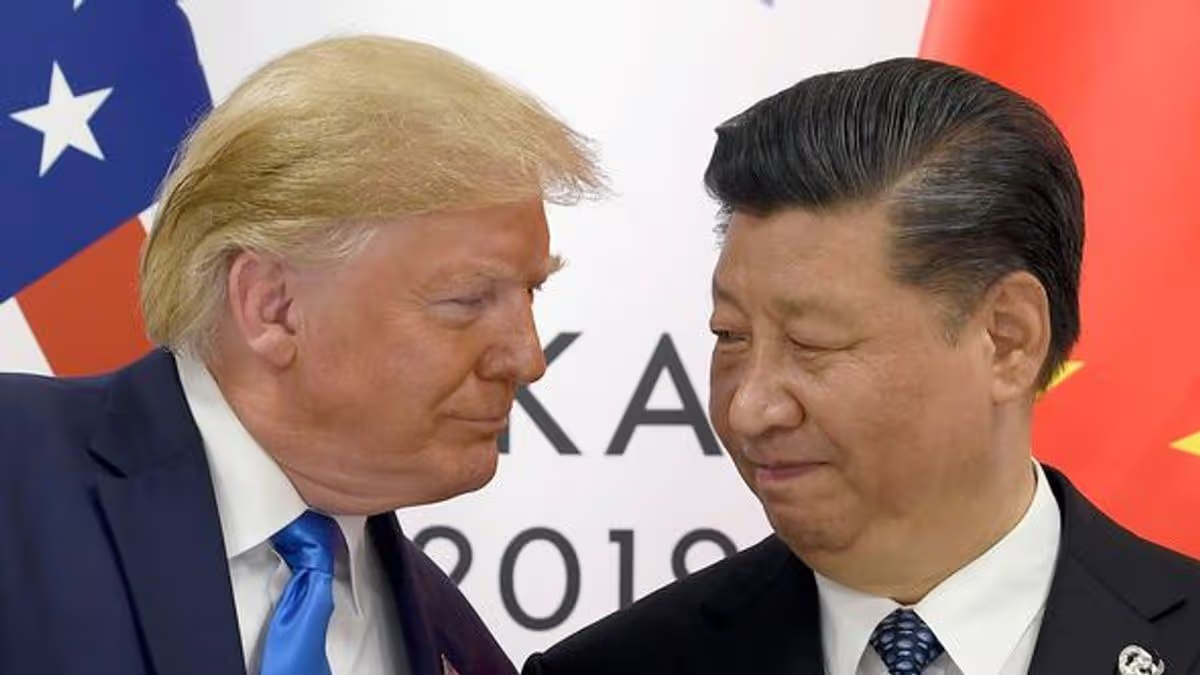
Tensions in the Middle East have risen dramatically after China warned Donald Trump “not to meddle” in its business with Iran after Donald Trump blocked the Strait of Hormuz. In a direct show of force, Beijing then sailed a tanker through the vital waterway without the US Navy intervening.
China threw its full weight behind Tehran in response to the US president’s controversial stopping of vessels in the vital waterway. Since the warning to Trump, a sanctioned Chinese tanker brazenly sailed through the contested waterway in a direct challenge to American authority.
The dramatic diplomatic confrontation unfolded as Beijing condemned the blockade as “reckless” and sent what observers described as its most forceful signal yet that it intends to continue trading with Tehran regardless of Washington’s actions. China’s Defence Minister Dong Jun delivered a searing broadside at the US, making clear that Beijing will not bow to American pressure over its economic and energy ties with Iran.


“Our ships are moving in and out of the waters of the Strait of Hormuz,” he said. “We have trade and energy agreements with Iran. We will respect and honour them and expect others not to meddle in our affairs. Iran controls the Strait of Hormuz, and it is open for us.”
The remarks were joined in condemnation from Beijing’s foreign ministry, which branded Trump’s blockade of Iranian ports “dangerous and irresponsible.” Spokesman Guo Jiakun warned that American actions risked tearing apart what remains of a fragile regional ceasefire.
“Such actions will only intensify contradictions, exacerbate tensions, undermine the already fragile ceasefire, and further jeopardise the security of navigation through the strait,” Guo said. “This is dangerous and irresponsible behaviour.”
The war of words came as maritime tracking data laid bare the limits of the American operation. The Rich Starry, a medium-range chemical tanker owned by Shanghai Xuanrun Shipping – a firm sanctioned by the US Treasury Department as far back as 2018 for its dealings with Iran – passed through the strait overnight after leaving the United Arab Emirates, listing China as its destination.
The vessel’s transit through the waterway was the first recorded since Trump’s announcement, although it was not plain sailing.
Tracking data showed the ship briefly carried out a U-turn alongside another tanker before resuming its course through the chokepoint. It arrived on the other side without apparent American interdiction.
The Rich Starry’s passage highlighted the ambiguity at the heart of Trump’s blockade.
US Central Command subsequently clarified that the operation applies only to vessels travelling to or from Iranian ports, and does not extend to ships transiting the strait bound for other countries. Critics were quick to suggest that the clarification highlighted the fragility of Trump’s blockade, showing it to be less sweeping than the US leader claimed.
Speaking during a meeting in Beijing, President Xi Jinping spoke about the blockade saying international law must be adhered to.
“The international system with the United Nations at its core, the international order based on international law, and the basic norms governing international relations based on the purposes and principles of the UN Charter must be firmly upheld,” he said.
Xi called for international law to be applied consistently, warning that it “must not be selectively applied or disregarded, nor should the world be allowed to regress to the law of the jungle.”
He put forward four proposals for restoring stability in the region: peaceful coexistence among states, respect for national sovereignty, consistent application of international law, and a joined-up approach linking security and development.
The intervention marked his most substantial public statement on the Middle East conflict since American and Israeli strikes on Iran began more than six weeks ago.