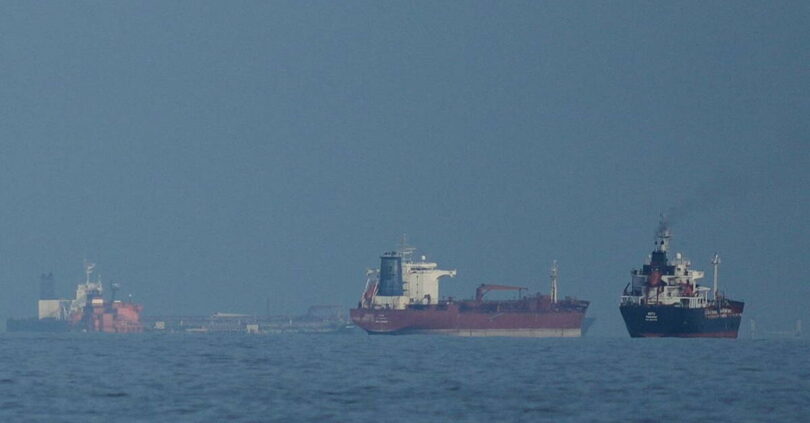
The US military vowed to blockade all Iranian ports starting on Monday, part of efforts to force Tehran into agreeing to open the crucial Strait of Hormuz and accepting a peace deal.
Iran responded with threats on all ports in the Persian Gulf and the Gulf of Oman, taking aim at US-allied countries.
That set the stage for an extraordinary showdown that contains serious risks for the global economy and raises the spectre that a ceasefire that is currently holding could collapse and the war could resume.
Talks aimed at permanently ending the conflict — which began on February 28 with US and Israeli strikes on Iran — finished without an agreement this weekend, and there has been no word on whether negotiations will resume.
Iran’s effective closure of the strait, through which 20% of traded oil passes in peacetime, has sent oil prices skyrocketing, pushing up the cost of fuel, food and other basic goods far beyond the Middle East.
Tehran has allowed some ships perceived as friendly to pass while charging considerable fees, leading to accusations it is holding the global economy hostage.
Some analysts are doubtful that the US can restore normal shipping through force alone — and it is not clear how a blockade would work or what the dangers might be to US forces.
The question is essentially who can endure the most pain: Could a blockade make Iran’s economic situation untenable and force it to concede? Or will it drive global oil and other prices so high that US president Donald Trump is forced to back down?
The US military’s Central Command announced that from 2pm GMT the blockade would be enforced “against vessels of all nations entering or departing Iranian ports and coastal areas”.
It said that would include all of Iran’s ports on the Persian Gulf and Gulf of Oman.
CentCom said it would still allow ships travelling between non-Iranian ports to transit the Strait of Hormuz, a step down from Mr Trump’s earlier threat to blockade the vital waterway.
Iran responded with threats of its own.
“Security in the Persian Gulf and the Sea of Oman is either for everyone or for NO ONE,” the Islamic Republic of Iran Broadcasting reported on Monday.
“No port in the region will be safe,” read a statement from the Iranian military and the Revolutionary Guard.
The threats halted the limited ship traffic that resumed in the strait since the ceasefire, according to a report from Lloyd’s List intelligence.
Marine trackers say more than 40 commercial ships have crossed since the start of the ceasefire last week, down from roughly 100 to 135 vessel passages per day before the war.
The blockade is likely intended to pile pressure on Iran, which has exported millions of barrels of oil since the war began, much of it likely carried by so-called dark transits that evade Western sanctions and oversight.
But the effects will be felt far beyond Iran. The price of Brent crude oil, the international standard, rose 7% to hover around 102 dollars per barrel on Monday. It cost roughly 70 dollars per barrel before the war.
Israeli prime minister Benjamin Netanyahu, who has come under domestic criticism for the inconclusive outcome of the war, expressed support for Mr Trump’s “strong stance to impose a naval blockade on Iran”.
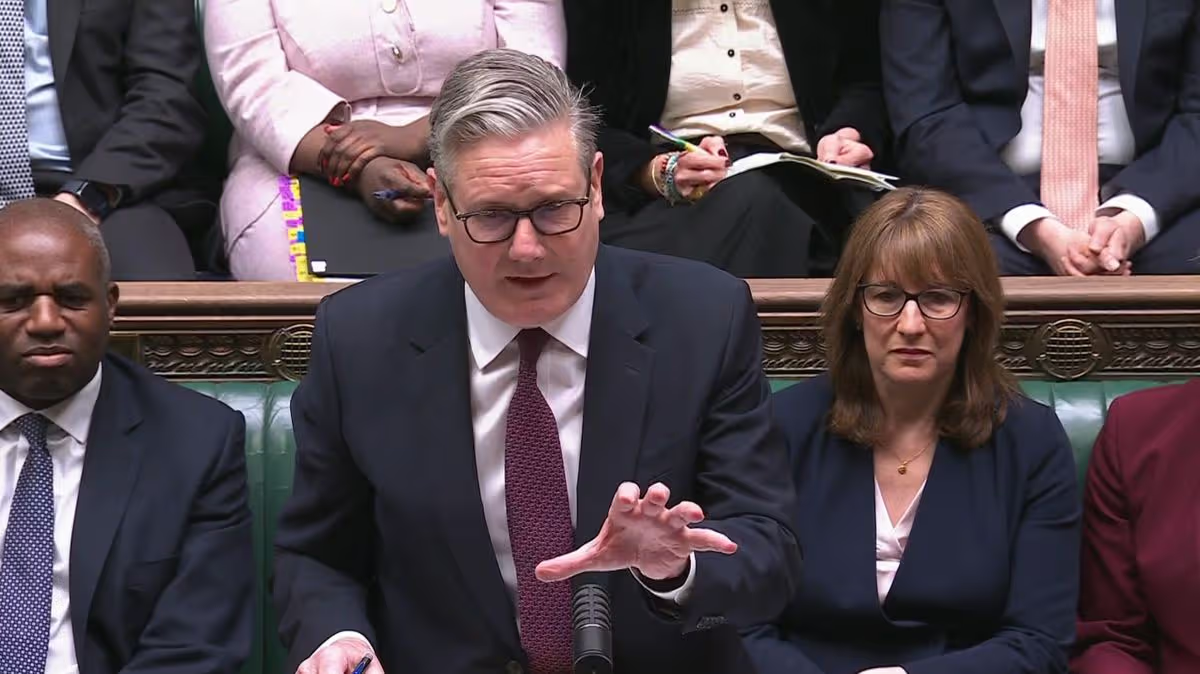
But traditionally close US ally Britain will not be part of the blockade, Prime Minister Sir Keir Starmer told BBC radio, adding his country is “not getting dragged into the war”.
Top-ranking Iranian officials threatened retaliation.

Ebrahim Rezaei, a spokesperson for the Iranian parliament’s National Security Commission, dismissed US warnings of a potential blockade of the Strait of Hormuz as “more bluffing than reality”, while warning that Tehran was prepared to respond if the situation escalates militarily.
“It will make the current situation (Trump) is in more complicated and makes the market — which he is angry about — more turbulent. And we may also reveal other cards that we have not used in the game,” he said in a post on X.
Iranian parliament speaker, Mohammad Bagher Qalibaf, addressed Mr Trump in a statement: “If you fight, we will fight.”
The blockade threat came after marathon US-Iran ceasefire talks in Pakistan ended without an agreement on Saturday.
US vice-president JD Vance said the talks stalled after Iran refused to accept American terms on refraining from developing a nuclear weapon.
Iran has insisted its nuclear programme is peaceful.
However, it has pushed forward with steps that could give it the ability to build a nuclear weapon, including enriching uranium to near weapons-grade levels and developing long-range missiles potentially capable of delivering a bomb.
Iranian negotiators could not agree to all US “red lines”, said a US official who spoke on condition of anonymity because they were not authorised to describe positions on the record.
Those red lines included Iran never obtaining a nuclear weapon, ending uranium enrichment, dismantling major enrichment facilities and allowing retrieval of its highly enriched uranium, along with opening the Strait of Hormuz and ending funding for its armed proxies in the region: Hamas, Hezbollah and the Houthis.
Iranian officials said talks fell apart over two or three key issues. Mr Qalibaf, Iran’s chief negotiator, did not mention the core disputes in a series of social media posts, but other Iranian officials signalled that the strait remains a key sticking point.
Neither Iran nor the US have indicated what will happen after the ceasefire expires on April 22.
The fighting has killed at least 3,000 people in Iran, 2,055 in Lebanon, 23 in Israel and more than a dozen in Gulf Arab states, and damaged infrastructure in half a dozen countries.
Pakistani foreign minister Ishaq Dar said his country will try to facilitate a new dialogue in the coming days.
Turkish foreign minister Hakan Fidan, whose country has supported mediation efforts, suggested that the ceasefire could be extended for 45 to 60 days to allow for more negotiations.