President Trump and his advisers are looking at resuming limited military strikes in Iran in addition to the U.S. blockade of the Strait of Hormuz as a way to break a stalemate in peace talks, according to officials and people familiar with the situation.
That is among the options that Trump was considering Sunday, hours after negotiations collapsed in Pakistan, the officials said. Trump could also resume a full-fledged bombing campaign, though officials said that was less likely given the prospect of further destabilizing the region and the president’s aversion to prolonged military conflicts. He could also seek a more temporary blockade while he pressures allies to take responsibility for a prolonged military escort mission through the strait in the future.
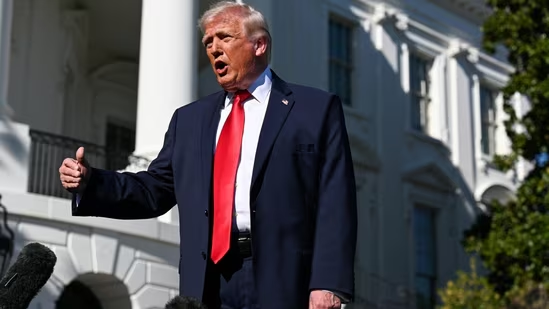
After the collapse of U.S.-Iran talks in Pakistan, Trump spent much of Sunday at his resort in the Miami suburb of Doral, Fla., calling in to a Fox News show, golfing and talking with advisers. He remains open to a diplomatic solution, aides said, even as he promised the blockade and threatened again to target Iran’s infrastructure.
“I would hate to do it, but it’s their water, their desalinization plans, their electric-generating plants, which are very easy to hit,” Trump said on Fox News.
A White House spokeswoman declined to discuss Trump’s specific options.
“The President has already ordered a naval blockade on the Strait of Hormuz, ending the Iranian extortion, and wisely keeps all additional options on the table,” White House spokeswoman Olivia Wales said. “Anyone who is telling The Wall Street Journal that they know what President Trump will do next is purely speculating.”
Trump asserted that Iran wants to return to the negotiating table, and an official close to the U.S. negotiating team said an offer remains. Reza Amiri Moghadam, a senior member of the Iranian delegation at the talks, called it the beginning of a process. “The Islamabad Talks laid the foundation for a diplomatic process that, if trust and will are strengthened, can create a sustainable framework for the interests of all parties.” he wrote on social media.
U.S. officials outlined Trump’s red lines in further negotiations with Iran. Those include Iran fully opening the Strait of Hormuz free of tolls for passage; ending all uranium enrichment and dismantling enrichment facilities; handing over its highly enriched uranium; accepting a broader security framework that includes regional allies; and ending funding of proxies such as Hezbollah in Lebanon and Yemen’s Houthi rebels.
The talks in Pakistan, led by Vice President JD Vance, broke down after Iran refused to give up its nuclear program. Trump said preventing Iran from acquiring nuclear weapons is a significant factor in why he launched the war.
U.S. officials and other people close to the administration said any option Trump chooses next faces major risks. Relaunching a full-scale war would further drain critical U.S. munitions and expose the president to more backlash from a voting base skeptical of Middle East conflicts. Yet drawing down the military operation while the regime is battered but intact with its nuclear ambitions and control of the strait would be viewed as a victory for Tehran.
Some officials and analysts lauded Trump’s decision to impose a naval blockade on the strait as his best—or least bad—option available. Around half of Iran’s government revenue comes from oil and gas. A successful blockade would choke off Iran’s oil exports, which are the engine of its economy, and demonstrate to U.S. allies and nervous global energy markets that Tehran can’t hold the strait hostage.
“We’ve seen this blockade strategy essentially work on Venezuela, and Trump has an opportunity to replicate it here,” said Matthew Kroenig, a former Pentagon official who is now at the Atlantic Council. “I think this is a way to really ramp up pressure on the regime and force them into some difficult dilemmas.”
A blockade is fraught with downsides of its own.
The Iranian government has yet to bow to economic pressure from the U.S., including decades of crippling sanctions, and remains defiant after weeks of intensive U.S. and Israeli bombing. U.S. officials said naval vessels operating in the narrow strait just off Iran’s coast could face new missile and drone attacks with little warning to react.
Trump has changed directions repeatedly during the war, insisting the strait wasn’t an issue before focusing more closely on it. He has been under pressure from allies who are most acutely feeling Iran’s choking off the passageway that handles about 20%t of the world’s oil supply. Trump also faces increasing political backlash at home and has conceded that gasoline prices could remain elevated—a liability for Republicans heading into midterm elections.
The president, who was at an Ultimate Fighting Championship event in Miami as Vance emerged from marathon talks in Islamabad, remained angered Sunday during his appearance on Fox News over what he views as unfair news coverage of the war. Trump was spotted in golf attire at his Doral club along with Florida Gov. Ron DeSantis. On Sunday he continued a feud with Bruce Springsteen, who has been critical of the president and the war, mocking his appearance in a social-media post.
A prolonged war will only deepen concerns among Trump’s advisers, allies and corporate leaders about the economic costs, including higher energy prices.
“My advice to the White House folks I’ve spoken to is secure the strait at any cost and immediately as a matter of economic and national and global security,” said Steve Moore, a longtime economic adviser to Trump. “We have the power to protect the flow of international trade and must use it. Or the whole world economy could tumble into a global recession.”
Trump on Sunday justified temporary pain as the cost for preventing Iran from having a nuclear weapon.
Fred Fleitz, a senior National Security Council official during Trump’s first term, said the large delegation Iran sent to Islamabad showed a diplomatic solution can be achieved. “I think Trump’s right, Iran is out of cards,” he said. “This conflict has only been going on for a few weeks. It’s too early to know how this will come out, but I think it looks promising.”
Write to Robbie Gramer at robbie.gramer@wsj.com and Alex Leary at alex.leary@wsj.com