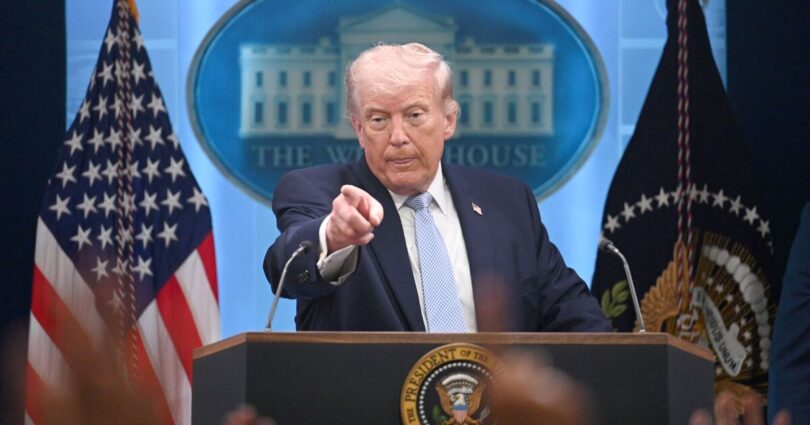
Donald Trump is exploring options ranging from targeted strikes to a sustained naval blockade as he tries to force Iran back to the negotiating table following the collapse of peace talks in Pakistan, according to officials the Express understands.
The breakdown of the Islamabad negotiations left the White House casting around for leverage, with a resumption of heavy bombing ruled out as too destabilising and too politically costly — Trump’s core supporters have little appetite for another open-ended Middle East war. A tighter, more targeted military operation running alongside the blockade is reportedly seen as more viable. So too is a temporary chokehold on the strait, with the longer-term burden of policing it handed to regional allies.
The president passed the day at his Doral club outside Miami, checking in with Fox News, getting a round of golf in and working the phones with his team. Those around him told reporters the door to diplomacy is not closed — even as Trump publicly doubled down on the blockade and revived his warnings about striking Iran’s civilian energy network.
“I would hate to do it, but it’s their water, their desalinisation plants, their electric-generating plants, which are very easy to hit,” he told Fox News.
Asked about Trump’s next move, the White House pushed back on speculation.
“The President has already ordered a naval blockade on the Strait of Hormuz, ending the Iranian extortion, and wisely keeps all additional options on the table,” spokeswoman Olivia Wales is reported to have said. “Anyone who is telling The Wall Street Journal that they know what President Trump will do next is purely speculating.”
Talks collapse
It was JD Vance who led the American delegation to Islamabad, and it was Iran’s refusal to make any concession on its nuclear programme that ended the process, reports the Wall Street Journal. Trump has been explicit that stopping Tehran from acquiring a nuclear weapon is one of the primary justifications for the military campaign.
For any renewed negotiations to get off the ground, Washington has laid out what it expects: unrestricted passage through the Strait of Hormuz with no tolls; the complete cessation of uranium enrichment and physical dismantling of the facilities involved; relinquishment of existing highly enriched uranium stocks; signing up to a wider regional security architecture; and cutting financial lifelines to proxy groups, among them Hezbollah and the Houthis in Yemen.
There are, however, indications that the channel is not entirely dead. Trump suggested Tehran was looking for a way back to the table. A senior figure on the Iranian side, Reza Amiri Moghadam, stopped short of closing the door. “The Islamabad Talks laid the foundation for a diplomatic process that, if trust and will are strengthened, can create a sustainable framework for the interests of all parties,” he wrote on social media.
Blockade strategy
Those who have studied the options say the naval blockade represents the least catastrophic path available to Trump, even if it is far from risk-free. Oil and gas account for roughly half of Tehran’s state income — throttling exports would hit the regime where it is most vulnerable and signal to jittery energy markets that Iran’s grip on the strait has limits.
“We’ve seen this blockade strategy essentially work on Venezuela, and Trump has an opportunity to replicate it here,” said Matthew Kroenig, a former Pentagon official now at the Atlantic Council. “I think this is a way to really ramp up pressure on the regime and force them into some difficult dilemmas.”
The complications are real. Sanctions have been piling up on Iran for decades without producing the capitulation Washington has sought, and the regime has shown no sign of breaking despite weeks of sustained bombardment from American and Israeli forces. Any warships stationed in the confined waters close to the Iranian shoreline would be sitting targets for missiles and drones, with reaction times measured in seconds rather than minutes.